Indiana is home to many impressive engineering landmarks, but few are as awe-inspiring as the Tulip Trestle in Greene County. When it was completed in 1906, this towering railroad bridge was recognized as the longest railroad trestle in the United States, a distinction that helped cement its place in transportation history.
Stretching across a scenic valley in southern Indiana, the massive structure remains an active rail line and a favorite destination for photographers, history enthusiasts, and curious travelers. With its remarkable scale, rural setting, and dedicated viewing area, the Tulip Trestle offers one of the most unforgettable sights in the Hoosier State.
A Steel Giant Above the Valley
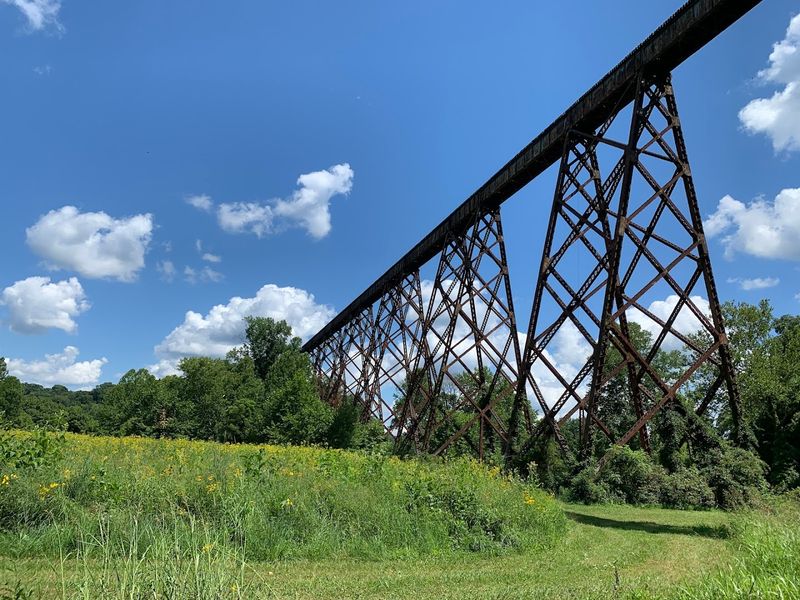
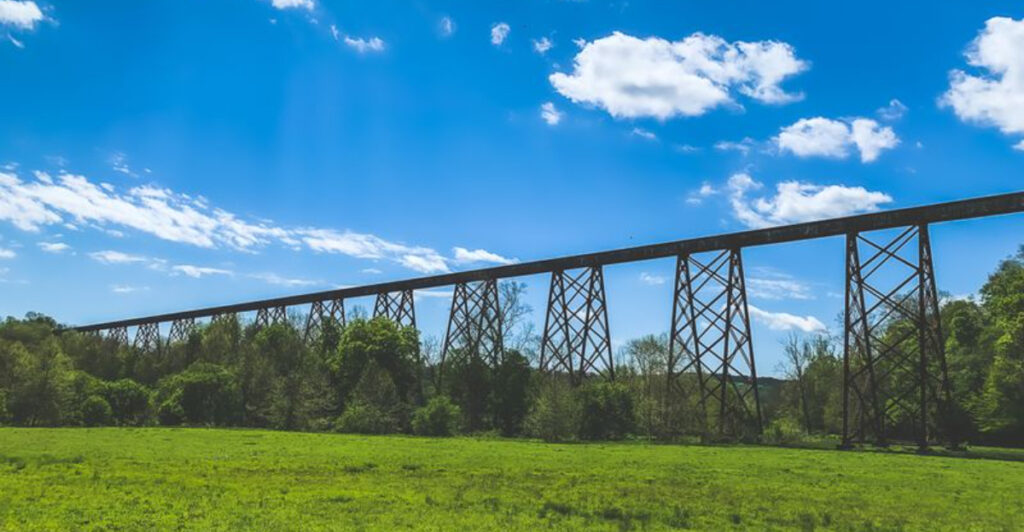
The first surprise at Tulip Trestle is not its age or even its history. It is the scale. The bridge stretches so far across the valley that your eyes need a second to track the full line of steel from one wooded ridge to the other.
From the overlook, the structure reads almost like a drawn horizon suspended above Richland Creek. Its repeating framework creates a crisp geometric rhythm, and that pattern looks even more dramatic against rolling hills, wild growth, and changing seasonal color.
You are not staring at a decorative landmark here. You are looking at a working railroad bridge built with unapologetic size.
That immediate visual punch explains why the site photographs so well. Even on a calm day, there is tension in the view because the trestle appears both delicate and impossibly strong, a grid of narrow members carrying enormous weight high over the ground.
The contrast gives the whole place energy. One moment your attention goes to the open valley below, and the next it locks onto the long, elevated track line cutting straight through it.
Tulip Trestle also benefits from the way it is revealed. You do not approach it through a busy commercial zone or a crowded downtown.
Instead, country roads, trees, and sudden elevation changes keep the setting quiet until the bridge finally takes command of the scene. That slow buildup matters.
By the time you reach the overlook, the trestle feels even larger because nothing nearby competes with it. In a state full of bridges, this one does not blend into the background. It dominates the landscape with the confidence of a structure that was engineered to be noticed.
Why the 1906 Superlative Still Matters
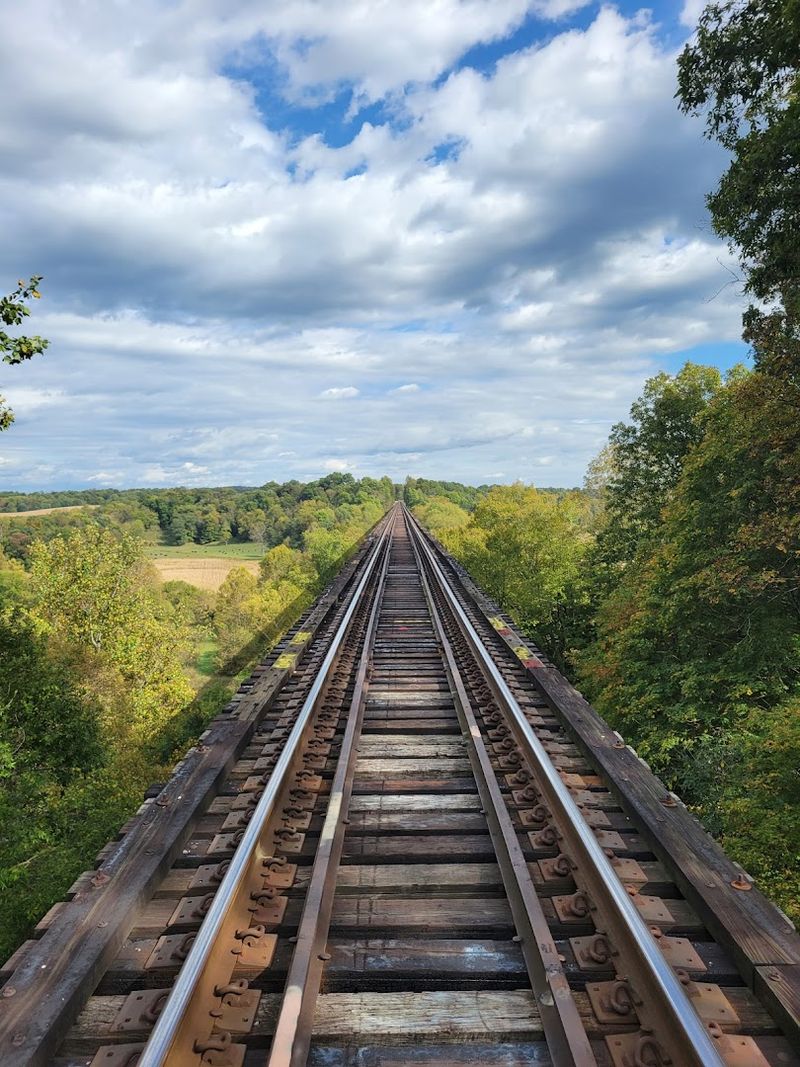
Tulip Trestle earns attention because its superlatives are not empty trivia. When it was completed in 1906, it was built as the longest railroad trestle in the United States, a claim that instantly gives the bridge national context.
That fact alone shifts your perspective. This is not simply an impressive local relic tucked into the countryside. It is a major engineering statement from an era when railroads shaped how regions grew and connected.
The numbers commonly associated with the bridge help explain the impact. The span runs roughly 2,295 feet and reaches about 157 feet at its highest point, which means the structure does not merely cross the valley.
It commands it. Standing near the site, those measurements stop being abstract. Length becomes distance your eyes travel, and height becomes the open air between the steel deck and the ground below.
Its long life adds another layer. More than a century after construction, the trestle still carries trains, and that continued use changes the mood completely.
You are not visiting a preserved shell or a museum prop. You are watching a historic bridge keep doing the job it was built to do, which makes the place feel active rather than frozen in time.
That continuity is part of the thrill. Many old industrial landmarks survive only as ruins, plaques, or partial remnants.
Tulip Trestle remains legible as infrastructure, with every line and support still clearly tied to function. The result is a site where history is easiest to understand by simply looking at the bridge itself. Steel, distance, elevation, and endurance tell the story before you ever read a single interpretive panel.
The Overlook That Turns a Stop Into an Experience
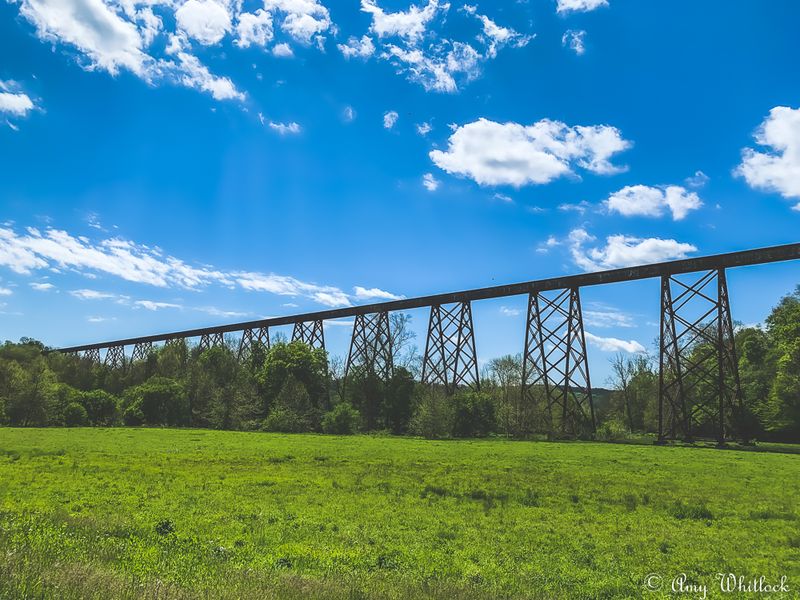
One reason Tulip Trestle works so well as a destination is that the site is set up for looking, not just arriving. The overlook gives the bridge a proper stage.
Instead of forcing you to piece together glimpses from the roadside, it frames the trestle in a way that makes the valley, the bridge, and the surrounding ridges read as one complete scene.
That viewing area adds comfort without flattening the place into something overly polished. There is still a remote, country-road character to the setting, but the practical details help.
Recent visitors have noted cleaner facilities, a nice parking area, and a space where those who do not want to tackle steeper terrain can still enjoy the signature view. Picnic tables and posted information also make it easier to linger rather than rush back to the car after a quick photo.
The overlook is especially useful because this is a structure best appreciated from a stable vantage point. Tulip Trestle is too long and too tall to absorb in fragments.
You need distance, a clear line of sight, and a chance to scan from one end to the other. The platform provides exactly that, allowing your attention to move from the truss pattern to the valley floor, then back up to the track suspended high above the trees.
It also broadens who can enjoy the site. Not every memorable outdoor stop has to require a strenuous scramble to feel rewarding.
Here, accessibility improvements make the landmark more welcoming while preserving the dramatic payoff. That balance is rare.
The overlook does not compete with the bridge or distract from it. It simply gives you the best seat in the valley and lets the trestle do the rest.
Southern Indiana Roads Set the Mood
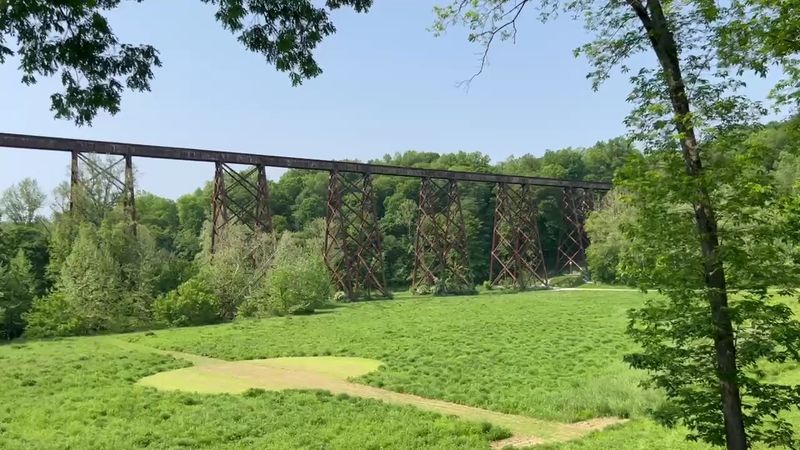
The approach to Tulip Trestle deserves attention because the drive is part of the experience. This corner of southern Indiana does not hand over the main attraction immediately.
Instead, you get narrow county roads, rolling hills, and quick shifts in elevation that make the landscape feel more layered than outsiders often expect from Indiana.
That route creates suspense. Every bend suggests a reveal, and then the bridge arrives with a sense of scale that the surrounding roads have quietly prepared you for.
It is easy to understand why the site has become a favorite for motorcycle rides, scenic loops, and casual afternoon drives. The roads are curvy enough to feel engaging, but the reward is not just motion.
It is the sudden encounter with a huge steel crossing in the middle of open country. There is, however, a practical side to the setting. This area is rural, and some stretches can hide oncoming traffic over hills, so the drive calls for patience and attention.
That caution does not weaken the trip. If anything, it underlines how removed the bridge is from busier tourist corridors.
Tulip Trestle is not framed by chain stores, stoplights, or suburban sprawl. The landscape around it remains a big part of its power. By the time you pull in, the bridge feels discovered rather than delivered. That distinction matters.
Places that require a little focus on the way in often land more strongly because the rhythm of travel sharpens the arrival. At Tulip Trestle, the country roads, the valleys, and the quiet all work like a slow introduction. Then the steel takes over, and the trip shifts from scenic drive to full-scale spectacle in a matter of seconds.
When a Train Crosses, Everything Changes
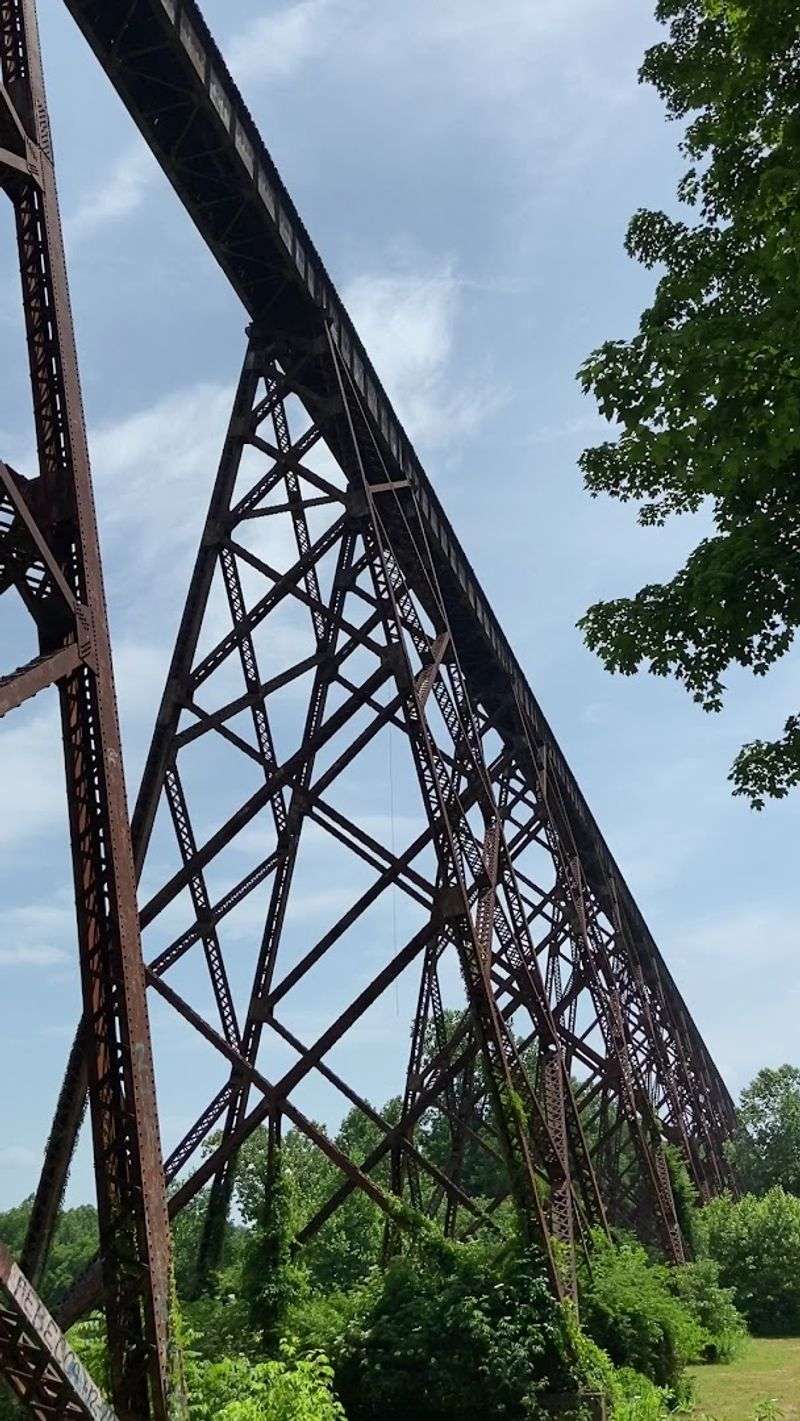
Tulip Trestle is impressive at any hour, but the site reaches another level when a train actually crosses. The bridge stops being a static landmark and turns into a moving demonstration of weight, rhythm, and purpose.
That shift is huge. A photograph can show the scale of the structure, yet only a train reveals how that scale functions in real time.
Locals and repeat visitors often time trips around the possibility of a crossing, and the late afternoon window gets frequent mention for good reason. The light softens, the valley picks up more contrast, and the steel framework stands out with extra clarity.
If a train arrives during that stretch, you get the full visual payoff: cars sliding across a bridge that already seems almost too long to be real.
The experience is striking because movement travels the entire span. Your attention follows the train from one side of the valley to the other, measuring distance in a way that no signboard ever could.
Sound matters too. Even from the overlook, the event has a physical presence, and the bridge no longer reads as an abstract historic object.
It becomes active machinery carrying freight over a century-old path through the hills. That possibility adds suspense to every visit, even if no train appears on cue. You keep glancing at the track line, half expecting the stillness to break.
Tulip Trestle works beautifully as scenery, but the chance of seeing it used as intended gives the stop extra voltage. It turns waiting into part of the attraction. A quiet overlook in Greene County suddenly becomes a front-row seat to working railroad drama.
The Volunteer Touch You Can Actually See
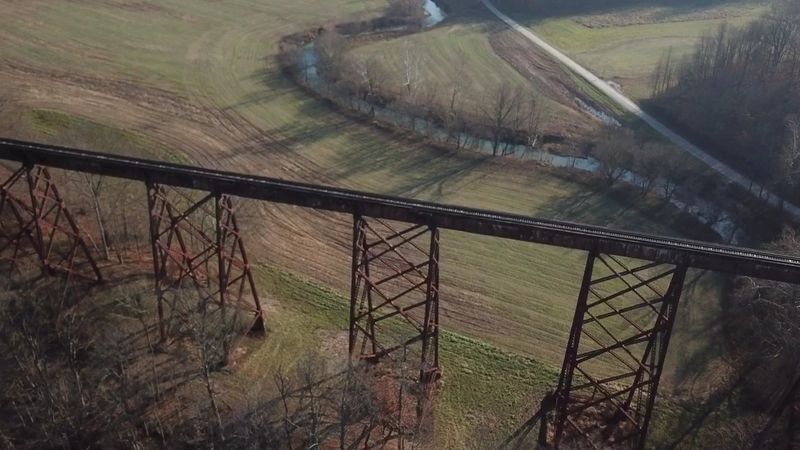
Not every infrastructure landmark gets cared for in a way that visitors can immediately notice. Tulip Trestle does. The viewing area, interpretive signs, and general upkeep show that local stewardship is more than a slogan here.
You can see it in the maintained overlook, the added amenities, and the effort to make the site welcoming without stripping away its rugged setting.
That matters because the bridge sits in a quiet, rural location where neglect would be easy to spot fast. Instead, the site communicates intention.
Informational boards help place the trestle in historical context, while practical additions such as cleaner restrooms and organized parking make the stop easier for families, day-trippers, and travelers who simply want a comfortable pause in the middle of the countryside.
Even small touches, including landscaping and wildflowers, soften the industrial force of the bridge without diminishing it.
There is also a community energy behind the site that gives the visit extra depth. Tulip Trestle is not presented as a disconnected artifact dropped into the valley for occasional photos.
It is treated as a landmark worth protecting, explaining, and sharing. That attitude comes through in the condition of the grounds and in how the overlook encourages people to slow down, read, and look longer.
The result is a rare combination of raw scale and human care. One side of the experience is all steel, height, and railroad history.
The other is local effort making sure you can appreciate those qualities safely and clearly. That blend keeps Tulip Trestle from feeling anonymous.
Plenty of big structures impress for a minute. This one also shows signs of ongoing attention, which helps transform a quick stop into a place with real civic pride behind it.
Why the Tulip Trestle Still Owns the Frame in Indiana
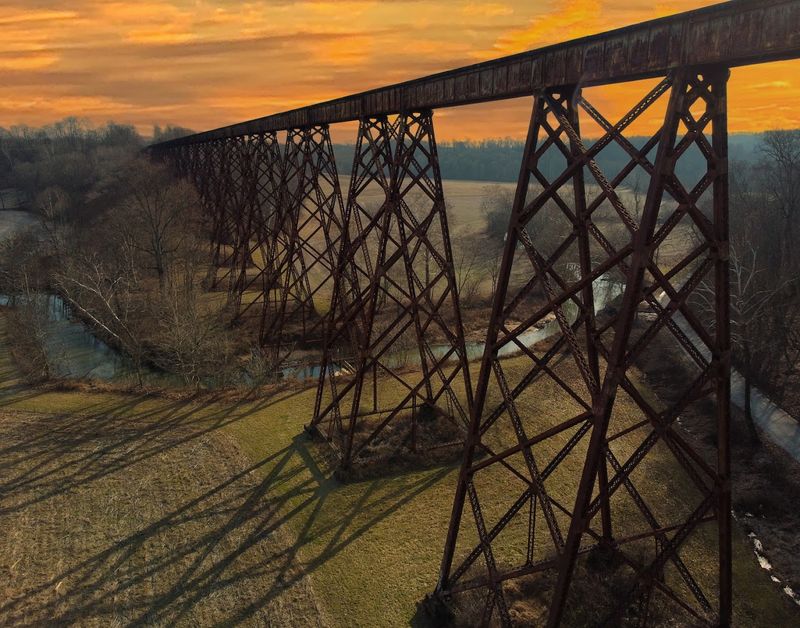
Plenty of landmarks ask you to admire them for what they once were. Tulip Trestle asks for something different. It stands out because it combines historic stature, present-day function, and a setting dramatic enough to match both. That is a rare mix anywhere, and in Indiana it gives the bridge a category almost to itself.
The visual logic of the place is hard to beat. Steel geometry runs across a deep valley, forested slopes rise around it, and the rural quiet strips away distraction.
In summer, the trestle cuts a dark line through dense green. In fall, the same frame turns into one of the strongest photo compositions in the state, with the bridge hovering above layered color.
Even a simple roadside angle can look cinematic because the structure is so long and so cleanly defined against the terrain.
Yet the bridge is more than a great image. Tulip Trestle rewards different kinds of attention depending on what you bring with you.
Rail history fans get a genuine feat of early twentieth-century engineering. Casual travelers get an overlook with immediate payoff.
Families get an easy scenic stop. Riders and drivers get one of those rural routes where the destination and the journey support each other instead of competing.
That broad appeal explains why the site keeps drawing return trips from people who already know exactly what is there. The bridge does not rely on novelty tricks or manufactured atmosphere.
Its power is structural, visual, and geographic. America once built this as its longest train trestle, and the claim still carries weight when you are standing in front of it.
Some landmarks shrink after the build-up. Tulip Trestle keeps its scale, keeps its purpose, and keeps commanding the valley below.
Share this story