An apartment exhibition in Moscow might seem like an unlikely starting point for a New Jersey museum outing. Yet that is where economist Norton Dodge bought Lev Kropivnitsky’s Outer Galactic Logic in 1962, beginning a collecting mission that eventually brought thousands of works to Rutgers.
Today, the Zimmerli Art Museum in New Brunswick holds the world’s largest collection of Soviet nonconformist art, preserving the work of artists who created beyond the boundaries of official approval. That sounds like serious territory for a casual afternoon, and some of it certainly is.
But the story also involves sharp humor, unexpected images, private gatherings, and people determined to make something their own. You do not need a degree in art history to find a way into it.
Behind this remarkable collection is a very human question that still lands hard today. What happens when someone else decides what you are allowed to create?
The Zimmerli Brings an Extraordinary Art Collection to New Brunswick
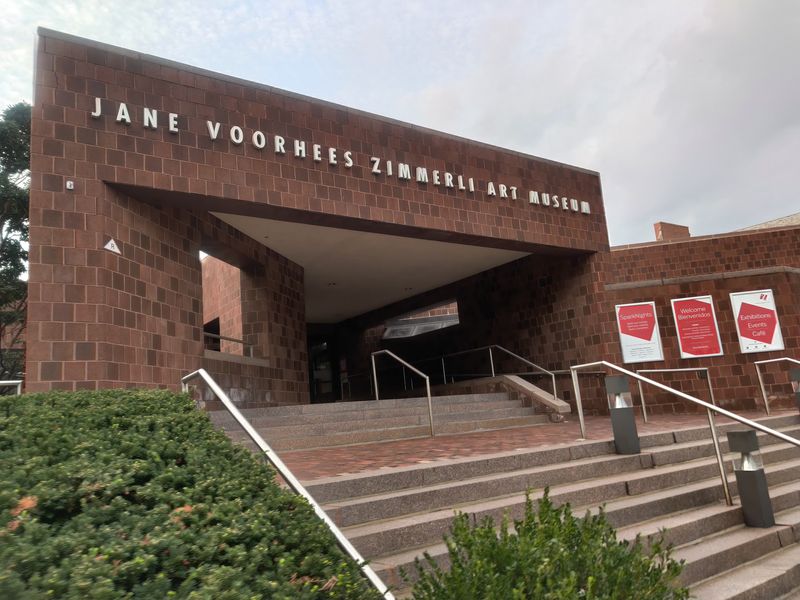
At the corner of Hamilton and George streets, a museum on the Rutgers campus holds a collection with a reach far beyond New Brunswick. The address is 71 Hamilton Street, placing the Zimmerli within a short walk of the city’s train station.
That everyday location is part of the appeal. A visit fits into an afternoon in town, even when the history inside takes you halfway around the world.
The institution began in 1966 as the Rutgers University Art Gallery. As its holdings grew, the Jane Voorhees Zimmerli Art Museum was established in 1983, with major construction support from Ralph and Alan Voorhees.
They named it for their mother. Today, its roughly 70,000-square-foot facility houses more than 75,000 artworks, with strengths that include American and European art, Soviet nonconformist art, and original illustrations for children’s literature.
Those broader collections give the museum room to surprise you beyond the subject that brought you through the door. Someone arriving for Cold War history can also encounter an entirely different artistic tradition elsewhere in the building.
The university setting makes particular sense for the Dodge Collection because these works invite questions that stretch across subjects. An unusual image can open a conversation about censorship, national identity, language, or the relationship between personal expression and public power.
There is plenty here for a dedicated museumgoer, but you can also approach it with the simpler curiosity you bring to an unfamiliar painting. What catches your eye?
What seems funny, strange, or uncomfortable? Why might that choice have mattered to its maker?
Starting there keeps an ambitious collection approachable. Its international significance is substantial, yet the visitor’s first task remains wonderfully manageable.
Slow down long enough to look at one work and give it your attention.
Soviet Nonconformist Artists Refused to Follow the Official Rules
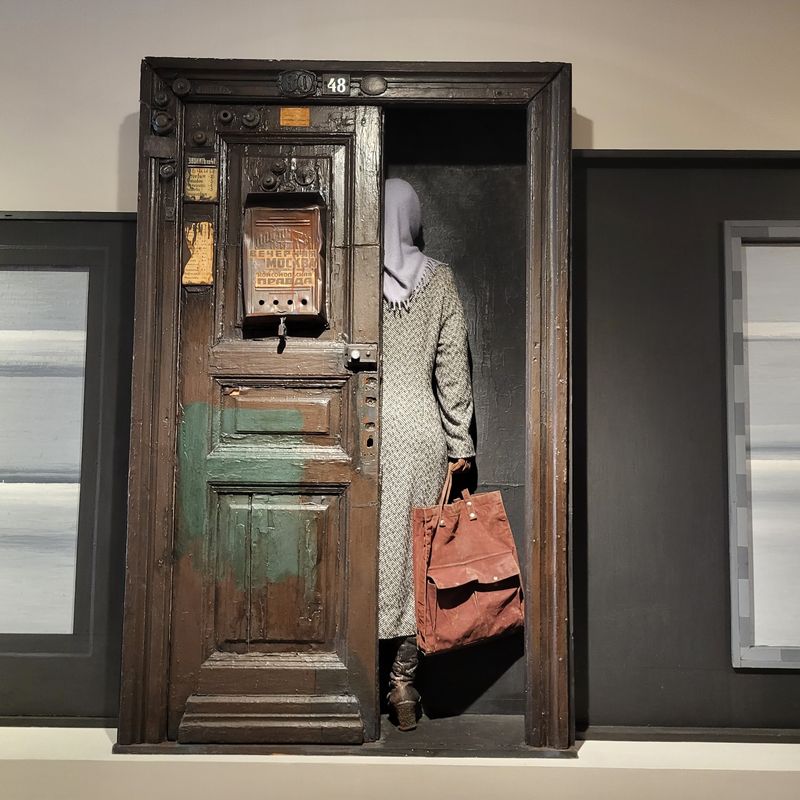
A painting did not have to carry an openly political message to fall outside Soviet expectations. The official artistic framework favored Socialist Realism, while artists pursuing other approaches could find themselves excluded from public exhibition and exposed to serious consequences.
Private apartments became places to share work that had little access to official galleries. That background helps explain the term “nonconformist,” which can initially sound like the name of a single artistic style.
In practice, the collection encompasses many different ways of departing from approved conventions. Abstraction, conceptual experiments, and satire offered distinct possibilities for artists who wanted greater freedom over what they made.
Some challenged authority directly; others carved out a more personal space within a restrictive system. Reducing every artist to a dissident with a paintbrush would flatten a much more complicated history.
The range becomes easier to grasp through specific examples. Vitaly Komar and Alexander Melamid, who worked together from 1972 through 2003, used humor and irony to scrutinize Soviet propaganda and officialdom.
Their criticism later extended to American capitalism and the art market, too. The Zimmerli explored their careers in its 2023 retrospective Komar and Melamid A Lesson in History.
That willingness to question more than one system gives their work an especially interesting edge. Humor can draw you toward an image before its implications fully register.
An abstract composition asks for a different response, perhaps beginning with color, shape, or texture rather than a recognizable argument. Both approaches make room for the individual artist’s decisions.
As a visitor, you can let the artwork lead and then use its historical context to deepen what you see. The stakes behind these choices were real, but the art deserves attention for its imagination as well as the circumstances under which it was created.
Norton and Nancy Dodge Helped Preserve a Defiant Generation of Art
The purchase that started it all was an abstract painting with a wonderfully improbable name. In 1962, Norton Dodge acquired Lev Kropivnitsky’s Outer Galactic Logic at an apartment exhibition in Moscow.
Dodge had first visited the Soviet Union in 1955, and his later economic research trips brought him into contact with artists working beyond official cultural structures. His collecting grew from those encounters into a sustained effort to preserve their work and bring it to wider audiences.
There is something especially compelling about that beginning. One person attended a private exhibition, took an artist seriously, and bought a painting.
The eventual scale was enormous, but the first transaction was personal. For artists with limited opportunities to show or sell their work, a collector’s interest could provide both income and recognition.
Norton and Nancy Dodge’s initial gift to the Zimmerli in 1991 included approximately 4,000 works. In 2017, Rutgers announced Nancy Ruyle Dodge’s promised gift of more than 17,300 additional artworks, valued at over $34 million.
A separate $10 million endowment from the Avenir Foundation supported the collection’s future. The donation included paintings, sculpture, installations, photographs, videos, works on paper, and artists’ books.
Those numbers explain how the collection expanded, but its significance rests equally on what happens after a gift arrives. Artworks need conservation, careful records, storage, research, and opportunities to be seen.
Placing them within a university museum gave the collection an institutional home capable of connecting those responsibilities. It also made the artists’ work available to people who might never otherwise encounter it.
For a New Jersey visitor, that long chain of relationships ends somewhere surprisingly accessible. A collecting project rooted in private Soviet gatherings became part of a public museum in New Brunswick, where the work can continue to prompt fresh questions.
The World’s Largest Collection Holds More Than 25,000 Works
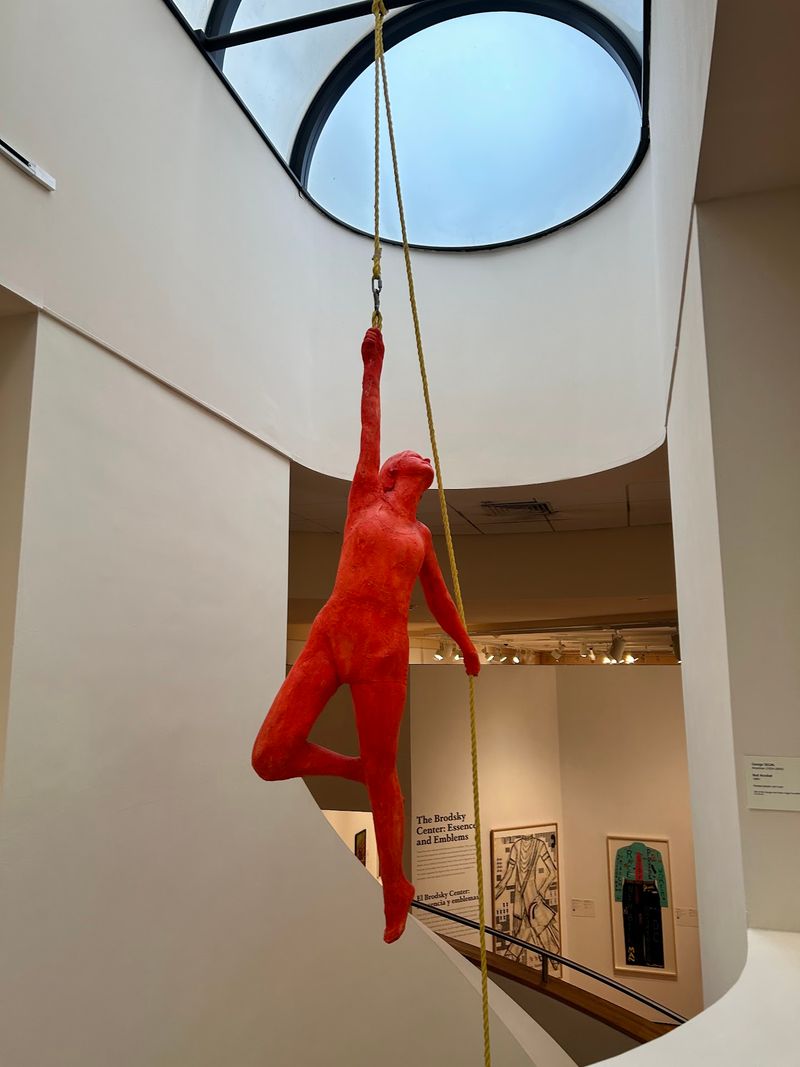
More than 25,000 artworks is an impressive total, but nobody should arrive expecting to tackle them all before lunch. The Dodge Collection represents over 1,500 artists and spans approximately 1956 through 1991, from the cultural thaw associated with Nikita Khrushchev to the dissolution of the Soviet Union.
Its size makes it the largest collection of Soviet nonconformist art in the world. The useful distinction for visitors is between what a museum owns and what it can display.
A collection this extensive necessarily includes material kept off view, so an exhibition offers a selected route through a much larger body of work. That selection can be an advantage.
A focused presentation gives you time to notice relationships and differences that would disappear in a marathon through thousands of objects. The holdings include Erik Bulatov’s oil painting DangerStratigraphic Structures – Changes, dated 1972–1973, and Igor Makarevich’s 1976 photomontage .
Another memorable title belongs to Leonid Sokov’s painted wooden work Project to Construct Glasses for Every Soviet Citizen, from 1975. These examples illustrate how varied the collection’s materials and approaches can be; their inclusion in the holdings does not guarantee they will be displayed during a particular visit.
Beyond the artworks, the museum’s research resources preserve correspondence, artist statements, documentary photographs, and audio and video recordings. More than 1,000 artist files help connect objects to the lives and practices behind them.
That supporting material matters because an image rarely explains every circumstance of its creation on its own. A letter or photograph can recover a relationship, document a gathering, or clarify an artist’s intention.
The collection’s scale therefore offers something richer than a numerical distinction. It preserves many individual perspectives, with enough surrounding evidence to keep their histories open to further study.
The Collection Tells Stories From Across the Former Soviet Union
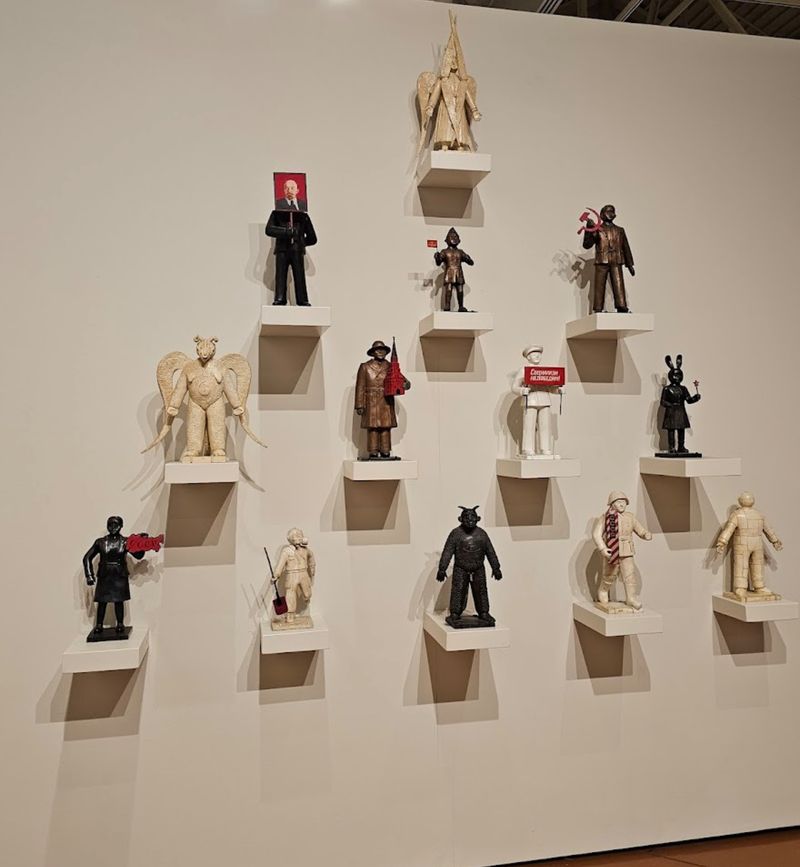
Moscow is only part of the map. The Dodge Collection includes art from Armenia, Azerbaijan, Belarus, Estonia, Georgia, Kazakhstan, Kyrgyzstan, Latvia, Lithuania, Turkmenistan, Ukraine, and Uzbekistan, as well as Russia.
Its geographic breadth is essential to understanding what the museum preserves. Calling everything simply “Russian art” would blur distinctions that deserve attention.
Artists across the Soviet Union worked within different cultural settings, and a shared political framework did not erase their individual experiences. For a visitor, paying attention to where a work was made can widen the story considerably.
A place name on a label may introduce a context you had not considered when you first looked at the image. The Zimmerli has used focused exhibitions to explore that breadth.
Its 2022 presentation Locating Georgia drew selections from the Dodge Collection to examine nonconformist art from Georgia. Earlier exhibition projects also investigated subjects such as art of the Baltics and Soviet nonconformist photography.
Those different routes through the holdings help prevent the collection from becoming one sweeping story told through a handful of familiar names. They also offer a good model for looking.
Keep the larger history in mind, then allow a particular artist, region, or medium to complicate it. The Zimmerli’s related collections extend the timeline in both directions.
The George Riabov Collection includes earlier Russian art, while gifts from Claude and Nina Gruen brought works from the post-Soviet 1990s and 2000s into the museum’s holdings. Together, these resources allow the Soviet period to sit within a longer artistic history.
Political change supplies important dates, but an artist’s practice does not necessarily begin or end neatly with them. That continuity makes the museum particularly rewarding for anyone interested in how creativity responds to changing circumstances while retaining its own questions, influences, and ambitions.
What to Know Before Your Free Visit to the Zimmerli
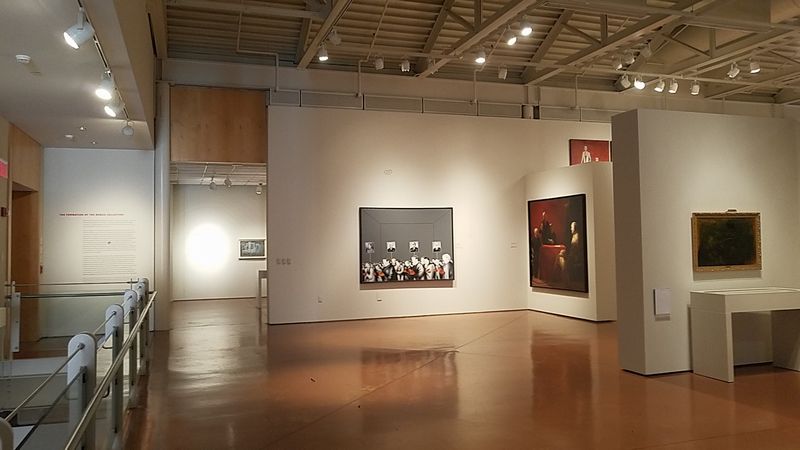
Admission costs nothing, and the museum welcomes the general public. You do not need to be a Rutgers student to visit.
Regular hours are 11 a.m. to 6 p.m. on Wednesdays and Fridays, 11 a.m. to 8 p.m. on Thursdays, and noon to 5 p.m. on Saturdays and Sundays. The museum closes Mondays, Tuesdays, major holidays, and throughout August; Thursday hours shorten during its summer schedule.
There is one particularly relevant detail for anyone planning a trip around the Dodge Collection. At the time of writing, the Upper Dodge wing is temporarily closed.
Confirm which Soviet nonconformist works and galleries are accessible before making a special journey for this collection. Exhibitions and gallery availability can shape the experience more than the collection’s overall size, so a little advance checking is useful here.
Getting to the museum is straightforward by train. From New Brunswick station, walk one block north along College Avenue to Hamilton Street, then one block east toward the building.
NJ Transit’s Northeast Corridor serves the station. Drivers can use paid street parking near the museum or the Gateway Center Parking Garage, with additional paid decks elsewhere nearby.
Many Hamilton Street parking meters now use ParkMobile, so follow the posted payment instructions. Give yourself enough time to read a few labels without turning the afternoon into an endurance event.
A smaller number of works considered carefully can leave a stronger impression than a hurried sweep through every open gallery. Free admission also makes a shorter visit feel perfectly reasonable.
Once you are outside again, Hamilton Street returns you to the familiar rhythm of New Brunswick. What stays with you may be a curious title, an unsettling image, or the realization that an artist’s seemingly small creative choice once carried consequences far beyond the studio.
Share this story