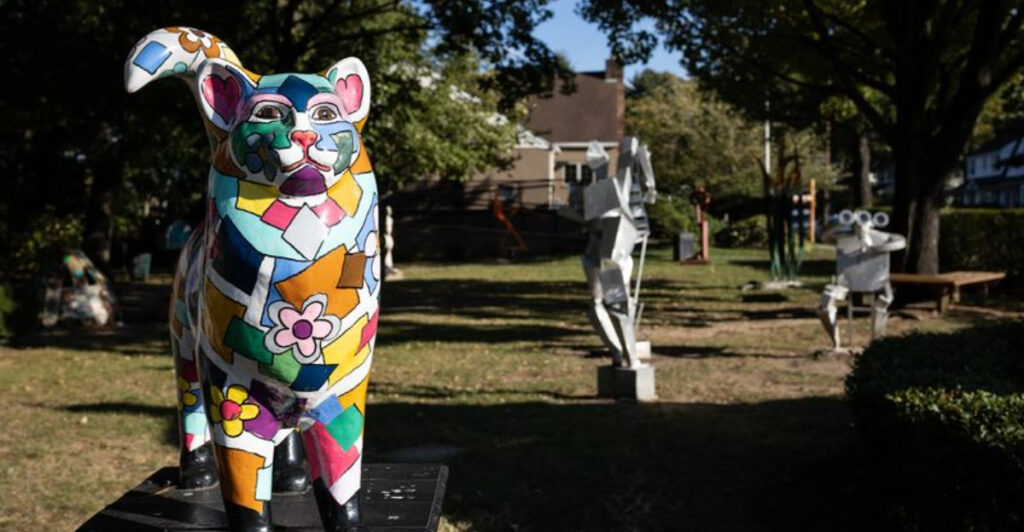
A bright fiberglass cow stands near the post office wearing a blue-and-gold pattern inspired by fine porcelain. Elsewhere in town, painted steel zigzags toward the sky, a bronze frog waits near a busy intersection, and two metal figures silently keep each other company.
None of these pieces sits behind museum glass. They are simply part of the scenery in Leonia, a small Bergen County borough near the George Washington Bridge.
Thanks to the volunteer-run Sculpture for Leonia program, more than 50 works have appeared in gardens, parks, school grounds, and other shared spaces across the community. The result is an art experience without a prescribed route, admission fee, or intimidating gallery hush.
Visitors can begin at the Erika and David Boyd Sculpture Garden before following the collection through town, discovering pieces almost by accident. In Leonia, picking up a library book or walking down Broad Avenue can unexpectedly become a visit to an outdoor exhibition.
Leonia Has Nurtured a Creative Spirit for More Than a Century
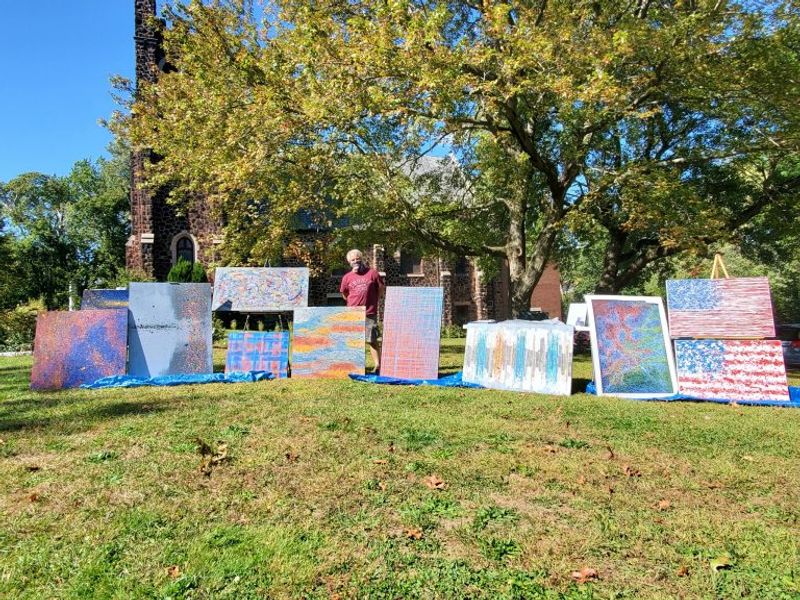
Long before sculptures began appearing beside sidewalks, Leonia already had the makings of an artists’ colony. From the late 1800s through the middle of the 20th century, the borough attracted more than 90 professional artists.
Painters, illustrators, photographers, writers, and performers settled in the compact community, sometimes converting barns and lofts into studios. Its location helped.
Leonia offered breathing room outside New York City while remaining close enough for artists to maintain professional connections across the Hudson River. Among the creative figures associated with the town were printmaker and graphic novelist Lynd Ward, illustrator Peter Newell, painter Harvey Dunn, and artists Rutherford and Harriet Boyd.
Their styles and careers varied, but collectively they gave Leonia an unusually strong creative identity for a borough covering less than two square miles. Art was not limited to private studios, either.
It became part of the community’s reputation and shaped how residents saw their hometown. That cultural streak continued well beyond the original colony.
The Players Guild of Leonia, founded in 1919, stages productions in the borough’s historic Civil War Drill Hall. Craft shows, readings, concerts, and other local programs have also kept creative work visible.
Leonia has even counted performers and cultural figures such as Alan Alda, Buddy Hackett, Sammy Davis Jr., Pat Boone, and Anthony Bourdain among its residents. Sculpture for Leonia fits naturally into that history.
The nonprofit did not have to convince the town that art mattered; it built on a value that had been present for generations. Its outdoor collection gives that heritage a physical form residents encounter every day.
The mediums have changed from easels and illustration boards to steel, stone, bronze, and fiberglass, but Leonia’s instinct remains familiar. Creative work belongs in the middle of community life, not hidden somewhere beyond it.
The Erika and David Boyd Sculpture Garden Anchors the Experience
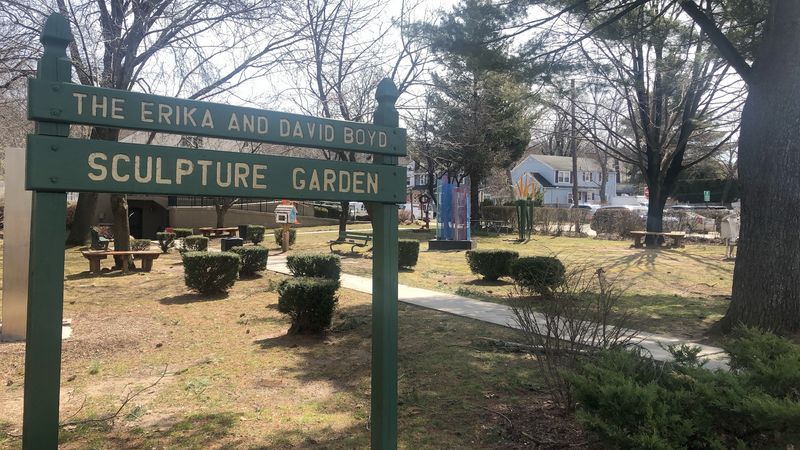
At the corner of Broad Avenue and Beechwood Place, greenery surrounds a gathering of shapes that would look equally at home on the grounds of a major contemporary art museum. This is the Erika and David Boyd Sculpture Garden, the centerpiece of Leonia’s public art program and the easiest place for a visitor to begin exploring.
Unlike an indoor gallery, the garden never presents a piece under perfectly controlled conditions. Sunlight moves across metal surfaces, trees throw shifting shadows over the installations, and seasonal changes alter the backdrop.
A sculpture framed by spring leaves can feel surprisingly different when bare branches stand behind it in winter. Wind can become part of the show as well, particularly when it catches one of the kinetic works designed to move.
The garden’s location is central to its appeal. It occupies an accessible piece of the borough rather than a secluded cultural campus, reinforcing the idea that art should share space with ordinary routines.
People can pause for a closer look while walking through the neighborhood instead of arranging an entire day around a museum visit. There is no lobby to navigate and no expectation that anyone must possess a deep knowledge of contemporary sculpture.
The space also offers enough concentration to feel like a destination rather than a random cluster of objects. Visitors can walk among several pieces, compare materials and forms, and notice how each artist responds to the surrounding landscape.
Some works command attention immediately, while others reward a slower circuit around them. The garden is located at 305 Beechwood Place and is open to the public free of charge.
It serves as the heart of the collection, but not its boundary. Once visitors step back onto the street, Leonia’s wider exhibition begins, spreading from this leafy corner into the places where residents shop, study, work, and meet.
More Than 50 Sculptures Turn an Ordinary Walk Into an Art Hunt
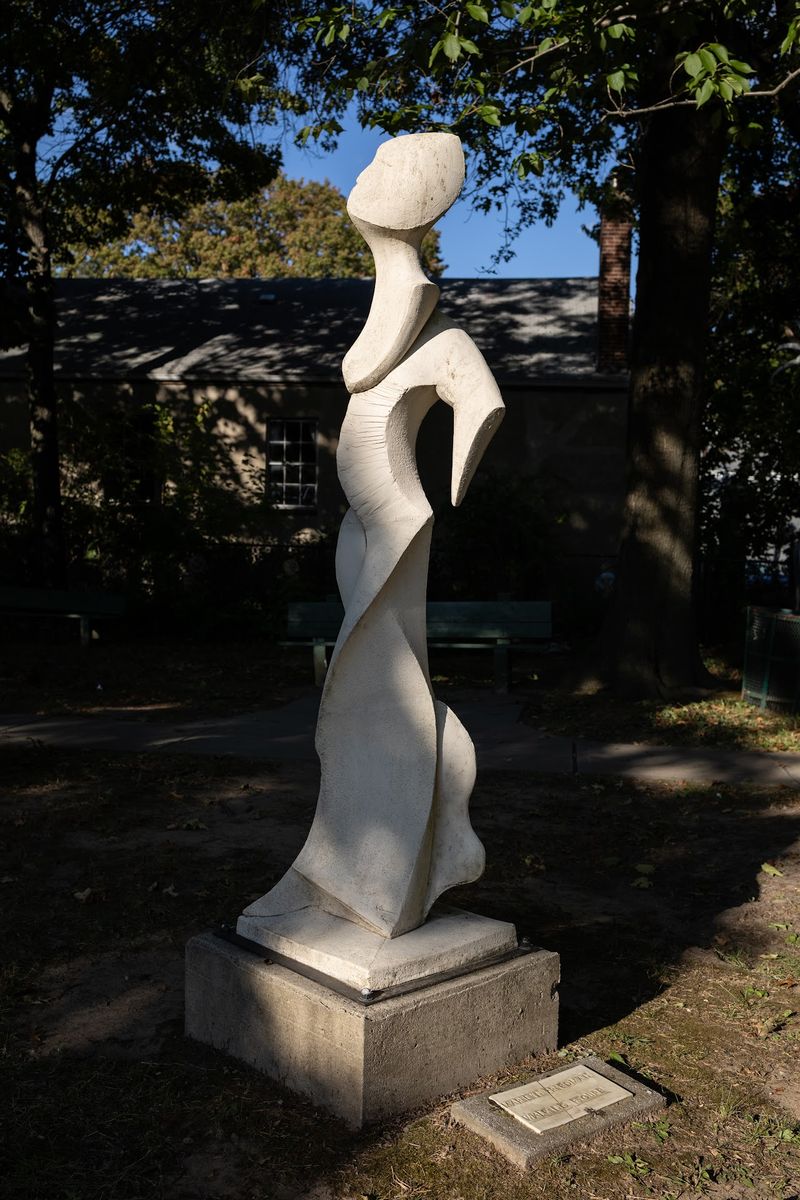
A trip to the library can lead past a kinetic flower. A stroll down Broad Avenue might reveal a towering column of colored steel.
Even the area near the post office contains a surprise in the form of Jane Keller Herzig’s Meissen Cow, a life-size fiberglass animal painted to resemble the blue-and-white Meissen porcelain pattern, with gold details completing the deliberately fancy look. That unpredictability is what makes Leonia’s collection so enjoyable to explore.
More than 50 sculptures have been installed throughout the borough, including pieces near schools, municipal buildings, parks, intersections, and pedestrian routes. The artwork is not confined to the Boyd Sculpture Garden, so visitors gradually begin to look at every patch of lawn and public corner with greater suspicion.
In this town, an unusual silhouette in the distance is probably worth investigating. Some placements feel playful.
Ailene Fields’ Frog Prince, located on the triangle at Broad Avenue and Magnolia Place, draws on the artist’s interest in fairy tales and mythology. Elsewhere, Bogdan Grom’s Mother and Baby Seal brings two whimsical fiberglass animals into a suburban setting.
Other works interact more subtly with their surroundings, using open areas, building lines, or nearby plantings as part of the composition. The broad distribution also changes the pace of the experience.
This is not a sculpture park where every visitor follows the same path and sees the pieces in an approved order. Someone might encounter five works during a quick walk or spend considerably longer tracking down installations across town.
Public art becomes a low-key treasure hunt, with traffic lights, storefronts, and residential blocks connecting one discovery to the next. Because Leonia is compact, the scattered locations feel linked rather than inconvenient.
The town itself becomes the gallery floor. There may be no arrows directing visitors toward the next exhibit, but that is partly the point.
The best sightings often happen when nobody is searching very hard.
Abstract and Figurative Works Bring Variety to Every Corner
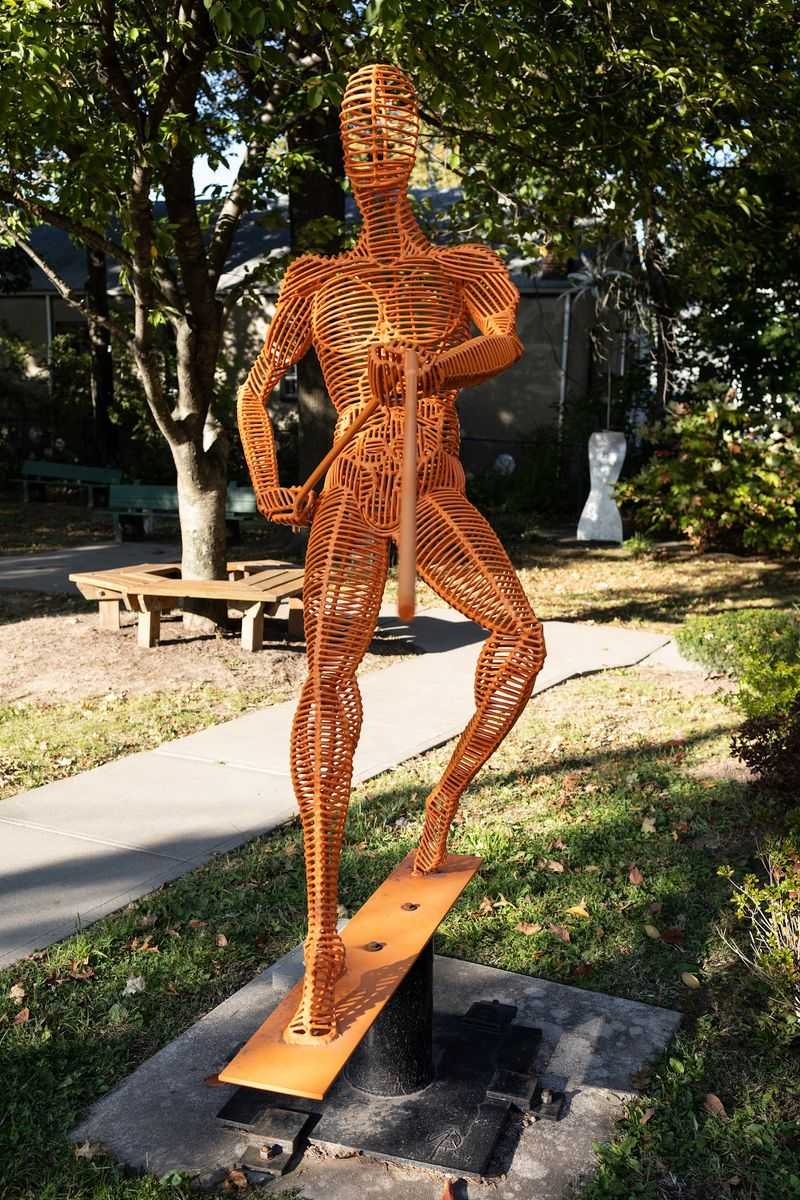
Not every sculpture in Leonia asks the same thing from its audience. Some are immediately recognizable, while others invite several minutes of circling, squinting, and cheerfully disagreeing about what they resemble.
That range prevents the town-wide display from feeling like a collection assembled around one narrow taste. William King’s Man and Woman offers a particularly approachable example of figurative art.
The two painted-aluminum sculptures reflect the humor and minimalist style for which King became known. His work entered the collections of institutions including the Metropolitan Museum of Art and the Whitney Museum of American Art, yet in Leonia, his lanky figures can be encountered without entering a gallery.
The pair was donated to Sculpture for Leonia, giving the borough a lasting connection to a major American sculptor. Michael Poast’s ZIG takes the experience in a different direction.
Made from steel and painted blue, red, and yellow, the work stacks a zigzagging pattern upward in a nod to Constantin Brancusi’s Endless Column. Its angles, bold colors, and negative spaces alter as the viewer changes position, making the surrounding sky part of the composition.
Movement adds another layer. Norman Sas named his kinetic work Aeolus after the Greek god associated with wind.
Its two components move independently in even a slight breeze, ensuring that the piece never looks quite the same from one moment to the next. Mary Rieser Heintjes also drew on motion for Oh Sit Still, a flower-like kinetic work inspired by the challenge of asking energetic children to remain seated.
Other installations incorporate stone, bronze, wood, found objects, or mixed materials. There are meditating figures, industrial forms, animals, flowers, and structures that resist a quick explanation.
Visitors do not need to decode all of them. Leonia’s collection works because it leaves room for curiosity, humor, confusion, and the occasional strong opinion before the next sculpture appears.
Rotating Installations Give Visitors Something New to Discover
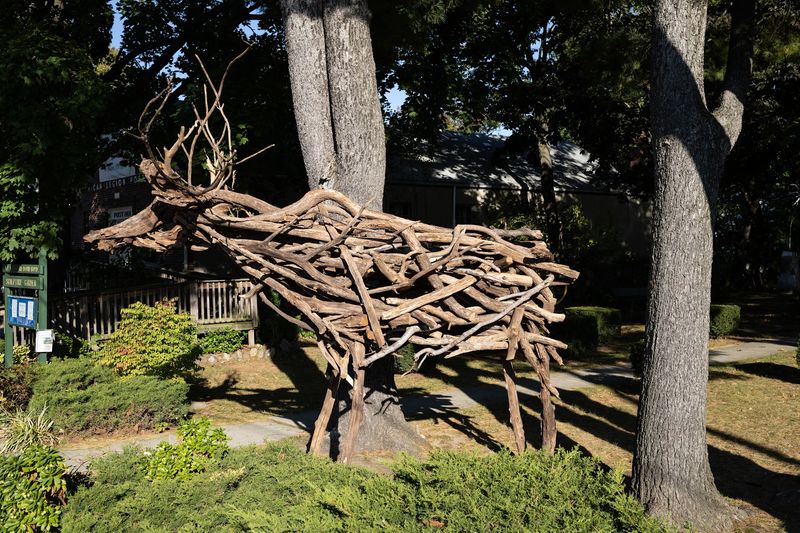
The collection is not frozen in place. Many of Leonia’s outdoor sculptures are loaned by the artists, allowing the program to introduce new works and retire others as exhibitions change.
A familiar corner may eventually gain a completely different shape, color, or personality, giving residents a reason to keep noticing spaces they pass every week. This rotating model benefits sculptors as much as visitors.
Large-scale work can be difficult to exhibit because it requires room, sturdy installation, and an audience willing to encounter it outside a conventional gallery. Sculpture for Leonia provides artists with highly visible public settings while giving the community access to work it might otherwise never see.
The arrangement creates a useful exchange: artists gain exhibition opportunities, and Leonia’s streets remain visually fresh. Recent additions demonstrate how varied those opportunities can be.
Ephraim Peleg’s Flowers of Steel uses repetition and sharply defined forms in work shaped by personal loss, survival, and renewal. Noel Caban’s Peace Talk employs found and commercial materials given a distressed, fractured appearance, reflecting on struggle and the hope for reconciliation.
Scott Gerber’s Peace, Love, and Happiness was originally fabricated for New York City’s South Street Seaport during the pandemic before finding a new public setting in Leonia. Installing outdoor sculpture, however, involves more than placing a piece on an empty lawn.
Each work needs an appropriate site, transportation, a secure foundation, coordination with the artist, and publicity that explains what viewers are seeing. Those practical demands are one reason the loan program depends heavily on donations and volunteer effort.
A changing collection also makes repeat walks worthwhile. One visit might be dominated by bold painted metal; another could introduce a kinetic piece that responds to the weather.
Even works that remain in place can change with the light and seasons. Leonia’s gallery never truly closes, but it also never stays exactly the same.
Volunteers and Local Events Keep Leonia’s Public Art Thriving
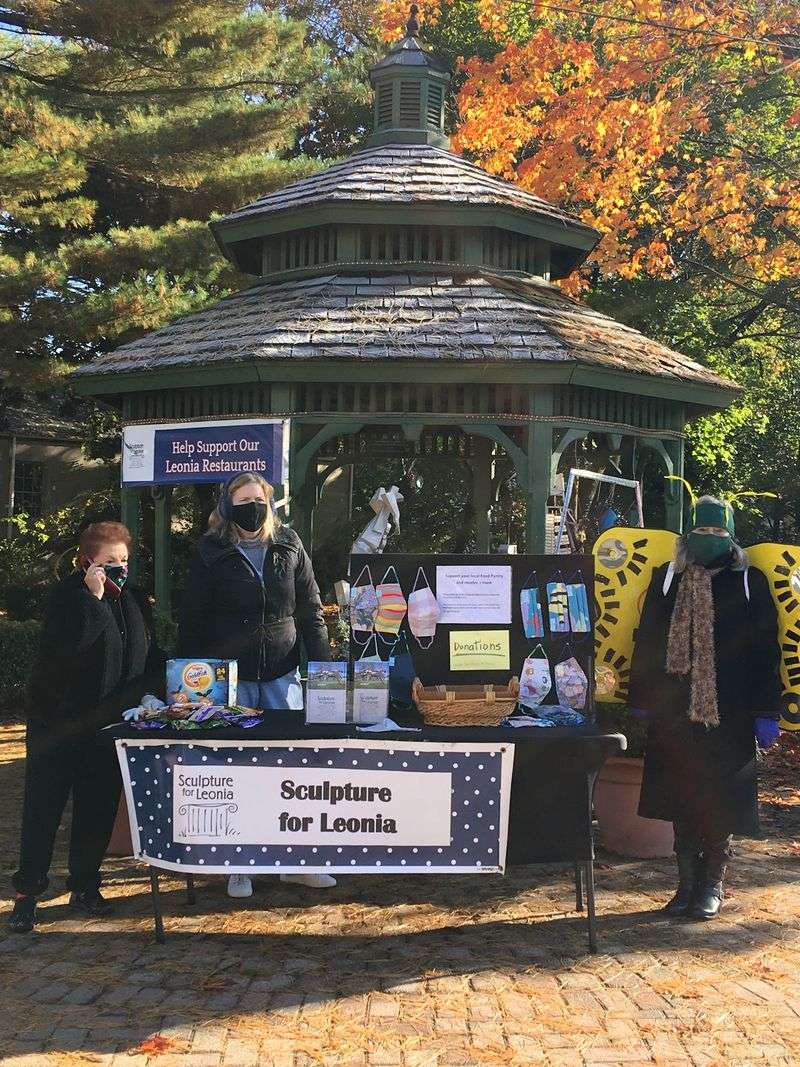
Behind every sculpture is a less visible structure made of planning meetings, fundraising, installation work, artist coordination, and community support. Sculpture for Leonia is an all-volunteer nonprofit, and its members handle the unglamorous jobs required to keep an outdoor collection growing.
The artists generally lend their works, but transporting and safely mounting a large sculpture still costs money. Catalogs, announcements, and programs introducing artists to the public add further expenses.
Community donations provide the organization’s financial foundation. That local backing has allowed the collection to expand beyond the Boyd Sculpture Garden and into dozens of sites around town.
It has also helped Sculpture for Leonia arrange Meet the Artist programs, publish information about participating sculptors, and create events that make the installations feel like shared community assets rather than anonymous objects dropped onto municipal property. Taste of Leonia has been one of the program’s signature fundraisers.
The event brings local food establishments, live music, and a silent auction into the sculpture garden, pairing public art with the borough’s culinary diversity. Instead of viewing the garden as a hushed space, attendees move among the pieces with samples in hand while music carries through the grounds.
Proceeds help fund future installations and other arts activities, turning an afternoon of food and conversation into direct support for the next public artwork.
The effort earned countywide recognition in 2016, when Sculpture for Leonia received Bergen County’s Outstanding Artistic Excellence Award for achievement in community outreach and the display of public art.
The organization presented the award to Leonia’s mayor and council for display at Borough Hall, an appropriate gesture for a project built around shared ownership. That collective spirit explains why the sculptures feel so thoroughly connected to their surroundings.
They are not decorations selected by a distant institution. They exist because artists are willing to lend their work and residents are willing to give their time, money, and attention.
Over the years, those individual contributions have transformed one small Bergen County borough into a gallery measured not in rooms, but in blocks.
Share this story