A roofless stone mansion stares through the trees above Ramapo Lake, looking less like northern New Jersey and more like the abandoned set of a gothic film. Elsewhere, concrete railroad arches cross a quiet valley without carrying a single train, and an old safari park has traded lions and baboons for mountain bikes and weeds.
These places were not built to become mysteries. They were homes, factories, resorts, transportation links, and entire communities created with serious money and bigger ambitions.
Then fires broke out, industries vanished, plans collapsed, and residents moved on. What remained was too sturdy, too remote, or simply too interesting to disappear completely.
Today, New Jersey’s woods conceal an astonishing collection of walls, foundations, furnaces, and forgotten roads. Some are easy stops; others demand a proper hike and good judgment.
Together, they raise the same irresistible question: How did something this substantial end up here—and why was it left behind?
1. Van Slyke Castle Ruins
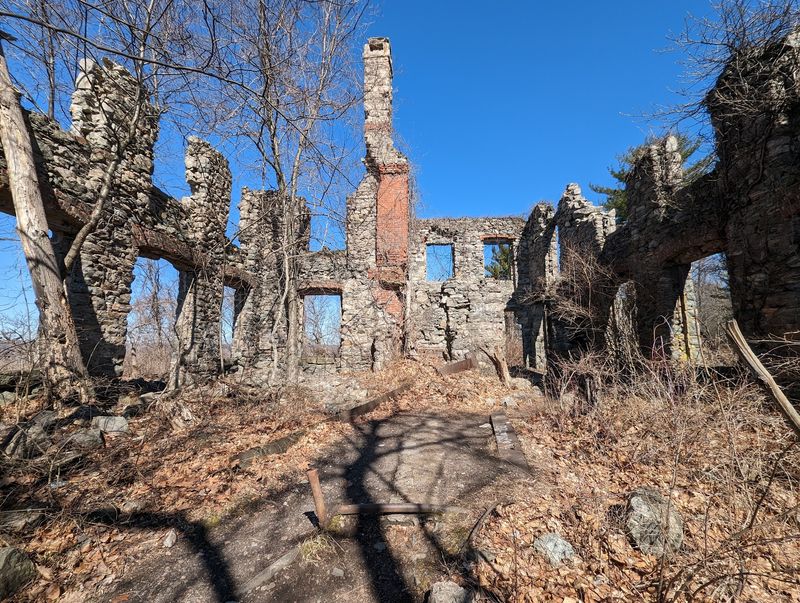
The first glimpse is the payoff: tall stone walls and empty window openings rising above the forest, with Ramapo Lake visible through the trees. This was never a medieval castle, despite the nickname and suitably dramatic appearance.
The estate, originally called Foxcroft, was built in the early 1900s for William Porter and later became associated with Ruth and Warren Van Slyke. After changing hands and falling into neglect, the mansion was gutted by fire in 1959.
The blaze stripped away its roof, floors, and domestic comforts but left enough masonry standing to preserve the outline of a very expensive dream. Reaching it is part of the fun.
The ruins sit in Ramapo Mountain State Forest, generally approached from the upper parking area off Skyline Drive through a network of rocky, occasionally confusing trails. A downloaded map is useful because cell service can be unreliable, and wet leaves make the climb more sporting than it appears on paper.
Look beyond the main house for remnants of the swimming pool and water tower, details that make the property feel like an estate rather than one isolated ruin. The walls are striking, but they are neither a playground nor a climbing gym.
Stay on established paths, keep off unstable masonry, and leave the site exactly as found. Visit during daylight, preferably in fall or early spring, when thinner foliage reveals both the ruins and the views.
2. Brooksbrae Brick Factory
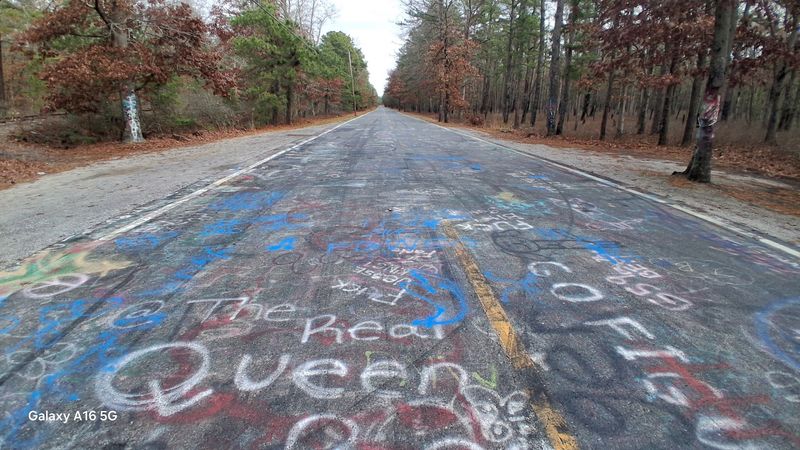
Bright graffiti rolls across long brick arches while pitch pines push in from every side. That collision between industrial history, street art, and Pine Barrens quiet gives Brooksbrae its peculiar appeal.
The ruins belonged to the Brooksbrae Brick Company, an early-20th-century operation near Pasadena in Manchester Township.
The factory intended to turn local clay into bricks and terra-cotta products, but transportation difficulties, financial trouble, and a devastating fire kept the business from becoming the success its founders imagined.
What survives is a series of heavy brick structures that resemble kilns, tunnels, or the remains of an ancient aqueduct—until a spray-painted character peers around the curve. Unlike a polished historic village, Brooksbrae provides few obvious clues about how the machinery worked or where employees would have stood.
That uncertainty is precisely what keeps visitors studying the shapes. The site lies within Brendan T.
Byrne State Forest and is generally reached by a sandy woodland route near Pasadena Road. Conditions matter: Pine Barrens roads can be deeply rutted, muddy after rain, and surprisingly unfriendly to low-clearance cars.
Parking without blocking gates or roadside access is essential. Once on foot, expect uneven ground, ticks, mosquitoes, and no visitor facilities at the ruins.
The artwork changes, but the old brick should not. Resist adding a signature, entering questionable openings, or scrambling onto the walls.
Brooksbrae works best as a curious hiking destination, not an invitation to test how much century-old masonry can hold.
3. Cliffdale Manor Ruins
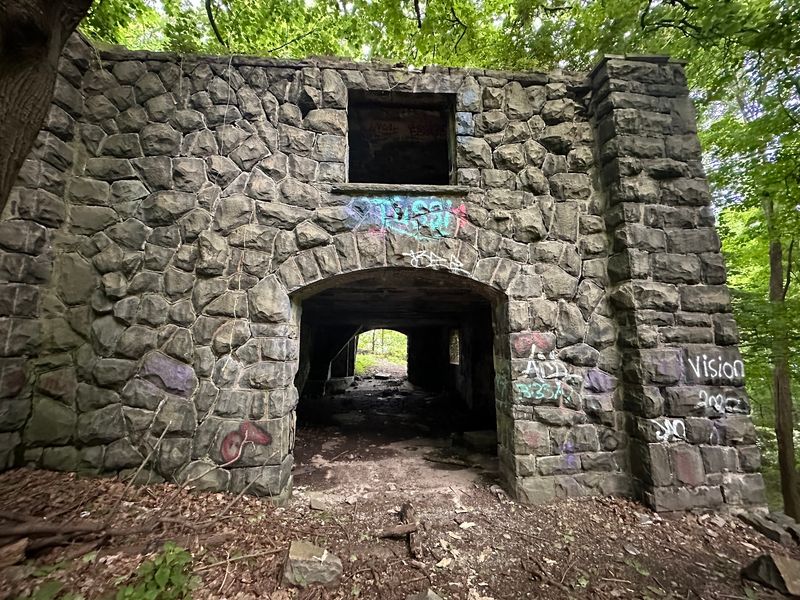
For a brief moment in leafless weather, drivers on the Palisades Interstate Parkway may spot a gray stone structure flickering between the trees. Hikers get the better view.
Cliffdale was the 15-room summer estate of flour executive and preservationist George A. Zabriskie, completed in 1911 on a prime stretch of cliff in Alpine.
Its location delivered sweeping Hudson River views and enough privacy for a country retreat, yet the house survived for less than three decades. John D.
Rockefeller Jr. purchased Cliffdale and neighboring properties as part of a broader effort to protect the Palisades from overdevelopment. He later donated the land with the intention of restoring the natural skyline.
In 1939, Works Progress Administration crews dismantled the mansion, though its massive hillside foundation proved stubborn. That two-story stone base remains beside the Long Path, roughly half a mile north of Alpine Lookout.
Trees grow through the interior, scattered columns sit among fallen leaves, and the date “1911” remains set into the masonry. The best approach is to park legally at an established Palisades facility and follow the marked trail; stopping on the parkway shoulder is dangerous and prohibited.
Stay alert for current closures, since rockfall and trail work can affect parts of the park. Cliffdale’s mystery is wonderfully backward: it was not abandoned because nobody cared.
It was deliberately reduced so the landscape around it could be preserved. The ruin is the leftover piece of a demolition project that nature never quite finished.
4. Feltville Deserted Village
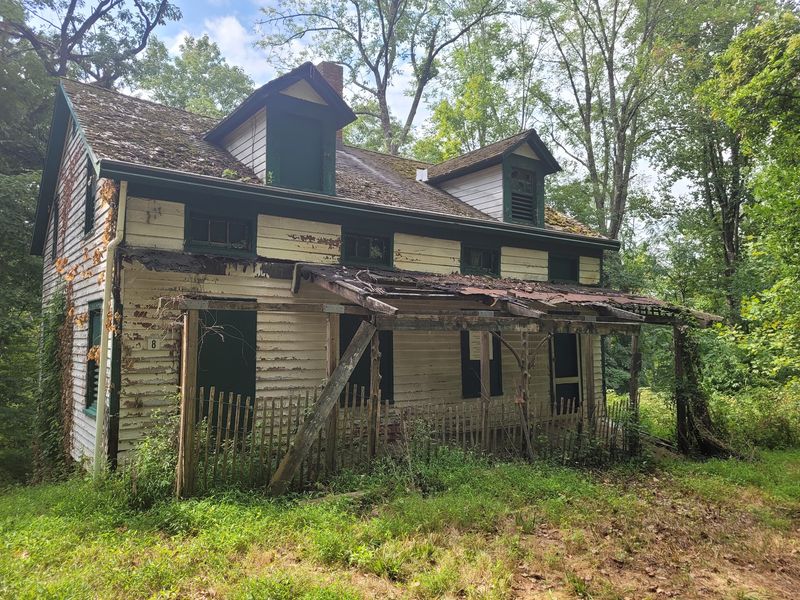
A row of old cottages stands beside a quiet road in Watchung Reservation, close enough to modern suburbs that the emptiness feels almost staged. Feltville, however, has been reinventing itself—and failing in fascinating ways—for nearly two centuries.
Businessman David Felt established a printing and stationery operation here in 1845, building a company village above Blue Brook for workers and their families. At its height, roughly 175 people lived in a community with housing, a school, a store, and a church.
Felt retired in 1860, and later enterprises struggled to keep the settlement alive. Warren Ackerman offered it a second act in 1882 as Glenside Park, a summer resort where guests could ride horses, fish, dance, and escape the city.
Changing vacation habits eventually pulled travelers toward the Jersey Shore, and the resort closed in 1916. Today, the preserved village is more approachable than most places on this list.
Its grounds are open from dawn to dusk, and a roughly one-mile self-guided route starts near the Glenside Avenue parking area. Interpretive signs identify buildings and archaeological features, while the restored Church/Store and Masker’s Barn provide a glimpse of the site’s better-kept chapters.
Some houses remain occupied, and several porches are structurally weak, so visitors should admire them from the road rather than wandering onto steps. Feltville raises a gentler question than a collapsed factory: how does a community become “deserted” more than once, yet somehow remain standing?
5. Jungle Habitat
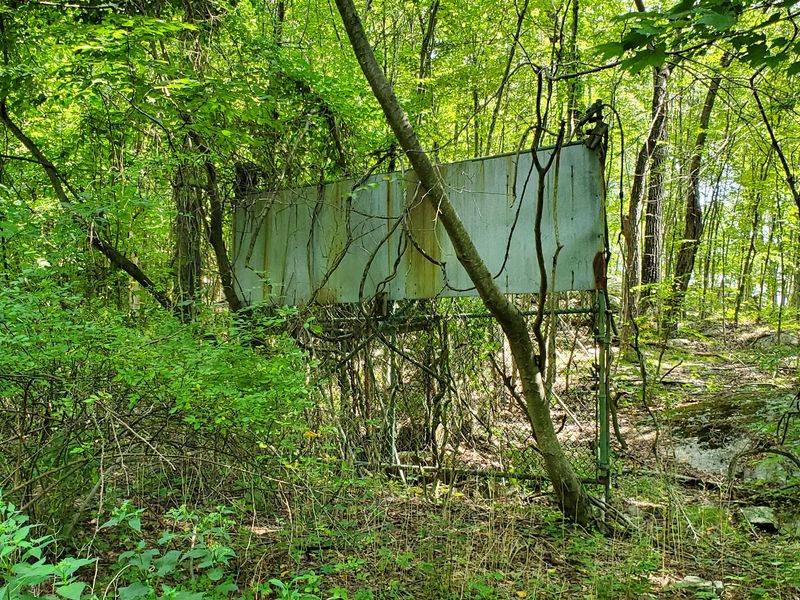
Imagine inching along in a station wagon while a baboon investigates the windshield and a lion watches from the roadside. From 1972 to 1976, that was a family outing in West Milford.
Warner Bros. Jungle Habitat combined a drive-through safari with a walk-through animal park housing more than 1,500 creatures.
It drew enormous crowds at first, but traffic, safety concerns, animal incidents, and disagreements over expansion strained its relationship with the surrounding township. When the park closed after the 1976 season, the animals were relocated, leaving behind paved loops, service roads, foundations, and fragments of infrastructure.
The site’s many rumors—including tales of exotic animals simply being released into the Highlands—have done almost as much as the ruins to keep its name alive. Today, the former safari property is public recreation land rather than a sealed-off urban-exploration target.
Hikers and mountain bikers use a broad network of trails where cars once crept past animal enclosures. Look closely and the old layout begins to emerge: cracked pavement running nowhere, curbs swallowed by brush, concrete pads, and faint traces of gates and structures.
The main access is near Airport Road, where visitors should consult the current trail map and posted rules before setting out. Mountain bikes can appear quickly on bends, so walkers need to stay aware.
There are no lions left to worry about, but ticks, rough terrain, and confusing trail intersections are real enough. The oddest moment comes when the woods fall quiet and an old strip of asphalt suddenly looks exactly like a safari road.
6. Paulinskill Viaduct
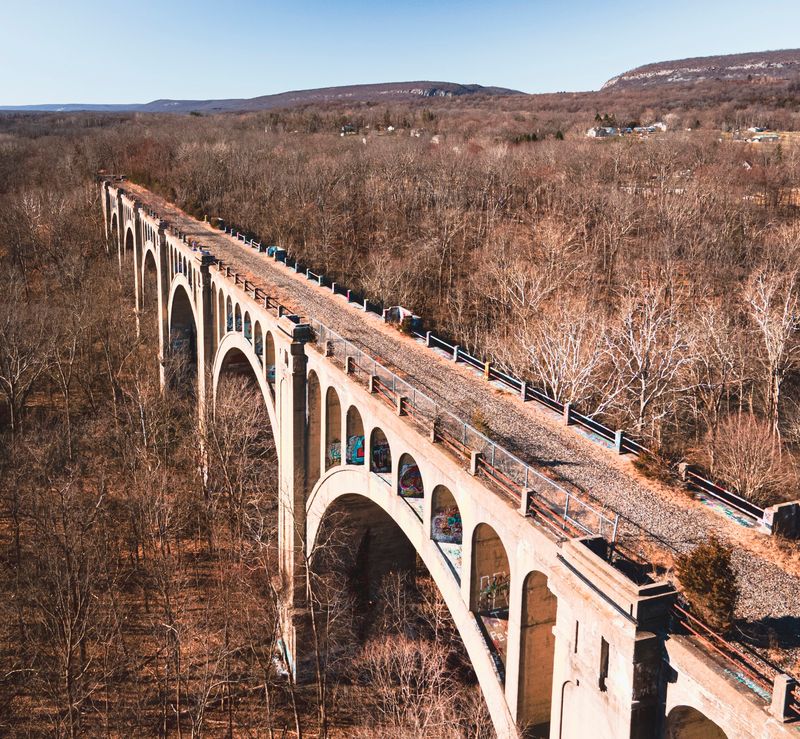
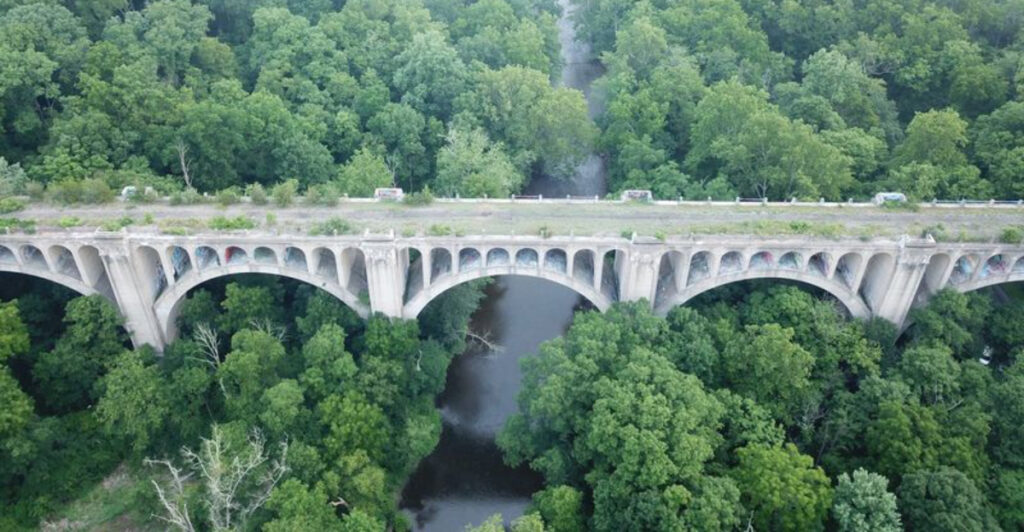
Seven enormous arches carry nothing across the Paulins Kill Valley. At 1,100 feet long and about 115 feet high, the Paulinskill Viaduct is far too large to fade politely into the landscape.
The Delaware, Lackawanna and Western Railroad completed it as part of the Lackawanna Cut-Off, an ambitious route designed to make rail travel straighter, faster, and more efficient. When finished in 1910, it was celebrated as the world’s largest reinforced-concrete structure.
Trains crossed it for decades, but passenger service ended in 1970, freight operations followed, and the rails were removed in the 1980s. The bridge remains, marked by weather, graffiti, and persistent questions about whether trains might someday return.
From public roads and lawful viewpoints below, its scale is startling; each arch frames a different slice of riverbank, trees, and sky. This is one ruin where good sense matters more than adventurous posing.
The top has no protective railing, the drop is deadly, and accessing railroad property or entering the structure may constitute trespassing. Interior chambers and ladders sometimes featured in exploration stories are not legitimate visitor attractions.
Photograph the viaduct from safe, publicly accessible areas and respect fencing and signs. Parking options near the structure are limited, so do not leave a vehicle where it obstructs traffic or private property.
The viaduct’s unanswered question is not simply why it was abandoned. It is why an engineering work built to outlast generations has spent so many years waiting for a purpose worthy of its size.
7. Weymouth Furnace
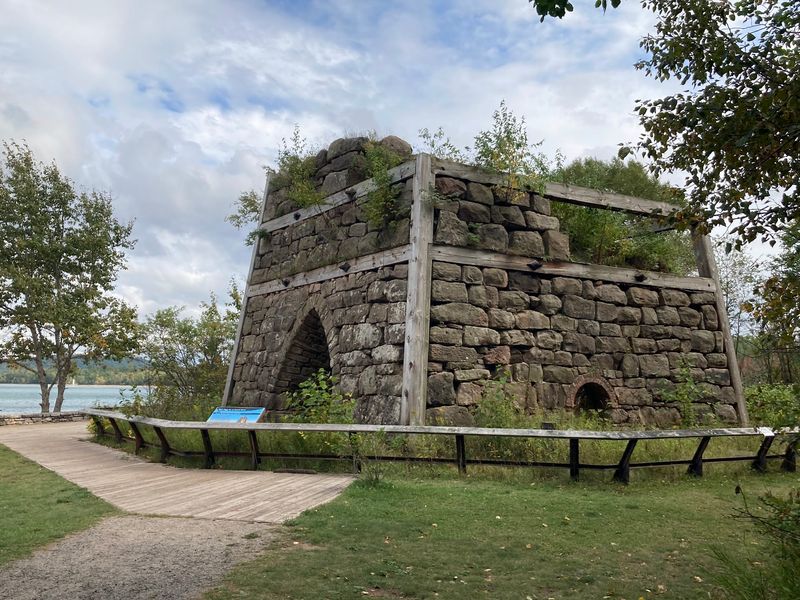
The Great Egg Harbor River slips past mossy stone arches that once stood amid heat, smoke, machinery, and relentless hammering. Weymouth began producing iron in the 18th century, using South Jersey’s bog ore and abundant timber to support an industrial settlement.
Cannonballs and other iron goods were made here during its working years, but the complex repeatedly changed owners and purposes as local ironmaking lost ground to richer ore deposits and more efficient furnaces elsewhere. A paper mill later occupied the site before the community was abandoned in the late 19th century.
What remains is unusually photogenic: tall stonework, mill foundations, and arches softened by vegetation beside the river. Unlike many remote Pine Barrens ruins, Weymouth Furnace is part of an established Atlantic County park with parking, picnic areas, trails, and water access.
It is an easy place to combine a history stop with lunch beside the river or the launch of a canoe or kayak. Swimming is not the smart activity here; currents and changing river conditions demand caution, and paddlers should check water levels before arriving.
The ruins deserve similar respect. Old foundations can be slick, gaps may hide beneath leaves, and climbing adds needless risk to a relaxed visit.
Come in the morning for softer light on the stone and fewer picnickers. Weymouth feels peaceful now, which makes its industrial past harder to picture—and makes those oversized arches seem even more improbable in the woods.
8. Clinton Furnace
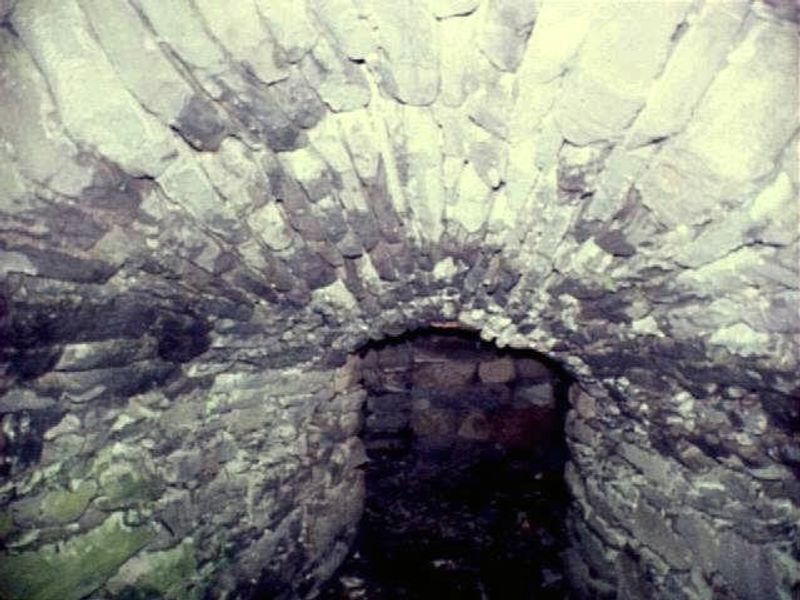
A massive stone tower beside Clinton Road looks vaguely ceremonial, which has encouraged plenty of imaginative explanations. It was built for iron, not rituals.
Completed in 1826 and put into operation several years later, Clinton Furnace smelted ore brought from mines in northern New Jersey. Water from Clinton Brook powered the operation, while charcoal supplied the intense heat required to turn ore into usable iron.
The enterprise was short-lived: large-scale operations ended in the 1830s, leaving the furnace as the final prominent remnant of a settlement once known as Clinton. At roughly 40 feet tall and nearly 30 feet wide at its base, the structure is substantial enough to make its brief career surprising.
It now stands on Newark watershed property near the base of Clinton Reservoir, along a road already burdened with ghost stories, strange-creature tales, and late-night dares. The furnace needs none of that decoration.
Its arched opening, heavy stone walls, and isolated setting deliver plenty of intrigue in daylight. Visitors should be particularly careful about access.
Watershed lands are regulated, roadside parking is limited, and posted signs or barriers must be obeyed. Clinton Road is narrow in places, with curves that make an improvised stop unsafe.
Treat the furnace as a historic landmark to view responsibly, not permission to wander into restricted land. The real puzzle is economic rather than paranormal: an industrial community was assembled around this formidable structure, operated for only a handful of years, and then vanished while its stone centerpiece endured.
9. Amatol Ghost Town
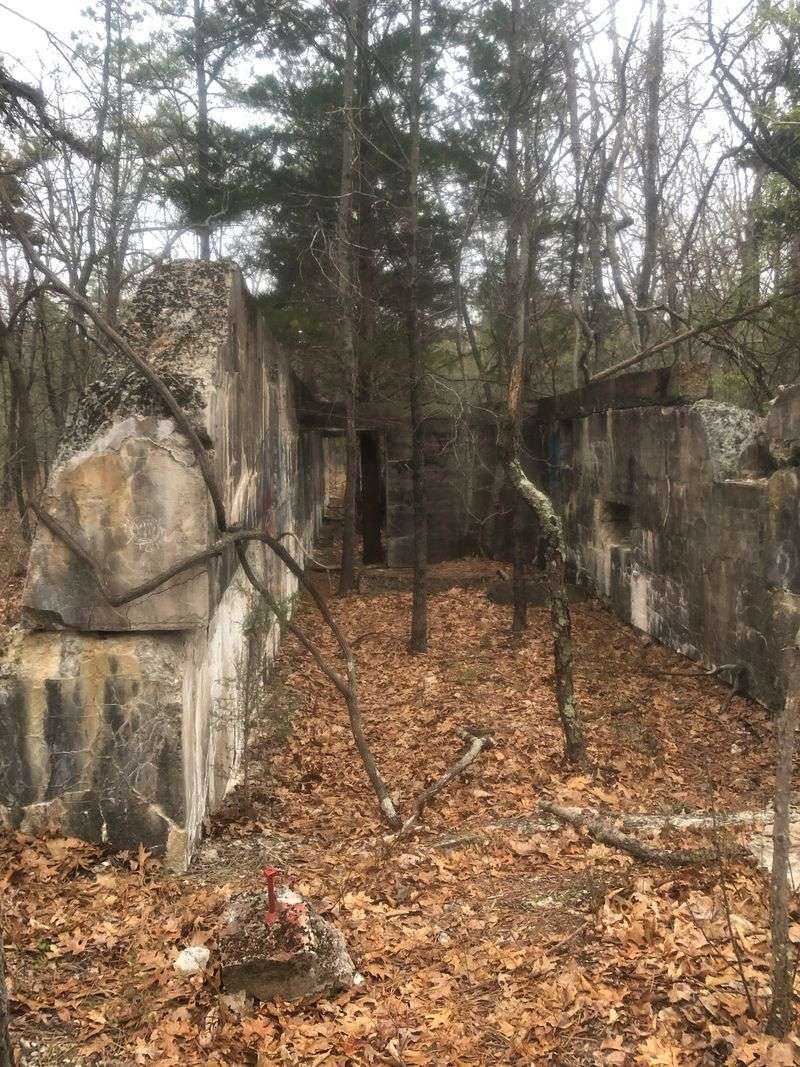
In 1918, a full industrial town rose from the Pine Barrens with almost wartime speed. By the time its streets, utilities, housing, and munitions facilities were ready to prove themselves, the war was ending.
Amatol was built in Mullica Township to load artillery shells with an explosive mixture of TNT and ammonium nitrate. The enormous complex included separate production lines, rail connections, worker housing, shops, recreation facilities, and modern water and sewer systems.
Residential areas were deliberately placed away from hazardous operations, and blast-conscious designs directed potential explosions upward rather than into neighboring buildings. Then the Armistice arrived.
Demand collapsed, workers departed, and much of the purpose-built community was dismantled. The property found an unlikely second use in the 1920s when the Atlantic City Speedway brought auto racing to a huge wooden oval, but that venture disappeared too.
Today, foundations, concrete remnants, old roadbeds, and traces of the racetrack survive among mature trees. Amatol is not a neatly interpreted historic attraction with a single entrance and gift shop.
The former complex covers a broad area with a mix of public wildlife land and private property, making careful route planning essential. Obey every posted boundary, avoid unexplained structures and pits, and never assume an old road guarantees public access.
For many readers, the history may be more rewarding than an improvised search through brush. Amatol’s lingering question is almost comic in its timing: what happens when a town built for one emergency finishes arriving just as the emergency ends?
10. Batsto Village
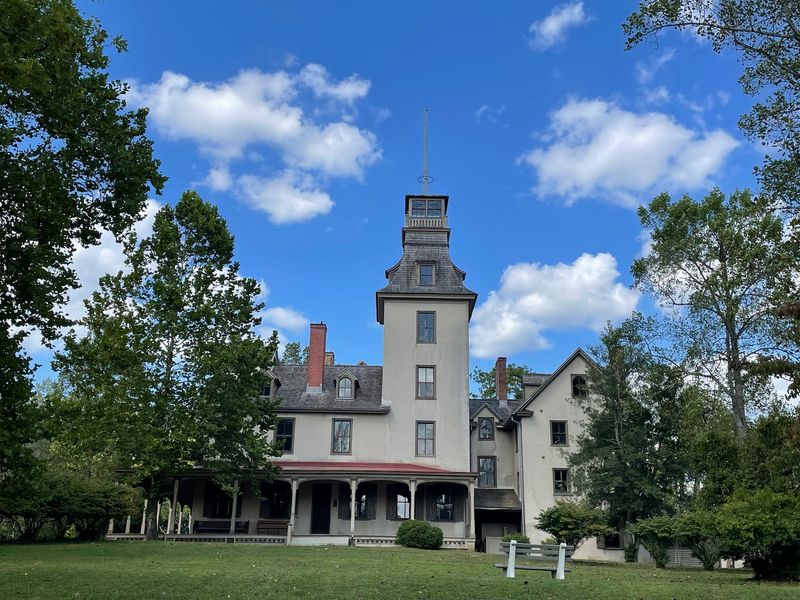
A tidy post office still operates in the middle of a village whose original industry disappeared more than a century ago. That detail captures Batsto perfectly: it is neither wholly abandoned nor conventionally alive.
Founded in 1766 beside the Batsto River, the settlement became an important bog-iron center, producing household goods and supplies connected to the Revolutionary War. Water powered its mills, nearby forests provided charcoal, and iron-rich deposits collected from local streams fed the furnace.
When ironmaking shifted toward Pennsylvania’s richer ore and coal resources, Batsto moved into glass production before declining again. Preservation spared the village the fate of many Pine Barrens company towns.
More than 30 historic structures remain, including workers’ cottages, a gristmill, sawmill, general store, barns, mansion, and the post office. The pleasure of visiting comes from walking the compact history trail and reading the landscape as a complete community rather than hunting for one dramatic ruin.
Batsto sits within Wharton State Forest and has established parking near the visitor center. The grounds can be explored without a ticket, while mansion tours and interior access may follow limited or seasonal schedules.
Check current operations before making a special trip, and bring insect repellent during warmer months. Some buildings are restored, others stabilized, and still others retain the worn edges that earned Batsto a place on this list.
Its big question is not why everything vanished, but why this particular industrial village survived when so many similar settlements became little more than cellar holes under pine needles.
11. Harrisville Paper Mill Ruins
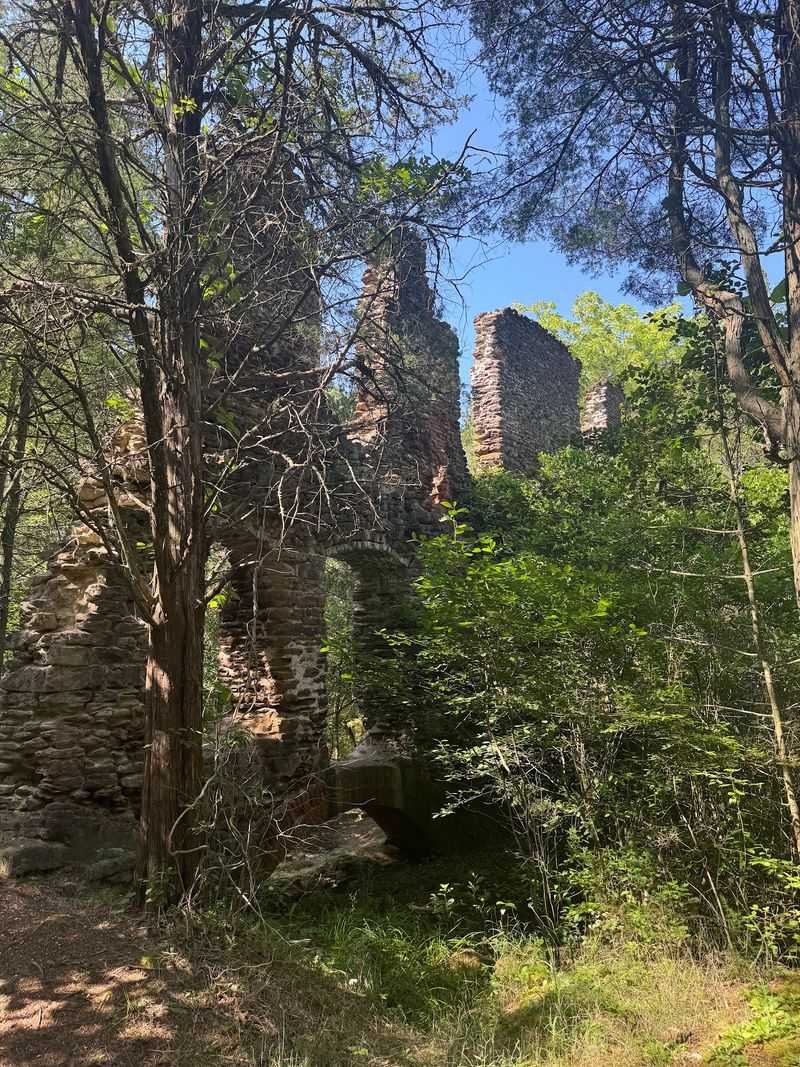
Brick walls rise beside dark water in one of the Pine Barrens’ most convincing ghost-town scenes. Harrisville began with water-powered industry near the Oswego River, first supporting sawmilling and an iron-slitting operation before becoming a paper-manufacturing community in the 19th century.
Under the Harris family, the village grew around the mill with worker housing, a company store, gristmill, and post office. Its machinery produced paper from discarded rope, fabric, and other fibrous material, while the surrounding waterways supplied essential power.
The business eventually failed, and fire dealt the settlement another blow in the early 20th century. Homes and everyday village buildings disappeared, but portions of the mill survived as long brick shells reflected in Harrisville Pond.
The effect is beautifully misleading: from a distance the walls look sturdy enough to enter, yet they are fragile ruins exposed to weather for generations. Protective fencing surrounds the mill for safety and preservation, and visitors should keep outside it.
The site lies in Wharton State Forest near Route 679, where a legal roadside stop and a short walk provide views without requiring a backcountry expedition. Still, Pine Barrens basics apply—watch for ticks, soft shoulders, wet ground, and fast-moving traffic near the road.
Late autumn offers the clearest sight lines and fewer insects. Harrisville’s empty windows do more than suggest a lost factory.
They outline the center of a company town whose houses, workers, store, and daily routines have otherwise been erased.
12. Split Rock Furnace
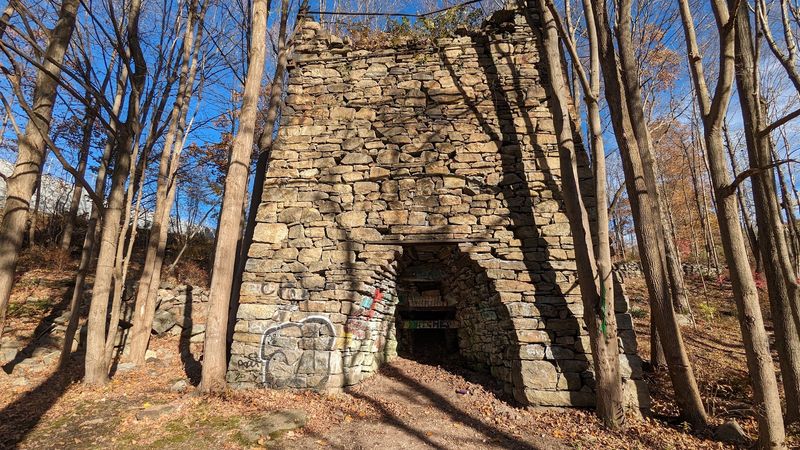
Built in 1862, this 32-foot stone furnace entered the iron business with a serious disadvantage: its technology was already falling behind. Split Rock Furnace used charcoal to smelt magnetite ore at a time when more efficient anthracite-fueled operations had been working for years.
Civil War demand made local iron production attractive, and a small settlement grew around the furnace with worker housing, a company store, and an ore-roasting kiln. Yet the operation lasted only about a decade.
Most of the village disappeared, leaving stone foundations and the tall furnace stack as evidence of an industrial gamble that never became a lasting center. The structure stands near the dam at Splitrock Reservoir in Rockaway Township, where water, woods, and rough roads create an appropriately remote setting.
Visitors can view it near Split Rock Road, west of the public boat launch, but should prepare for a drive that may include potholes and uneven surfaces. Parking is limited and popular reservoir access points can fill quickly, especially on pleasant weekends.
Hiking trails in the area are rocky, wet after storms, and more demanding than the furnace stop itself; sturdy shoes are a better choice than casual sneakers. Keep clear of unstable masonry and do not remove stones or artifacts from surrounding foundations.
Split Rock is worth including because its mystery is visible in its design. Someone invested in a formidable, carefully built furnace just as the industrial world was choosing a different path—and the obsolete technology proved more durable than the business behind it.