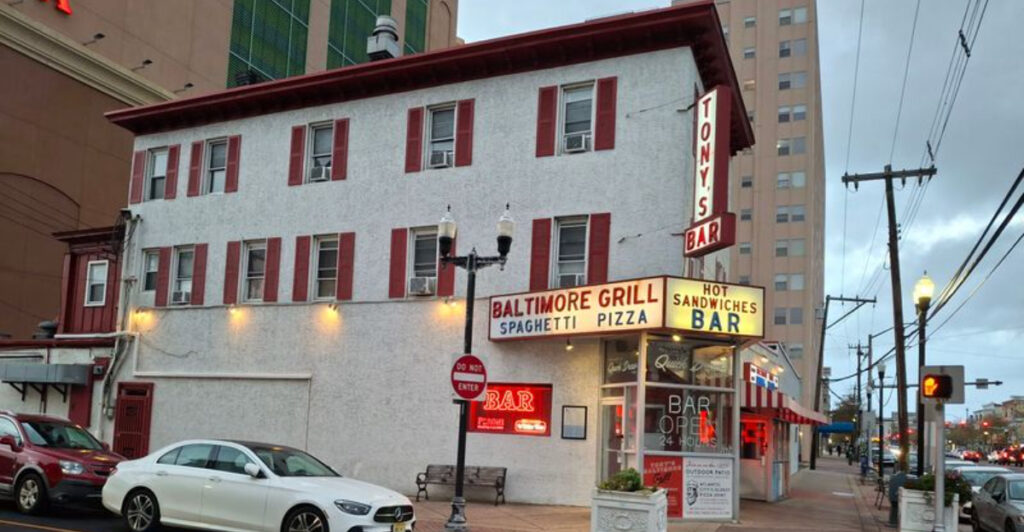
A miniature jukebox sits beside your booth, the room glows red, and somewhere nearby a 12-inch pizza is sliding onto a table beside a basket of bread. This is Tony’s Baltimore Grill, where Atlantic City looks a whole lot less like casino towers and a whole lot more like the city your grandparents remember.
The restaurant has been around since 1927, and unlike places that spend serious money trying to manufacture a vintage aesthetic, Tony’s has simply accumulated one. The dark booths, globe lights, old-school bar, neon signage, and tabletop jukeboxes feel convincing because they’ve been part of the scenery for generations.
Meanwhile, the menu keeps things equally unfussy with pizza, spaghetti and meatballs, fried seafood, roast beef, and Italian-American comfort food. At 2800 Atlantic Avenue, Tony’s offers something increasingly difficult to find in Atlantic City — a place with nearly a century of history that still functions as an everyday neighborhood joint.
Step Into Old-School Atlantic City at Tony’s Baltimore Grill
The story actually starts at a different address. In 1927, Philadelphia native Joseph Tarsitano opened the Baltimore Grille at 604 Atlantic Avenue, serving pasta and fried seafood.
According to the restaurant’s own history, Joseph eventually called his son Tony into the kitchen, where Tony began making what his father called a tomato pie. The restaurant credits that pie as Atlantic City’s first, and the basic idea eventually became the 12-inch pizza that remains at the center of Tony’s menu today.
After Joseph died, his brother John ran the restaurant. Tony served during World War II, then returned home and bought the business with his younger brothers Dominic and Lou, at which point it became Tony’s Baltimore Grill.
The move to the familiar present-day location came later. In December 1964, Tony and William “Ricky” Rich purchased Paddy McGahns Cafe and Musical Bar, converted the space, and opened the new Tony’s Baltimore Grill on April 1, 1965.
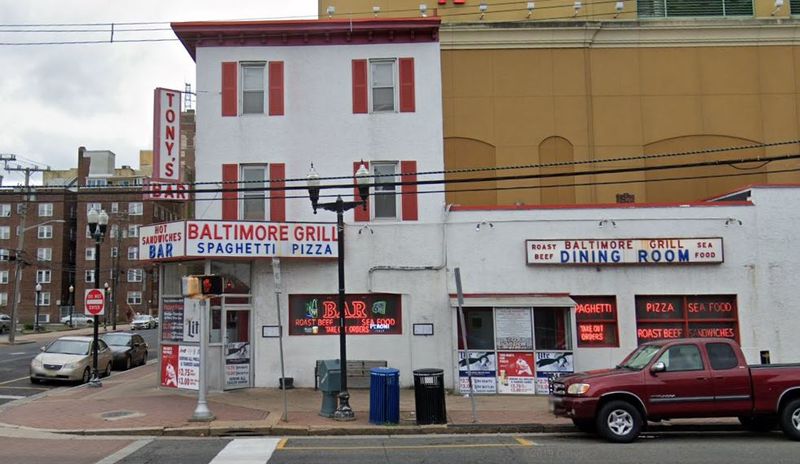
The restaurant says lines stretched down the avenue that day. Nearly six decades later, 2800 Atlantic Avenue still doesn’t resemble the polished dining rooms inside the casino resorts.
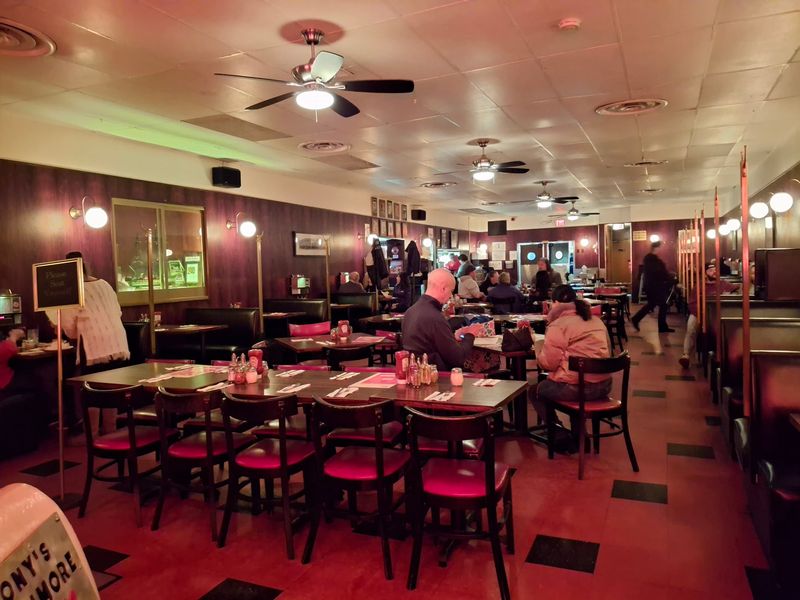
The white exterior, old signage, red-heavy interior, dark booths, hanging globe lights, and circular wooden bar have much more personality than polish. That contrast is part of the fun.
Atlantic City has changed around Tony’s again and again, especially since casino gambling arrived in the late 1970s, but this room still feels built for pizza, a cold drink, and a conversation that runs longer than planned. There is no elaborate historical exhibit explaining what you’re looking at.
The history is the restaurant itself.
The Boothside Jukeboxes Keep the Retro Charm Alive
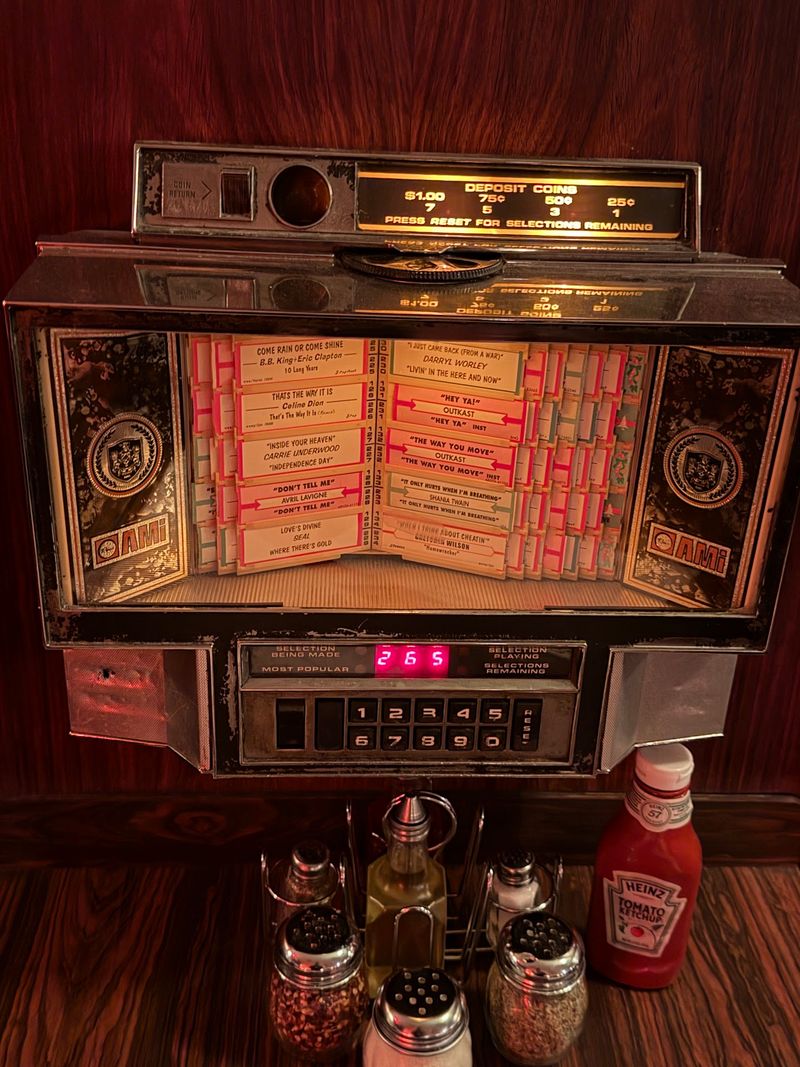
You slide into a booth, start looking for somewhere to set your phone, and there it is — a little tabletop jukebox staring back at you. Of all Tony’s old-school touches, these boothside music machines may be the most memorable.
They turn something as ordinary as waiting for pizza into a small ritual: look through the song choices, debate what deserves to play, and remember that restaurant entertainment once required more participation than connecting to Wi-Fi.
The jukeboxes fit naturally into a dining room already dominated by dark wood, reddish lighting, vintage details, and a bar that looks like it has heard every possible version of an Atlantic City story.
They aren’t decorative props added during a recent remodel. They belong to the same visual vocabulary as the booths and neon outside, which is why the room feels lived-in rather than themed.
Photos of the dining room show the compact jukebox units mounted right beside the tables, close enough that diners can control the soundtrack without leaving their seats. That little detail says a lot about Tony’s.
Modern Atlantic City is built around sensory overload — giant video screens, casino floors, clubs, digital signs, and attractions competing constantly for attention. Here, the entertainment can be choosing a song while somebody across the table reaches for another slice.
The whole setup is wonderfully low-tech by comparison. Even younger diners who have never dropped money into a diner jukebox understand the appeal pretty quickly.
And for anyone who remembers when these machines were common in neighborhood restaurants, seeing one beside dinner has an entirely different effect. Plenty of restaurants can hang an old record on the wall.
Tony’s gives the music a seat at the table.
The Thin-Crust Pizza Has Been Drawing Locals Back Since 1927
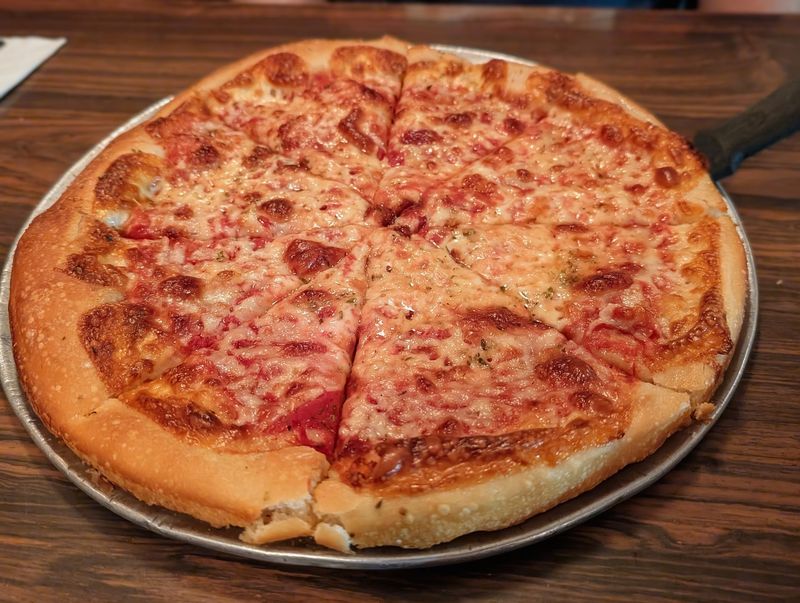
Forget the giant floppy slice you might grab while walking near the Boardwalk. Tony’s pizza is its own thing, arriving as a compact 12-inch pie with a thin crust, straightforward sauce, plenty of melted cheese, and the sort of proportions that make ordering a second variety seem perfectly reasonable.
The current menu lists a plain red or white pizza at $13.95, while the TBG Special with cheese, mushrooms, and sausage is $17. Specialty pies are listed at $19, although the restaurant notes that prices can change.
That manageable 12-inch size is part of Tony’s identity rather than a recent attempt at portion control. The restaurant traces its pizza back to the tomato pies Tony Tarsitano began making during the family’s early Atlantic City years, and the menu still proudly labels the pizza “world famous.”
What keeps it interesting is how little the formula seems interested in modern pizza fashion.
There are no precious descriptions of imported flour or elaborate explanations about fermentation. You choose red or white, add sausage, pepperoni, mushrooms, onions, anchovies, cherry peppers, extra cheese, or whatever else sounds right, and get on with dinner.
The menu even includes a nod to Anthony Bourdain, who described the food as “a taste of my youth.” That phrase gets at the appeal better than a complicated tasting note could. Tony’s pizza isn’t chasing the blistered Neapolitan trend or trying to produce an oversized social-media spectacle.
It belongs to an older Atlantic City tradition of uncomplicated Italian-American food served to families, workers, musicians, regulars, and people wandering in late at night.
After almost a century, the pizza has become less of a signature dish than a piece of local continuity — hot, cheesy, thin-crusted proof that not every successful recipe needs an update.
Don’t Skip the Spaghetti Pizza and Clams Casino Pie
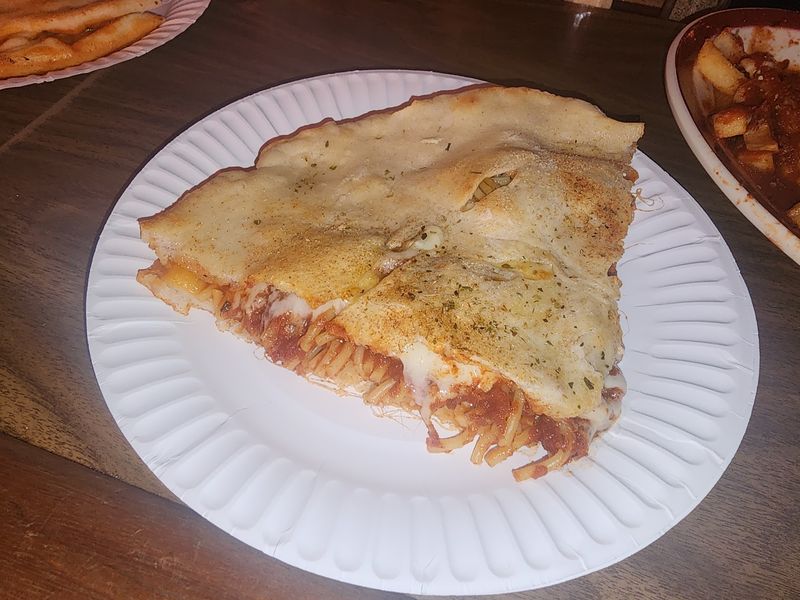
Then there’s the spaghetti pizza, an idea that sounds like somebody lost a bet until you consider the ingredients. Pizza crust, tomato sauce, cheese, spaghetti, and meatballs are hardly strangers.
Tony’s has become associated with a version that piles the pasta-and-meatball combination onto a pizza crust, creating what is essentially two old-school Italian-American comfort foods sharing one plate.
There is one useful thing to know before arriving determined to order it, though: spaghetti pizza does not appear among the specialty pies printed on Tony’s current official full menu, so availability is something to ask about rather than assume.
It has nevertheless been served and documented at the restaurant. The Clams Casino pie is much easier to plan around.
It is right there on the current menu for $19, built on white clam sauce with bacon, onion, green pepper, and garlic. It sounds unmistakably Jersey Shore — seafood, garlic, bacon, and pizza all refusing to stay in separate lanes.
There are other specialty pies worth noticing, too. Nino’s Favorite combines sausage with cherry peppers, while The Judge, named for Damon Tyner, uses cherry peppers with half sausage and half pepperoni.
The Margarita comes with sliced tomato, provolone, basil, and garlic, and Chris’ Veggie starts with a white pie topped with broccoli, onion, green pepper, and garlic. Buffalo chicken, Hawaiian, and chicken bruschetta round out the familiar crowd-pleasers.
What makes the lineup work is that the unusual pizzas don’t feel like gimmicks cooked up for attention. Even the Clams Casino pie uses flavors already deeply at home in an old Jersey Italian-American restaurant.
Tony’s may have nearly 100 years of history behind it, but apparently nobody told the kitchen that old-school had to mean predictable.
Come for the Pizza and Stay for the No-Frills Neighborhood Vibe
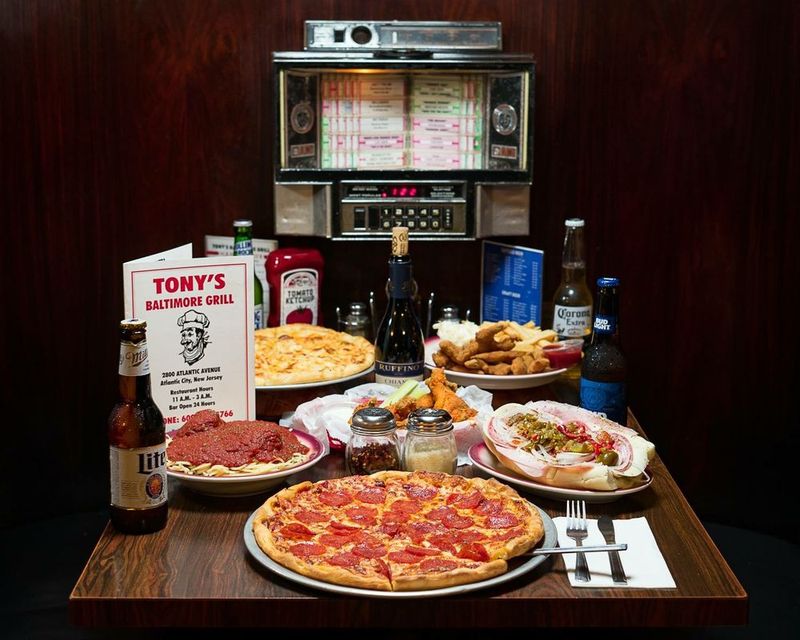
Tony’s makes especially good sense when the hour gets late. Dining runs from 11 a.m. until 2 a.m.
Sunday through Thursday, with a limited late-night menu from midnight until closing. On Friday and Saturday, the dining room stays open until 3 a.m.
The bar goes considerably further: according to Tony’s, it operates 24 hours a day, seven days a week. Those hours help explain why the place has long attracted such a mixed crowd.
Atlantic City musicians once made Tony’s a regular stop before or after gigs, while generations of locals have used it for everything from family dinners to post-event meals. You can feel why that works as soon as you look at the menu.
Pizza may get top billing, but this is the kind of restaurant where spaghetti and meatballs still counts as a complete plan. The current menu prices that plate at $12.95 and serves pasta dinners with Atlantic City bread.
There are meatball and sausage platters, chicken parmigiana, roast beef, fried shrimp, scallops, ravioli, antipasto, wings, sandwiches, and a gloriously unfashionable cheese plate. A hot or cold roast beef sandwich is listed at $10.95, while seven Atlantic City fried shrimp run $20.95.
Nothing about the menu requires a lengthy explanation from a server. Neither does the room.
TVs around the bar, worn-in booths, old signage, jukeboxes, regulars, tourists, families, and late-night diners all coexist without anyone trying to turn the combination into a carefully branded “experience.” That’s exactly what separates Tony’s from a retro-themed restaurant. The place did not select an old-school aesthetic.
It simply stayed around long enough for its everyday look to become old-school.
Why Tony’s Baltimore Grill Still Feels Like a True Atlantic City Original
The most revealing part of Tony’s history may have nothing to do with pizza. The Tarsitano and Rich families are no longer involved, but the restaurant says its current owners, themselves a local family, see their role less as owning Tony’s and more as taking care of it so another generation can have the same place.
That attitude explains why nearly 100 years of history doesn’t feel trapped behind glass. Tony’s is not valuable because every chair is pristine or every detail has been frozen in its original condition.
In fact, the opposite is closer to the point. Restaurants acquire character when people actually use them. Booths get worn. Menus develop dishes that seem strange to outsiders and completely normal to regulars. Families attach specific tables to memories. Musicians find somewhere to eat after work.
Kids who once came with their grandparents eventually walk through the same door with children of their own. That kind of continuity is hard to reproduce in a city known for reinvention.
Tony’s opened in 1927, moved into its current home in 1965, lived through the arrival of casino gambling, and is still serving 12-inch pizzas at 2800 Atlantic Avenue in 2026. The late hours matter.
The spaghetti and meatballs matter. The neon, red glow, circular bar, and boothside jukeboxes matter, too.
But they work because Tony’s still operates like a restaurant first and a piece of Atlantic City history second. You can notice the decades in the room without being asked to admire them.
Then a pizza lands on the table, someone starts flipping through songs beside the booth, and the history goes right back to doing what it has done for generations — providing the background to dinner.