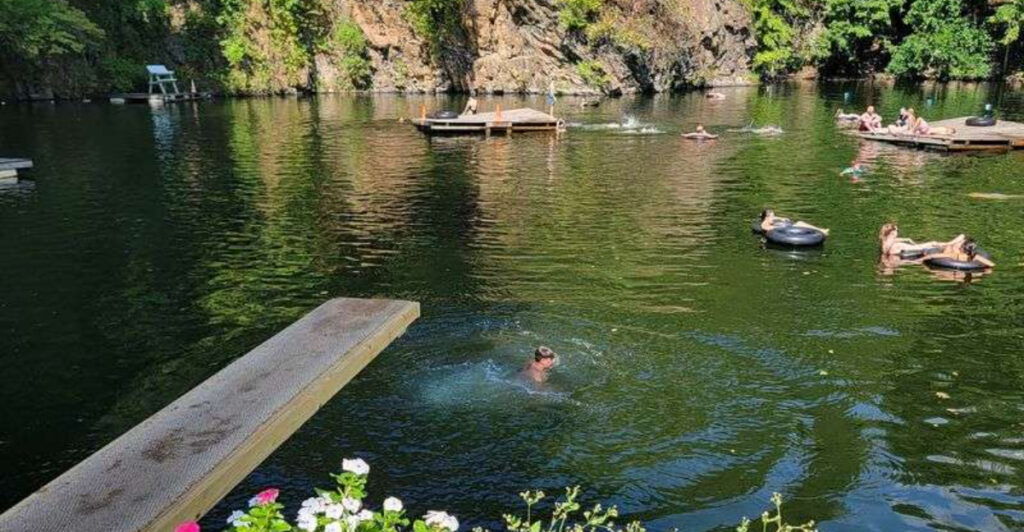
A 12-foot diving board over dark, spring-fed water is not the first thing most people picture when someone says “New Jersey swim day.” Yet that is exactly the setup at Hopewell Quarry, where a former stone pit on Crusher Road has been turned into one of Mercer County’s strangest and most memorable summer hangouts.
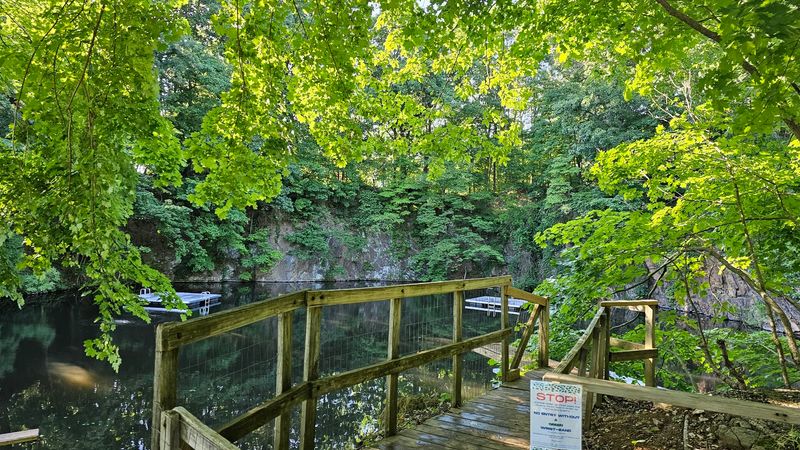
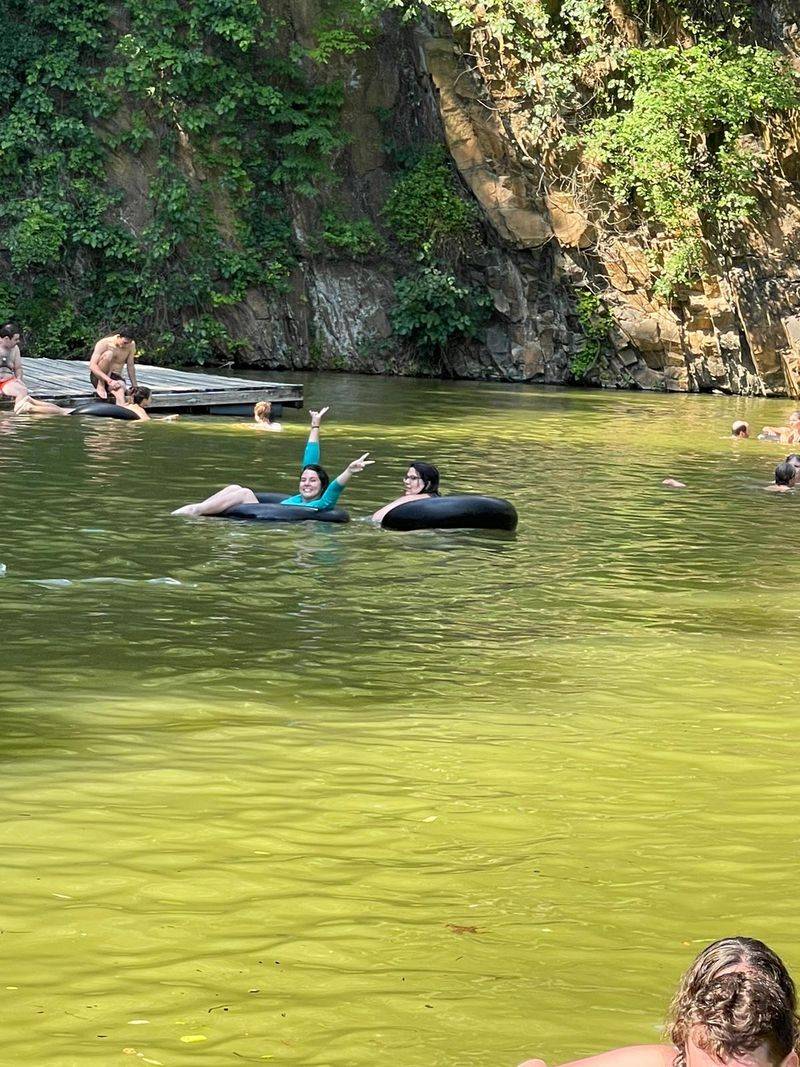
The water fills a one-acre quarry surrounded by rock and trees, and swimmers can paddle out to floating platforms, drift in inner tubes, or work up the nerve for the highest board.
There is also a separate shallow pool, which makes the property far more family-friendly than its rugged setting first suggests. Best of all, the place still feels rooted in its local history.
People have been cooling off here for roughly a century, long before “hidden swimming hole” became the kind of phrase people searched for on their phones. Hopewell Quarry is old-school summer fun in a setting that genuinely earns the description.
Why Hopewell Quarry Is Unlike Any Other Swimming Spot in New Jersey
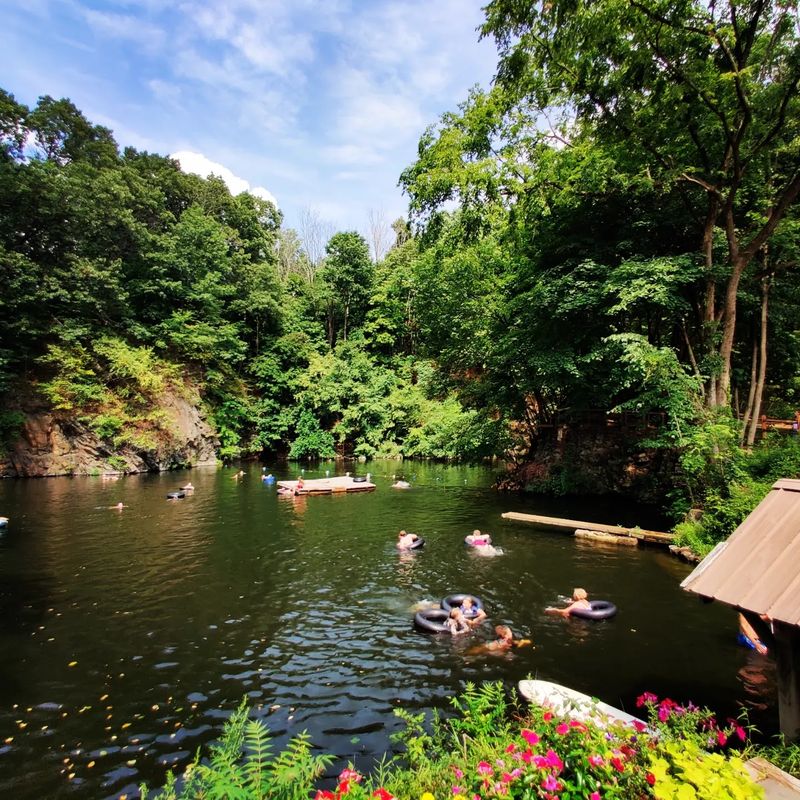
Drive onto Crusher Road and the clue is right there in the name. This is not a landscaped pond dressed up to look rustic.
The swimming area occupies a former rock quarry in Hopewell Township, with steep stone edges, deep water, and trees pressing in around the site. The quarry itself covers about an acre, while the surrounding recreation area spreads across roughly three acres with picnic space and other amenities.
That combination makes it feel very different from the municipal pools, lake beaches, and Shore towns that usually dominate New Jersey summer plans. The biggest difference is the water.
Hopewell Quarry is spring-fed, and the swimming area reaches roughly 30 feet deep today. There is no broad sandy shoreline where you can casually wade farther and farther out.
Once you are in the quarry, you are dealing with genuine deep water, which is why the rules are stricter than they would be at a typical pool. Lifeguards are stationed at both the quarry and the separate pool, and younger swimmers must prove they are capable before entering the main swimming hole.
That seriousness does not make the place feel stiff. Quite the opposite.
Free inner tubes bob around the water, three large floating platforms give swimmers somewhere to pause between laps, and diving boards rise 2, 7, and 12 feet above the water. The result lands somewhere between a neighborhood swim club and the summer-camp swimming spot you wished you had as a kid.
There is enough structure to keep the day organized, but the rock walls and dark water constantly remind you that this place was never built as a swimming pool. In a state with no shortage of places to cool off, that is what gives Hopewell Quarry its personality.
How an Old Rock Quarry Became a Beloved Summer Swimming Hole
Long before there were inner tubes and lifeguard whistles, this patch of Hopewell was a working stone quarry. Mining continued into the early 1900s, and crews had to pump away groundwater as they dug into the hillside.
When quarrying stopped in 1916 and the pumping equipment was removed, underground springs began reclaiming the pit. The abandoned hole filled with water, reportedly reaching an initial depth of about 55 feet.
That could have been the end of the story. Instead, local kids noticed.
By the 1920s, the flooded quarry had become the kind of unofficial swimming hole that spreads by word of mouth. Young people walked, biked, and even hitchhiked there during the summer.
Historic accounts describe swimmers getting around a rickety fence to reach the water, which tells you plenty about both the appeal of the place and the very different safety standards of the era. As crowds grew, admission followed, and the Quarry Swim Club was incorporated in 1928.
The site gradually became more formal without losing its basic character. An in-ground pool was added in 1946, followed by changing facilities, an admissions booth, and a refreshment building.
During the late 1940s and early 1950s, the club and the American Red Cross even staged summer Water Carnivals with diving competitions, boating demonstrations, and water-safety programs. The quarry kept passing from one generation of caretakers to another.
Nancy and Jim Gypton ran it from 1988 through 2021, adding picnic tables, charcoal grills, a pavilion, dressing rooms, and a sand volleyball court while preserving the old-fashioned feel. Then, in August 2021, the nonprofit Friends of Hopewell Quarry purchased the property.
That move protected it as open space and kept a local swimming tradition alive instead of allowing a century-old summer ritual to disappear behind a “private property” sign.
What Makes Swimming in the Quarry Such a Unique Experience
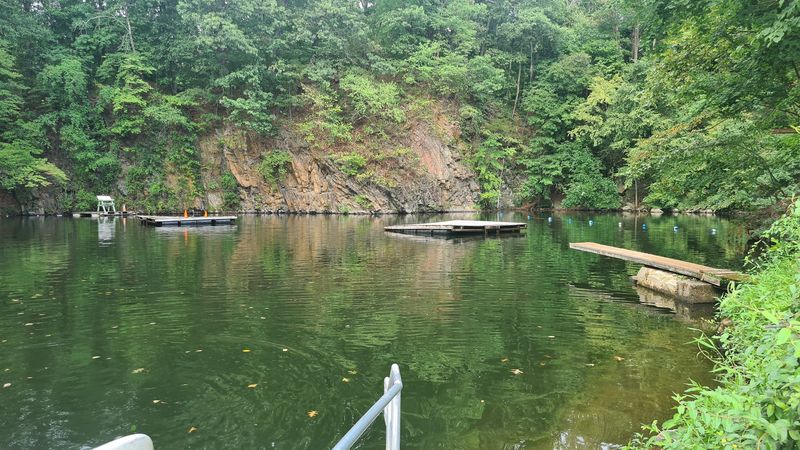
The first jump is the one you remember. You leave the board, get a quick flash of rock wall and treetops, then hit water that looks and feels nothing like the bright blue rectangle at the neighborhood pool.
That contrast is the whole Hopewell Quarry experience. The place has the familiar pieces of a swim club, but they are arranged around a spring-fed former excavation instead of a concrete basin.
Swimmers can head for three large floating platforms anchored in the quarry, grab one of the free inner tubes, or take turns on the diving boards. The boards are set at 2, 7, and 12 feet, so there is a natural progression from an easy hop to the kind of jump that makes you reconsider your confidence halfway up the ladder.
The quarry’s rock walls make the setting dramatic, but the actual swimming is carefully controlled. Guests are not supposed to swim near the cliffs or hang around beneath the diving boards, and lifeguards keep watch over the water.
One detail families should notice is the separate pool. It slopes from about 1.5 feet to 4 feet deep and gives non-swimmers and younger children a much more manageable place to splash around.
That matters because the quarry itself is not designed for tentative swimmers. There is no shallow end to retreat to, and flotation devices do not turn a non-swimmer into someone who is allowed in the main quarry.
That split gives the property an unusual rhythm. Strong swimmers can spend an afternoon moving between the platforms, boards, and tubes, while less confident swimmers still have their own water space nearby.
You can be having a classic family pool day and, a few yards away, watch someone launch from a 12-foot board into a flooded stone pit. There are not many places in New Jersey where those two experiences happen in the same afternoon.
The Swim Test That Helps Keep the Deep Water Safe
Before a child or teenager gets access to the quarry, there is a very practical question to answer: can they actually handle deep water? Anyone ages 7 through 17 must pass Hopewell Quarry’s swim test before entering the main swimming hole, and the test is deliberately more demanding than a quick lap across a shallow pool.
First comes an approximately 80-yard swim using either the crawl or breaststroke. The stroke has to be performed properly, and swimmers cannot stop, touch the bottom, or grab onto anything along the way.
Doggy paddle and backstroke do not count. That may sound strict until you remember the basic problem the test is designed around: in the quarry, a tired swimmer cannot simply stand up and catch a breath.
The second part is three minutes of treading water near the lifeguard stand. The swimmer must keep their chin above the surface without leaning the head back into the water.
Staff use the memorable instruction to “wear the water like a necklace,” which is a pretty effective way to explain the body position they want to see. Passing both portions shows that a swimmer has enough endurance and control to be in a deep, open swimming area.
There is no same-day do-over if a swimmer fails, so this is not something to treat as a formality on arrival. The good news is that once a child passes, their name is recorded and they do not have to repeat the test on later visits.
Children under 7 are not permitted in the quarry at all, regardless of swimming ability, though the separate shallow pool gives families another option. It is a firm policy, but at a swimming hole with no gradual shallow section, the logic is easy to understand.
The quarry is fun precisely because it is unusual, and the rules acknowledge that unusual water demands better swimming skills.
There Is More to Do Here Than Just Take a Swim
By midafternoon, even the person who insisted they could swim “all day” is usually ready for dry land. Hopewell Quarry is set up for that part of the visit, too.
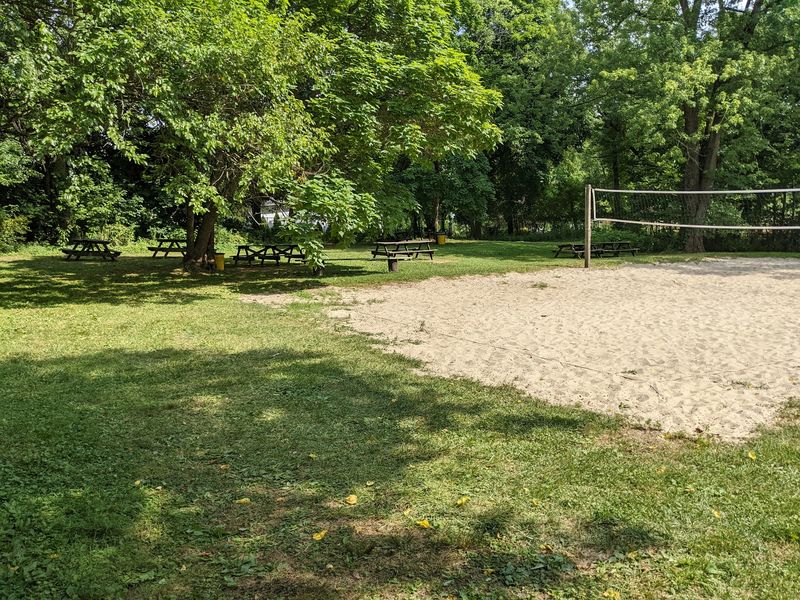
The swimming hole sits within a roughly three-acre park area where trees provide shade over picnic tables and grills, giving families room to spread out rather than crowding around the water’s edge.
The sand volleyball court is an easy way to turn a swim day into a mildly competitive family tournament, and there are lawn games around the property as well.
Volleyballs, footballs, and Frisbees are available for use on site. A pavilion adds another place to get out of the sun, and the grounds still have the casual picnic-club character that longtime visitors helped shape over the decades.
Food is intentionally low-key. Guests can buy snacks, drinks, and local ice cream on site, and food trucks sometimes appear on weekends depending on the event schedule.
You are also welcome to bring your own food and nonalcoholic drinks, which makes the quarry a good candidate for the classic cooler-and-sandwiches approach. One important distinction: use the grills provided on the property rather than bringing a personal grill, which is prohibited under the current rules.
Alcohol is not allowed anywhere on the grounds, including the parking area. The quarry also hosts swim lessons and occasional community programming beyond ordinary open-swim hours.
Still, the best non-swimming activity may be doing very little. Find a shaded table, let your towel dry, listen to the periodic splash from the diving boards, and watch the tubes drift across the water.
Hopewell Quarry does not need a giant water slide complex or a row of arcade machines to fill an afternoon. The appeal is having enough to do without turning a simple summer swim into an itinerary.
What to Know Before Spending a Summer Day at Hopewell Quarry
Hopewell Quarry is at 180 Crusher Road in Hopewell Township, and summer visits require a little more planning than simply tossing a towel in the car. The swimming season runs from Memorial Day weekend through Labor Day.
During the main summer schedule, the facility is open Monday through Wednesday from noon to 6 p.m., Thursday and Friday from noon to 7 p.m., and Saturday and Sunday from 11 a.m. to 6 p.m. Saturday mornings from 9 to 11 are reserved for adults 18 and older.
Water access ends 15 minutes before the facility closes. Capacity is capped at 300 people.
Day passes can be bought in advance, which matters on busy weekends because arriving without a ticket does not guarantee immediate entry once the property is full.
Season passes are also available; current full-season prices are $430 for an individual adult, $695 for a couple, and $905 for a family of up to six people, with additional junior, child, and half-season options offered at checkout.
Pack for a picnic-style day rather than a resort visit. Bringing food, nonalcoholic drinks, lounge chairs, and extra lawn games is fine.
Leave pets, glass containers, alcohol, and personal grills at home. Families with younger swimmers should also remember the quarry rules before promising anyone a turn on the diving board: ages 7 through 17 need to pass the swim test, and children under 7 cannot enter the quarry itself.
Weather can change the plan. Thunder or lightning clears both the quarry and pool, and the facility generally waits 30 minutes after the last strike before reopening the water.
That combination of deep-water rules, limited capacity, and weather policies is worth checking before departure.
Once those practical details are handled, what remains is refreshingly simple: a towel on the grass, a cold drink under the trees, and a former industrial pit that has spent roughly a century becoming one of Hopewell’s favorite places to swim.