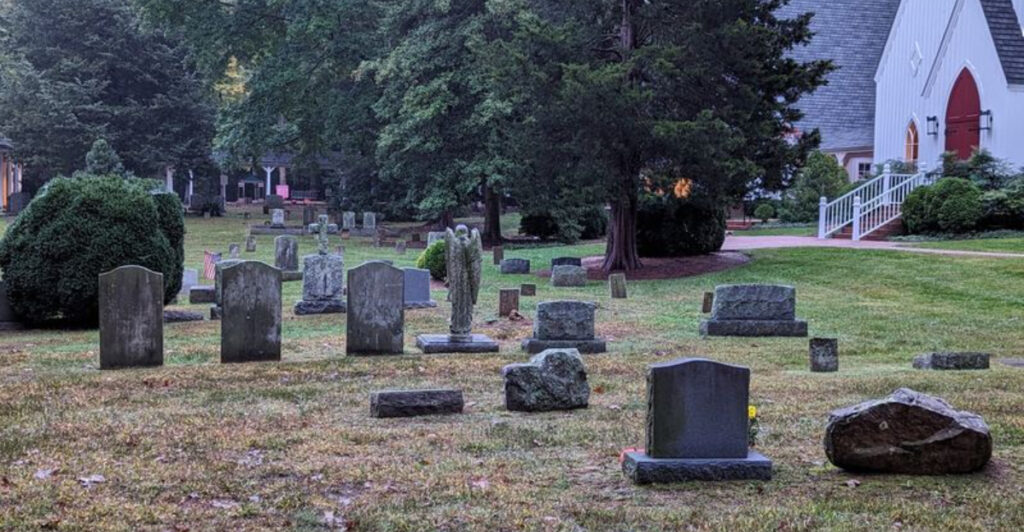
The wooden gate at St. Mary’s has a slightly ominous bit of trivia attached to it. It is a lych gate, a traditional churchyard entrance whose name comes from an old English word for “corpse.” Walk beneath it, though, and the scene is far more peaceful than spooky.
Weathered gravestones lean beneath mature trees, dates from the early 1700s appear on worn stone, and two very different churches rise on either side of the burial ground. This is St. Mary’s Episcopal Churchyard in Burlington, a place where New Jersey’s colonial story is packed into a remarkably small patch of ground.
The property at 145 West Broad Street contains graves connected to Revolutionary soldiers, governors, clergy, and national political figures, while Old St. Mary’s itself dates to the opening years of the 18th century. Even the entrance has history: the lych gate was built in 1883 as a memorial to Stephen Germain Hewitt.
A Churchyard That Predates the American Revolution
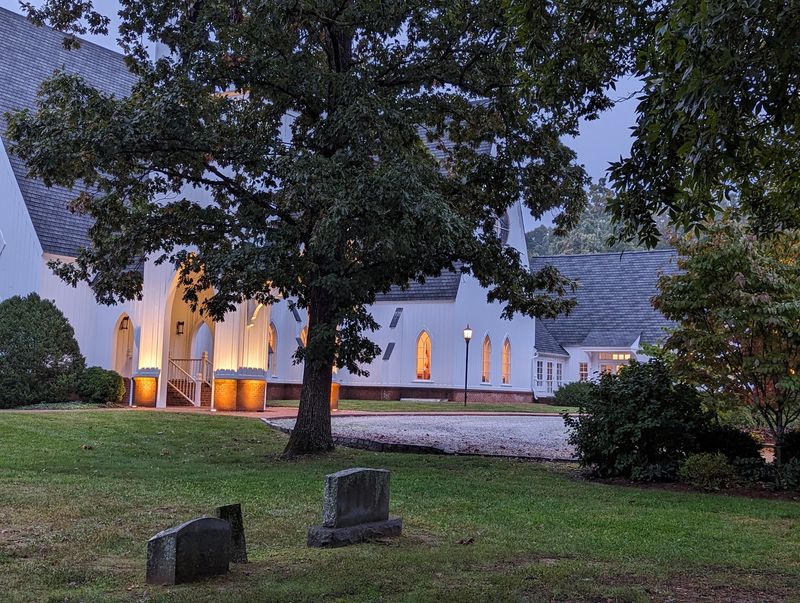
The date to remember here is 1695. That July, John Tatham, Edward Hunloke, Nathaniel Westland, and several others purchased land beside what is now Wood Street specifically to serve as a Christian burial ground.
That puts the churchyard’s beginnings more than 80 years before the Declaration of Independence and before plenty of places we casually label “historic” had even entered the picture. Additional land acquired in 1702 made room for a church, and construction on Old St. Mary’s began the following year.
Its cornerstone was laid on March 25, 1703, with the first service held that August. Burlington was a fitting place for an ambitious new Anglican parish.
The city had been the capital of West Jersey, one of the two political divisions that existed before East and West Jersey were reunited as a royal colony. The surrounding population was heavily influenced by Quaker settlement, making an Anglican church an especially interesting piece of Burlington’s religious landscape.
St. Mary’s eventually became what the parish describes as New Jersey’s oldest continuously active Episcopal parish. The burial ground came first, however, and that order matters when you walk through it.
This was not a decorative cemetery added around an old church after the fact. People were setting aside this ground for the dead before Old St. Mary’s walls rose beside it.
Burials from those earliest years may now be unmarked or impossible to identify, but surviving stones begin in the first decade of the 1700s. In a state packed with Revolutionary landmarks, St. Mary’s manages to reach even farther back, into a New Jersey that was still sorting out what it was going to become.
Weathered Gravestones Tell Stories From Colonial New Jersey
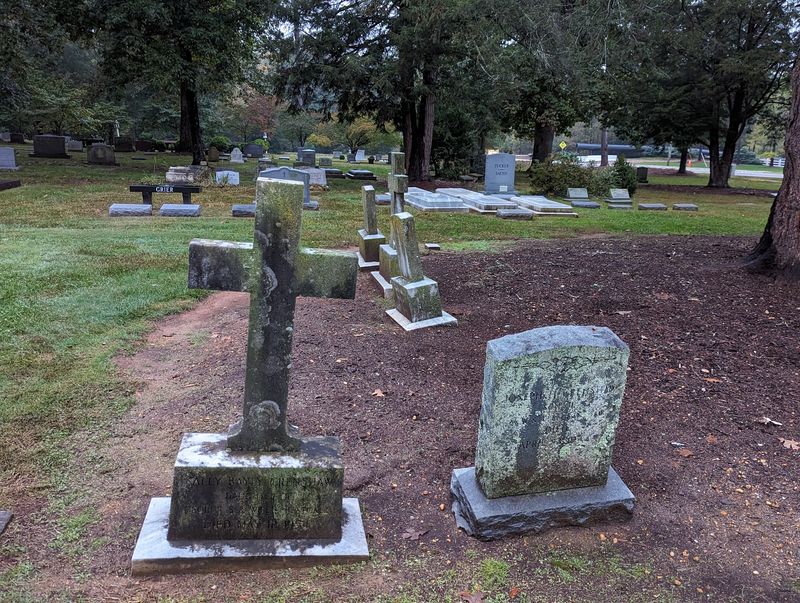
Some of the most interesting names here are not the famous ones. Look for the early Steward family markers and the churchyard starts to feel less like a collection of monuments and more like a surviving document.
Mary Steward’s gravestone dates to 1706, while Edman Steward’s dates to 1707, making them the earliest legible stones identified in the churchyard. Their design is distinctly of its time.
The arched markers include carved pilasters and an hourglass, the latter serving as a fairly blunt reminder that life moves quickly. Colonial gravestone carvers were not known for subtle messaging.
Those details reward a slower walk. Lettering on old stones may be softened by three centuries of rain, frost, heat, and biological growth, and the churchyard includes markers from several different periods rather than one neatly preserved era.
That gradual shift in carving styles is part of the appeal. Early stones emphasize mortality with symbols and compact inscriptions; later memorials become larger and more elaborate as Burlington and its families changed.
The grounds themselves changed too. Although the original burial property dates to 1695, St. Mary’s expanded the churchyard several times during the 19th and 20th centuries.
That means a walk between the markers is not strictly a colonial experience. You are moving through layers of local history, with the earliest 18th-century stones sharing space with memorials from generations that followed.
Some graves belong to people whose biographies made it into history books. Others preserve little more than a name, a relationship, and a date.
In a way, those quieter stones make the place more compelling. Political history tells you who held office and fought in wars. A centuries-old family marker reminds you who actually lived here.
Patriots and Prominent Early Americans Rest Beneath These Grounds
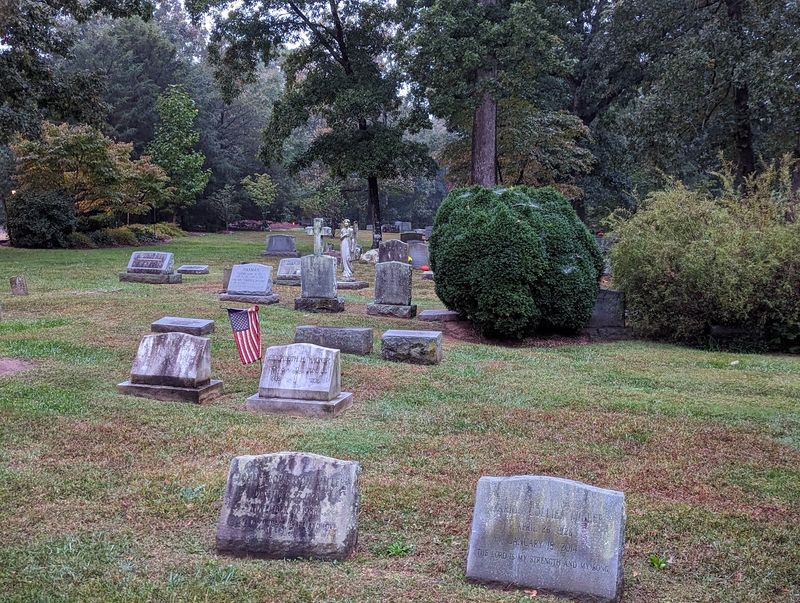
You could build a respectable early-American-history syllabus around the names at St. Mary’s. Elias Boudinot alone gives you plenty to work with.
A lawyer and Revolutionary patriot, Boudinot represented New Jersey in Congress and served as president of the Confederation Congress from November 1782 to November 1783, a period that included the signing of the Treaty of Paris ending the Revolutionary War.
He later represented New Jersey under the new federal Constitution and served as director of the U.S. Mint. Nearby is William Bradford, Boudinot’s son-in-law, who fought during the Revolution and later became U.S. attorney general under George Washington.
Joseph Bloomfield brings the story closer to home. He entered the Continental Army as a captain in the Third New Jersey Regiment in 1776, later became New Jersey attorney general, and was elected the state’s fourth governor in 1801.
Burlington ties run through his career as well, and the North Jersey town of Bloomfield eventually took his name. St. Mary’s also preserves a more complicated Revolutionary story than a simple parade of patriots.
The parish itself was split by the conflict. Figures including Bowes Reed, Bloomfield, and Charles Read supported independence, while other parishioners remained loyal to Britain.
William Franklin, New Jersey’s final royal governor and Benjamin Franklin’s son, worshiped here and stayed loyal to the Crown, as did St. Mary’s rector Jonathan Odell. Even the placement of certain burials tells you something about status.
First rector John Talbot and Colonel Daniel Coxe were not buried out among the headstones at all; they received the old privilege of burial inside Old St. Mary’s. This is the sort of place where one grave can send you down a historical rabbit hole before you have walked 20 feet.
Old St. Mary’s Has Watched Burlington Change for Centuries
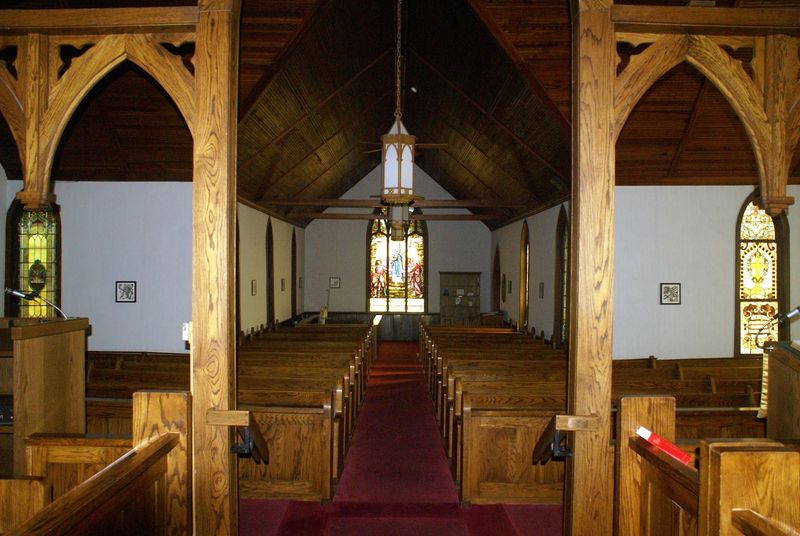
Imagine Burlington in August 1703, long before Route 130 traffic, riverfront condos, or anything resembling the modern city. George Keith, a former Quaker who became an Anglican missionary, preached the first service in the unfinished St. Mary’s church that summer before the governor and assembled guests.
The building was modest, but it would not stay that way. As Burlington grew, so did the church. A major 1769 renovation expanded the structure, added a west gallery and belfry, and moved the entrance. The bell installed during that work still hangs in the belfry.
Architect Robert Mills, later known for major public buildings including the Washington Monument, worked on further alterations in 1810 and 1811, adding the five-sided apse. More additions in 1834 and 1835 gave the old building its cruciform form.
Those physical changes mirror what was happening outside its walls. Burlington had started as a major Quaker settlement and capital of West Jersey, became caught up in Revolutionary divisions, and continued developing into a busy 19th-century community on the Delaware.
St. Mary’s moved through all of it. Its congregation included royal officials before independence and civic leaders after it.
Bishop George Washington Doane later used Burlington as a base for an ambitious burst of religious and educational activity, establishing St. Mary’s Hall for girls in 1837 and Burlington College for young men in 1846. Old St. Mary’s eventually became too small for the congregation, but it was never discarded.
Today it remains part of the active parish and is used for summer worship and special events. That continuity is what makes the building especially interesting.
It is not a reconstructed colonial church placed behind velvet ropes. It has been altered, reused, restored, and kept alive by generations living in the same city around it.
The Gothic Church Beside the Graves Adds Another Layer of History
Then there is the spire. Rising about 175 feet above Burlington, New St. Mary’s looks almost startlingly ambitious beside the low, older church and tightly packed gravestones.
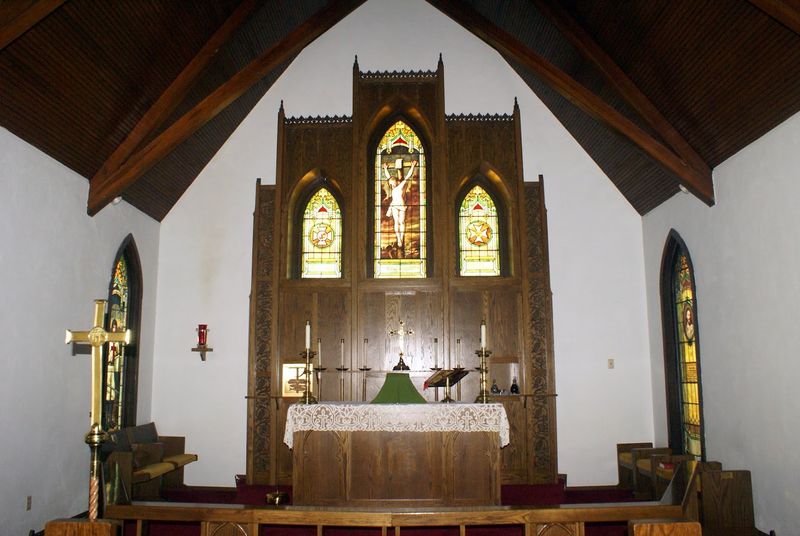
Bishop George Washington Doane commissioned architect Richard Upjohn after the parish outgrew Old St. Mary’s, and the resulting church was constructed between 1846 and 1854. Upjohn was one of the leading figures of America’s Gothic Revival, and New St. Mary’s became one of his most important works.
The building follows an Early English Gothic design, with a cruciform plan, pointed forms, a long nave, substantial stone walls, and that unmistakable tower and spire.
The National Park Service has described the St. Mary’s complex as pivotal to the development of Gothic Revival architecture in the United States, noting that the newer church represented an unusually serious American attempt to follow a specific medieval English model.
It is quite a contrast with Old St. Mary’s. Stand in the churchyard and you can essentially compare two centuries of American church architecture without crossing the street: a small colonial building on one side and a grand 19th-century Gothic statement on the other.
New St. Mary’s has its own scars. On April 15, 1976, heat from a redirected tower floodlight ignited old roof timbers, causing a devastating fire that destroyed much of the interior.
The stone walls and spire survived, as did several important interior elements, and an extensive restoration followed. The church was reconsecrated in 1979 and designated a National Historic Landmark in 1986.
The graveyard may pull you into the 1700s, but one look upward reminds you that this little block kept collecting history long after the colonial period ended.
Why Walking Through St. Mary’s Feels Like Stepping Back in Time
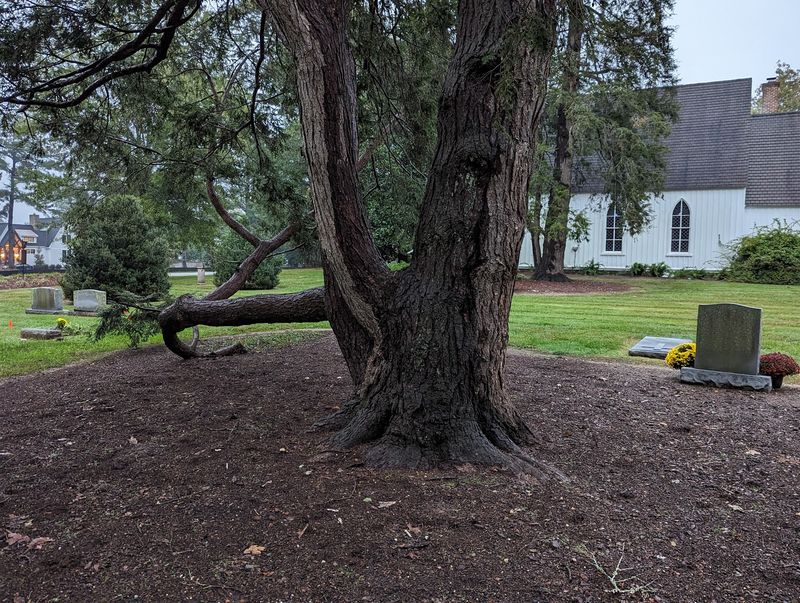
What makes St. Mary’s work so well as a history stop is how little distance separates everything. You enter beneath an 1883 lych gate, pass stones carved when Queen Anne was on the British throne, look toward a church begun in 1703, and then turn around to face Richard Upjohn’s towering 19th-century Gothic church.
There is no sprawling museum campus and no need to imagine where the original buildings once stood. The graveyard sits between the old and new churches, exactly where centuries of parish life accumulated around it.
Even the imperfections help. Stones tilt. Inscriptions fade. Architectural additions from different eras do not line up into one tidy period.
That is what real historic places tend to look like after 300 years of continued use. St. Mary’s is at 145 West Broad Street in Burlington, close to the heart of the city’s historic district.
Anyone hoping to see inside the church buildings should plan rather than simply show up expecting a tour. The parish office currently lists weekday hours from 9 a.m. to 2 p.m. and asks visitors to contact the office to schedule an appointment; Old St. Mary’s is also still used for summer worship from June through September and for special events.
The churchyard itself deserves the unhurried part of the visit anyway. Read the dates. Notice which stones have almost surrendered their lettering to the weather. Look from the restrained old church to the Gothic spire beyond the graves.
Burlington’s colonial past is often explained through documents, maps, and famous names, but here it is much more immediate. It is carved into stone, built into walls, hanging in a centuries-old belfry, and gathered together on one remarkable block of West Broad Street.