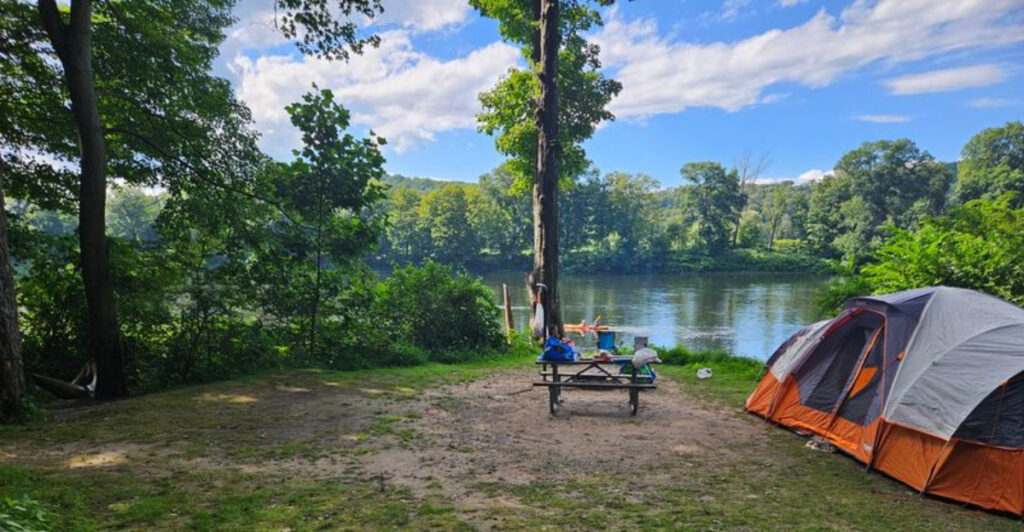
Morning arrives differently when the Delaware River is just beyond your tent. Before the coffee heats up, mist hangs over the water, birds trade calls across the valley, and Pennsylvania sits quietly on the opposite bank.
It is an impressive view for a campsite that costs less than many restaurant entrees. This is Worthington State Forest, a rugged pocket of Warren County where the Kittatinny Ridge rises above more than 6,400 acres of woods.
The campground occupies a particularly beautiful stretch near the Delaware Water Gap, giving overnight guests easy access to river paddling, shaded ravines, and some of northern New Jersey’s most rewarding trails.
You can spend the morning climbing Mount Tammany, slow down beside Dunnfield Creek after lunch, and return to camp while daylight still flickers across the river.
The setting feels wonderfully removed from ordinary life, yet the entrance is only a few miles from Interstate 80. That combination is Worthington’s real trick.
Worthington State Forest Feels Worlds Away From New Jersey
Exit 1 is the final New Jersey exit on Interstate 80, but taking it feels more like slipping through a hidden door. The traffic quickly falls behind, the road narrows beneath the trees, and the broad Delaware begins appearing through gaps in the foliage.
One memorable three-minute traffic signal controls a one-lane section of Old Mine Road, forcing everyone to pause before continuing to the forest office at 2 Old Mine Road in Columbia. Consider it an unofficial transition from hurry mode to hiking mode.
Worthington was established in 1954 after New Jersey acquired land once owned by the family of Charles Campbell Worthington, an industrialist whose former estate helped shape this corner of the Delaware Water Gap.
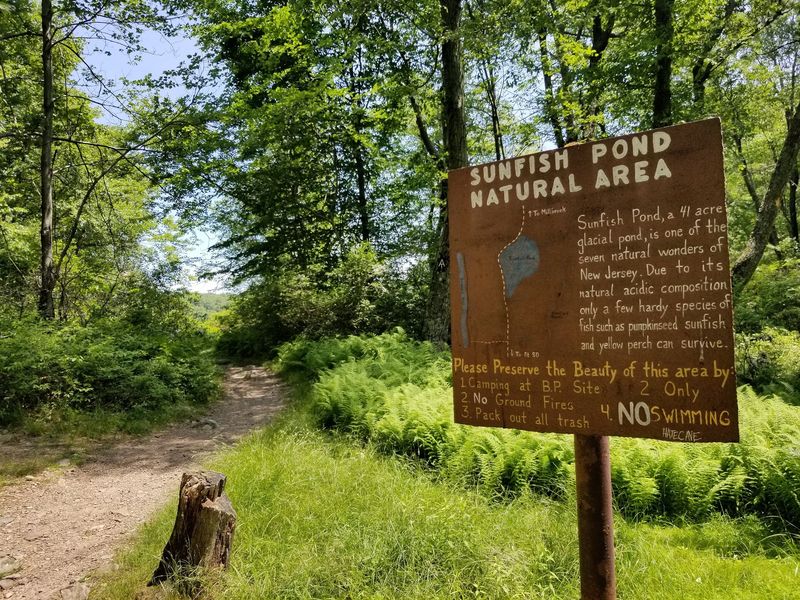
Today, the state forest encompasses more than 6,400 acres and protects two notably wild areas, Dunnfield Creek Natural Area and Sunfish Pond Natural Area.
More than 26 miles of trails cross the property, including a section of the Appalachian Trail. That is a substantial amount of wilderness squeezed against the state line.
What makes the forest especially appealing, though, is how neatly it balances rugged terrain with easy access. You can hear trucks crossing the Gap from certain overlooks, yet down beside a creek or beneath a thick stand of hemlocks, the outside world seems to disappear.
The terrain supplies the drama, with rocky slopes, tumbling water, fern-covered ground, and the steep wall of Mount Tammany rising above the river. The campground adds just enough comfort to make an overnight stay approachable for casual campers.
Flush toilets and showers are available, while picnic tables and fire rings keep dinner from becoming an advanced survival exercise. There are no cabins, resort pools, or organized entertainment schedules.
Worthington’s version of luxury is simpler and considerably harder to manufacture: a river at the edge of camp and an entire mountain waiting beyond breakfast.
Riverside Campsites Make Every Morning Memorable
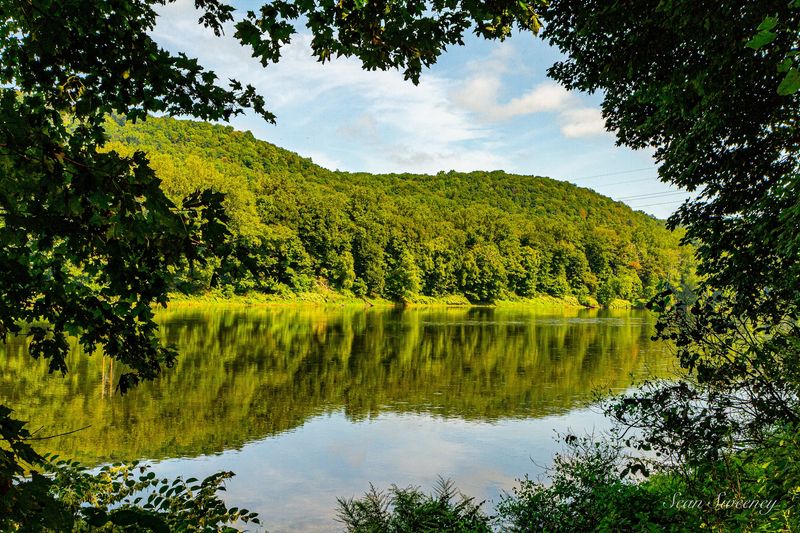
Unzip the tent at sunrise and the first thing you may see is pale light spreading across the Delaware. Several campsites sit close enough to the river for guests to hear it moving after dark, while many others have water views through the trees.
The campground includes smaller tent-only sites as well as family sites that can accommodate tents, pop-ups, and RVs. Do not mistake that RV access for full-service camping, however.
There are no electrical or water hookups, so this remains a pleasantly old-school operation. Each standard site allows up to six people and two vehicles, and most come with the essentials: a picnic table, fire ring, and lantern hook.
Tent-only sites are generally wooded, shaded, and private, with parking immediately beside rather than directly on the campsite. Bathrooms and hot showers are within walking distance, which is welcome news after a sweaty trip up the ridge.
Standard sites currently run $20 per night for New Jersey residents and $25 for nonresidents, making a riverfront weekend remarkably affordable. Reservations made online require at least a two-night stay, and popular summer and fall dates can disappear early.
Tent-only camping generally runs from April 15 through October 31, while the family tent-and-trailer area has a longer season, typically April 1 through December 15. A few practical rules are worth knowing before packing.
Alcohol and swimming are prohibited, and pets are not allowed in the campground, although trained service animals are welcome. Leashed dogs may use the hiking trails.
Black bears also live throughout the region, so food and scented items need to be secured properly rather than left in a cooler beside the tent. These restrictions do not diminish the experience; they protect a peaceful place that already gives visitors plenty.
Once the fire settles into glowing coals and the river darkens beyond the trees, even an ordinary folding chair starts feeling like the best seat in New Jersey.
Dunnfield Creek Leads Into an Ancient Hemlock Ravine
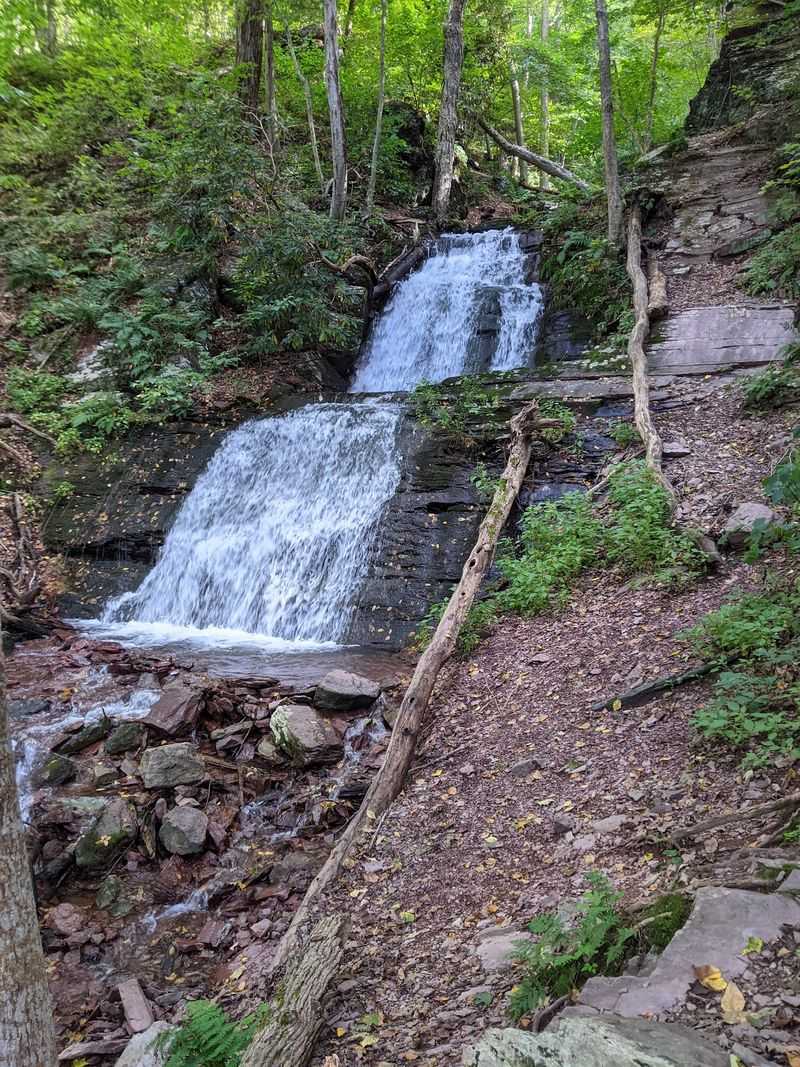
On a warm afternoon, the temperature seems to drop the moment the trail enters Dunnfield Creek Natural Area. Water slips around mossy boulders, hemlock branches soften the sunlight, and the creek provides a steady soundtrack that is far better than anything coming through earbuds.
The blue-blazed Dunnfield Creek Trail begins near the Interstate 80 parking area and follows the water into one of the forest’s prettiest ravines. The early portion is approachable for many hikers, although exposed roots, wet rocks, and uneven ground still demand sensible footwear.
This is not the place to discover that fashion sneakers have no grip. Small cascades appear along the route, including the popular Dunnfield Creek Falls, where water tumbles through a rocky chute surrounded by dense greenery.
Hikers can enjoy the ravine as a shorter out-and-back walk or continue toward Sunfish Pond, roughly 3.7 miles from the trailhead. That longer option involves a steady climb and turns a casual creek walk into a proper half-day hike.
Sunfish Pond sits high on the Kittatinny Ridge and was carved by glacial activity during the last Ice Age. It is often described as New Jersey’s southernmost glacial lake and has long been one of the signature destinations along this section of the Appalachian Trail.
Swimming is prohibited, so the payoff is the sight itself: dark water ringed by rock, mountain laurel, and forest, with no snack bar or paddleboat dock interrupting the scene. Many hikers return by combining the Dunnfield Creek Trail with the Appalachian Trail, creating a loop of more than seven miles.
Back in the ravine, the smaller details remain just as memorable as the pond. Ferns crowd the banks, fallen logs bridge narrow channels, and patches of moss turn the rocks an almost theatrical shade of green.
It feels ancient because, geologically speaking, it is. Camping nearby means there is no need to cram the entire outing between a long drive and sunset. The creek can be explored at the leisurely pace it deserves.
Kittatinny Ridge Delivers the Ultimate Scenic Reward
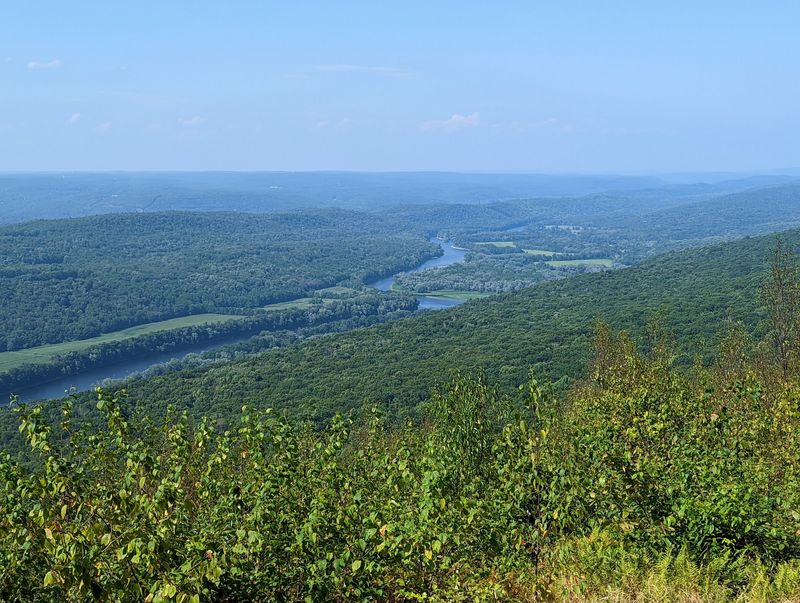
Mount Tammany does not hand out its views for free. The summit rises to roughly 1,527 feet, and the red-dot trail reaches it through a short, steep climb filled with stone steps, boulder-strewn stretches, and enough elevation gain to expose anyone who skipped breakfast.
From the Interstate 80 trailhead, the red-blazed route runs about 1.2 miles to the main overlook. That distance looks innocent on paper.
The mountain has other ideas. The trail gains around 1,200 feet and becomes increasingly rocky as it climbs, so allow more time than the mileage suggests and bring more water than seems necessary.
The reward appears in stages. An early viewpoint offers a preview over the Delaware, but the summit overlook delivers the scene people come for: the river curving through the Gap, Mount Minsi standing across the water in Pennsylvania, and forested slopes filling nearly everything in between.
Cars and trucks on Interstate 80 shrink to toy size below, a useful reminder that the noisy world is still there even when it no longer feels important. Most hikers turn the trip into a loop by descending the blue-blazed Pahaquarry Trail and returning through the Dunnfield Creek corridor.
The complete route is commonly measured at about 3.5 miles. It is generally kinder on the knees than retracing the steep red-dot trail, though “kinder” is doing some work there; the descent remains rocky and requires attention.
Starting early is smart, especially on fair-weather weekends when the trailhead parking lot can fill quickly. Summer hikers should expect heat on exposed rock, while autumn visitors get a sweeping look at the Kittatinny Ridge dressed in red, copper, and gold.
The climb is demanding without requiring technical equipment, which makes it a satisfying centerpiece for a camping weekend. Afterward, returning to a riverside picnic table feels almost decadent.
Shoes come off, dinner tastes better than it has any right to, and the mountain across the campsite is no longer scenery. It is something you earned.
The Delaware River Opens the Door to More Adventure
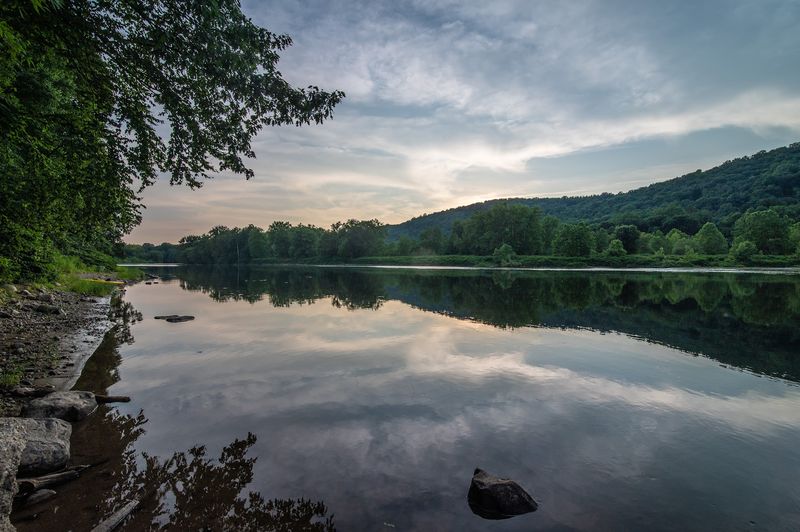
A kayak changes the scale of the entire landscape. From the water, the wooded banks look taller, the Kittatinny Ridge becomes more imposing, and the sky seems to widen over the channel.
Worthington has its own designated river access along the Middle Delaware National Scenic and Recreational River, making the campground a useful stop for paddlers as well as hikers.
This portion of the Delaware is known for long quiet pools interrupted by occasional riffles, so it can feel welcoming to beginners when water and weather conditions cooperate.
That does not make it a lazy river ride. The current, submerged rocks, cold water, and changing conditions demand a properly fitted life jacket and a realistic plan for getting back to camp.
A one-way paddle works best with two vehicles, an arranged shuttle, or service through an authorized local outfitter. For a manageable stretch, Smithfield Beach in Pennsylvania is about two river miles upstream from Worthington.
Kittatinny Point, near the Water Gap, lies roughly four river miles downstream. Longer outings can begin at Poxono Access in New Jersey, approximately four miles above Worthington, or Bushkill Access in Pennsylvania, about 12 river miles upstream.
Those distances make it possible to choose anything from a short float to a substantial day on the water. Fishing brings its own slower rhythm.
Smallmouth bass are a favorite target in the Middle Delaware, and anglers also encounter other warm-water species depending on the season and location. A valid license is required where applicable, and anyone fishing from or toward the opposite bank should understand whether New Jersey or Pennsylvania regulations govern that spot.
The river also provides entertainment without a boat or rod. Bald eagles are seen in the Delaware Water Gap region, while great blue herons often patrol shallower edges with impressive patience.
Back at the campground, watching evening light move across the current can occupy far more time than expected. The river is not merely a pretty boundary beside Worthington.
It is the feature that sets the tempo for the entire stay.
Every Season Brings Its Own Kind of Magic
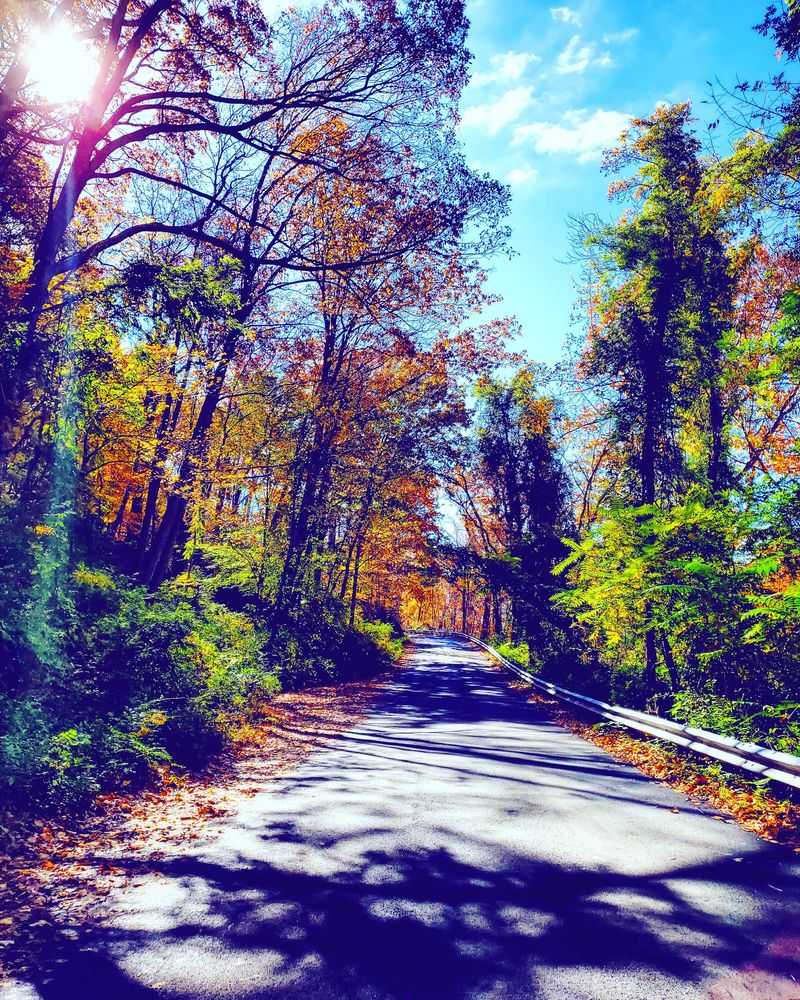
Fall gets most of the attention here, and it certainly knows how to use it. By October, hardwoods along the ridge shift through yellow, orange, scarlet, and deep rust, while the Delaware reflects the color whenever the surface settles.
Cool nights improve sleeping weather, mosquitoes become less ambitious, and a campfire finally feels necessary instead of decorative. It is also one of the busiest periods, so a spontaneous foliage-weekend reservation may require unusual luck.
Spring offers a quieter personality. Dunnfield Creek runs lively after rain, young ferns begin uncurling beside the trail, and mountain laurel eventually brightens the woods.
Temperatures can swing sharply, though, and April nights near the river may feel more like winter than the forecast implied. Summer brings long daylight, full tree cover, and enough time to pair a morning hike with an afternoon paddle.
The shaded ravine is particularly valuable when the temperature rises, but humidity and ticks make repellent, water, and regular clothing checks nonnegotiable. Swimming is prohibited throughout Worthington State Forest, even when the Delaware looks especially tempting.
Winter strips the landscape down to rock, water, and bare branches. The standard campground operates on a limited seasonal schedule, with tent-only sites closed after October 31 and family sites generally closing December 15, but the forest itself remains accessible.
Old Mine Road can confuse navigation apps during this period. The state-managed approach from Route 80 north to the campground stays open year-round, while the National Park Service section farther north closes after the first snowfall or on January 1, whichever comes first.
Snow and ice also turn the ridge trails into serious terrain, so traction gear and winter experience matter. Each season edits Worthington differently without changing what makes it special.
The river remains at the bottom of the valley, the ridge keeps watch above it, and darkness at camp still arrives with the clean smell of wood smoke and moving water.