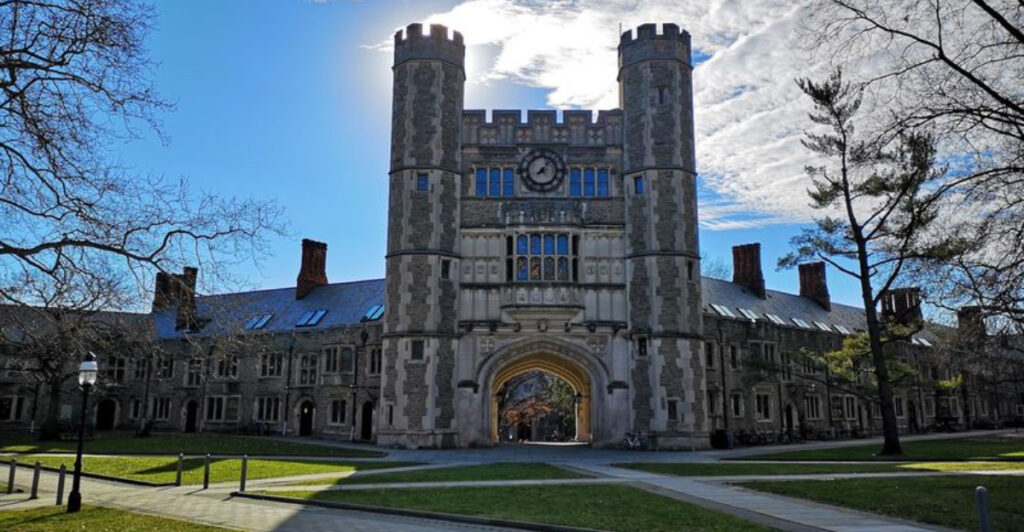
Walk through the doors of Princeton University Chapel and your eyes immediately have a problem: there is simply too much to look at.
Pointed arches climb toward a ceiling nearly 80 feet above the crossing, carved figures hide in the woodwork, and stained-glass panels turn professors, poets, saints, scientists, and presidents into a cast of jewel-colored characters.
Emily Dickinson is here. So are Galileo, Isaac Newton, James Madison, Dante, and John Witherspoon.
The effect feels far older than the building actually is. Completed in 1928, the chapel was deliberately designed to echo the great English Gothic churches of the Middle Ages, right down to its stonework and elaborate imagery.
Yet this is not a museum piece tucked behind velvet ropes. It remains Princeton University’s religious and ceremonial center, sitting beside Firestone Library and just a short walk from Nassau Street.
For anyone who enjoys architecture with details worth hunting for, this place delivers plenty.
Princeton University Chapel Feels Like a Slice of Medieval England
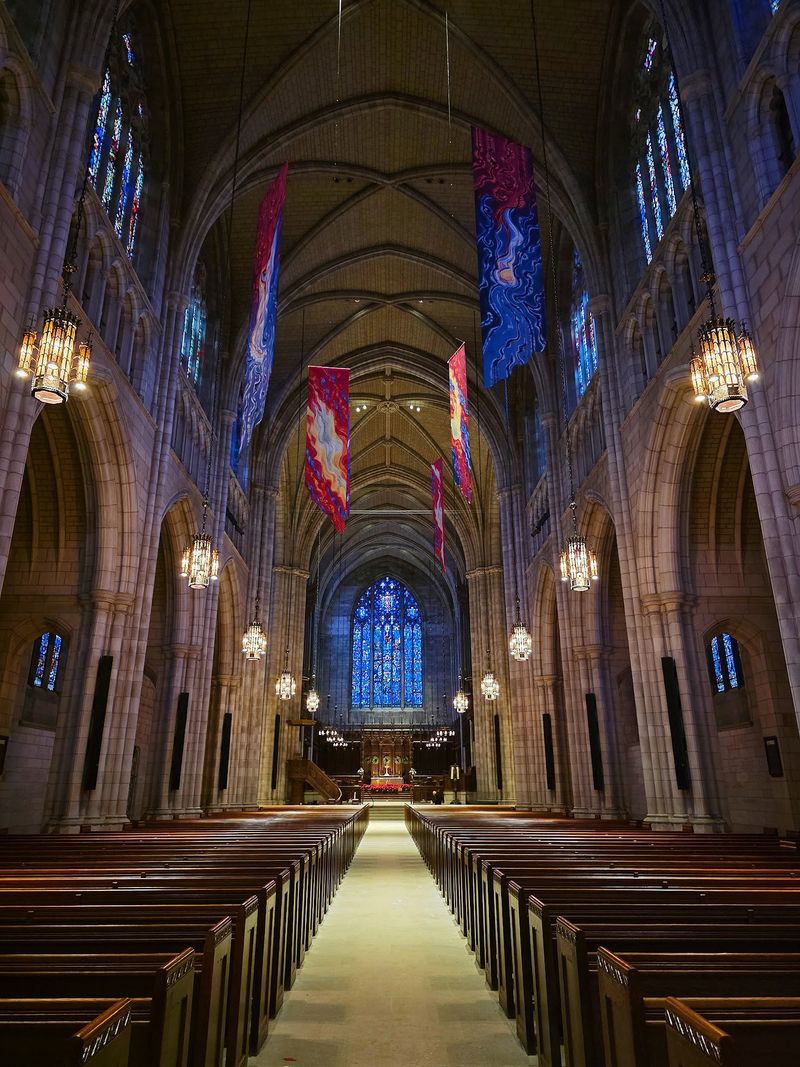
The first clue is the scale. Step into the nave and the ceiling seems to keep going long after you expect it to stop.
At the crossing, the interior rises roughly 78 feet, 6 inches, producing the kind of vertical drama normally associated with centuries-old European churches rather than a university campus in central New Jersey. The illusion was intentional.
Princeton President John Grier Hibben wanted the new chapel designed in a style based on 14th-century English Gothic architecture, and the finished building fit neatly into the Collegiate Gothic look already spreading across campus. The details do much of the convincing.
There are pointed arches, deeply recessed doorways, buttresses, stone carvings, Gothic tracery, dark wood, memorials, and windows divided into narrow panels packed with tiny scenes. Outside, the weathered stone makes the chapel look considerably older than its 1928 completion date.
Inside, the long sightline toward the chancel turns the building into something that feels almost cinematic. The chapel was massive even by university standards when it opened.
It cost more than $2 million to complete and could seat about 2,000 people; Princeton’s history of the building notes that it was then second in size only to the chapel at King’s College, Cambridge. Look closer, though, and the place becomes less like a European copy and more distinctly Princeton.
Memorial stones and inscriptions reference generations of university figures, while the pews, windows, and furnishings weave campus history into the Gothic setting. One particularly odd detail is easy to miss: the oak used for the nave pews had originally been intended for Civil War gun carriages.
That is the chapel in miniature. It looks medieval from across the room, but the closer you get, the more American stories start appearing in the stone, glass, and wood.
The Chapel Rose From the Ashes of a 1920 Fire
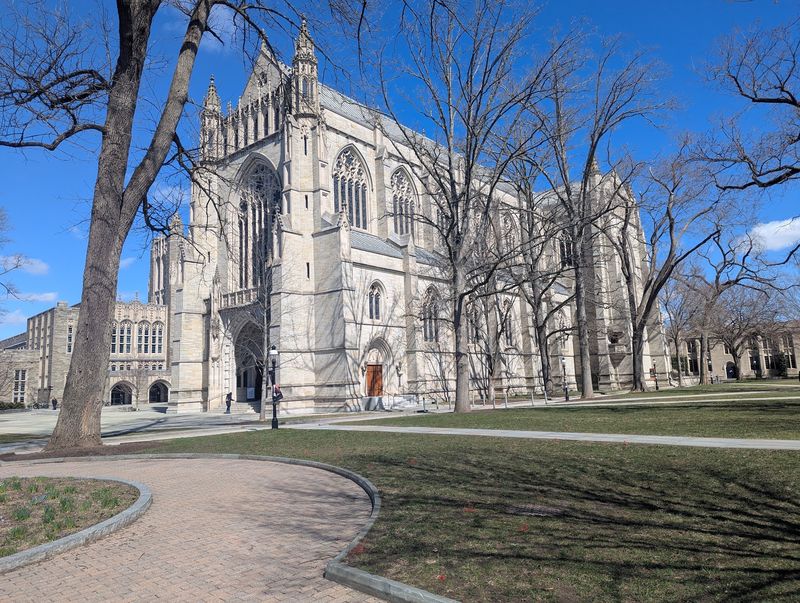
Princeton did not plan to replace its previous chapel quite as suddenly as it ultimately had to. In 1920, Marquand Chapel burned during the university’s house party weekend, wiping out a building that had stood since 1881.
For the next several years, worship services shifted to Alexander Hall while administrators faced the question of what should replace it. The fire was only the latest chapter in a much longer sequence of Princeton worship spaces.
When the institution was still the College of New Jersey, services were held in the homes and churches connected to its early presidents. After the college moved permanently to Princeton in 1756, worship took place inside Nassau Hall.
A separate chapel finally appeared in 1847, followed by the larger Marquand Chapel as enrollment increased after the Civil War. Then came the 1920 fire and another reset.
This time, Princeton went big. President John Grier Hibben appealed for money for a chapel that would acknowledge the university’s religious roots while fitting an institution whose student body and public mission were changing.
The result was not supposed to be simply Marquand Chapel 2.0. It would be larger, more ambitious, and packed with references to religion, literature, history, science, education, and civic life.
Construction stretched through much of the 1920s, and the new University Chapel was formally dedicated on May 30, 1928. That timeline explains one of the most interesting things about visiting today.
The architecture spends considerable energy convincing you that the building belongs to a distant age, but the chapel is unmistakably a product of the early 20th century. It was constructed during an era when American universities were borrowing medieval forms to create a sense of permanence and tradition.
In Princeton’s case, a destructive fire provided the opportunity to build one of the campus’s grandest examples.
Ralph Adams Cram Gave Princeton Its Gothic Showpiece
By the time Princeton needed a new chapel, Ralph Adams Cram was exactly the architect you would hire if subtle modernism was not on the agenda. The Boston-based architect was one of America’s major champions of the Gothic Revival, and Princeton already knew his work well.
The university had hired him in 1906 to help create a campus master plan, and he was responsible for major Princeton projects including the Graduate College.
When Marquand Chapel burned in May 1920, Cram suddenly had the chance to design the kind of monumental Gothic chapel he believed belonged at the center of university life.
His answer was unapologetically medieval in inspiration. The new chapel drew heavily from English Gothic churches of the 1300s, using traditional proportions, pointed arches, buttresses, stone sculpture, rich wood carving, and acres of narrative glass.
Yet Cram was not building a fake ruin. This was a functioning 20th-century building meant for huge university gatherings, weekly services, ceremonies, concerts, and thousands of students passing through over generations.
That tension is part of what makes the architecture fun to examine. From a distance, the chapel reads as one enormous Gothic statement.
Up close, it turns into hundreds of smaller decisions. Faces appear in carved stone. Decorative figures cluster around entrances. Tracery divides windows into elaborate patterns.
Doorways become mini architecture lessons of their own. Princeton’s broader embrace of Collegiate Gothic helped the chapel fit naturally into campus rather than feeling like a medieval-themed surprise dropped onto the lawn.
Blair Hall had already helped establish the style decades earlier, and other Gothic buildings followed. Cram simply pushed the idea much further.
Nearly a century after the chapel opened, his design still does what it was meant to do. You can walk out of busy Princeton, cross a campus filled with bikes, backpacks, and modern research buildings, and enter a room that rearranges your sense of scale within seconds.
The Hand-Cut Stonework Rewards a Closer Look
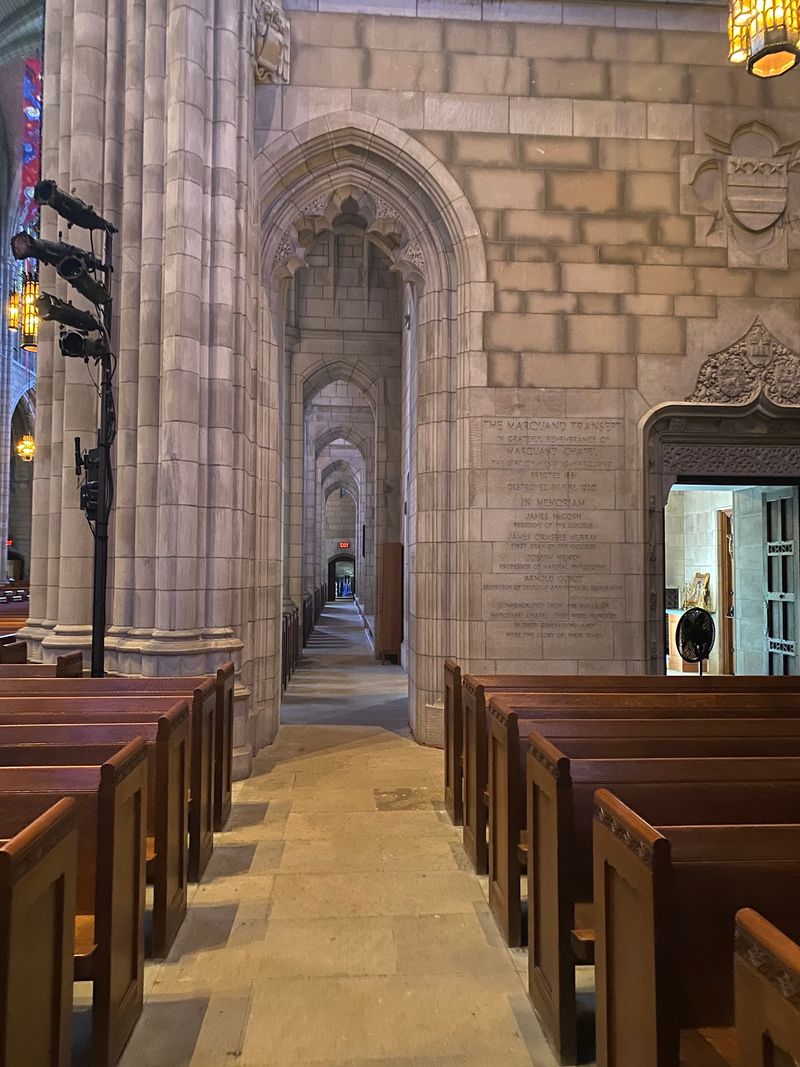
Most people instinctively look up inside the chapel, which is understandable. The arches practically demand it.
But spending the entire visit staring at the ceiling means missing some of the best details at eye level. Gothic design loves hiding things in plain sight, and Princeton’s chapel is full of carved figures, memorial inscriptions, sculptural details, decorated portals, and woodwork that rewards anyone willing to slow down.
Princeton describes scenes of virtues, vices, and biblical stories appearing around the chapel’s portals, while the interior contains memorials to generations of people connected with the university. The craftsmanship continues in the seating.
The chancel pews were made from wood brought from Sherwood Forest in England, and Princeton says their carving required roughly 100 people working for more than a year. The figures worked into those pews include people associated with music, scholarship, teaching, and church history.
Nearby stands another piece that seems to have arrived by time machine: a French pulpit probably dating to the mid-16th century. Before being installed at Princeton, it had reportedly been painted bright red.
The chapel’s stonework has required serious care to survive New Jersey weather. During a major restoration around 2000 and 2001, masonry specialists repaired and repointed the exterior, replacing deteriorated or missing stone and working on damaged carvings.
Stained-glass specialists simultaneously tackled the windows, with roughly 90 percent removed for cleaning, repair, releading, and reinstallation. Maintenance continues on smaller details as well.
Princeton craftspeople have worked in recent years to restore damaged carvings on the chapel pews while matching the original designs as closely as possible. The result is a building where “old” is partly an illusion maintained through an enormous amount of skilled work.
Those battered-looking stones and intricate carvings have not simply been left to age gracefully. People have been carefully keeping the story intact.
The Stained Glass Tells Stories Far Beyond the Bible
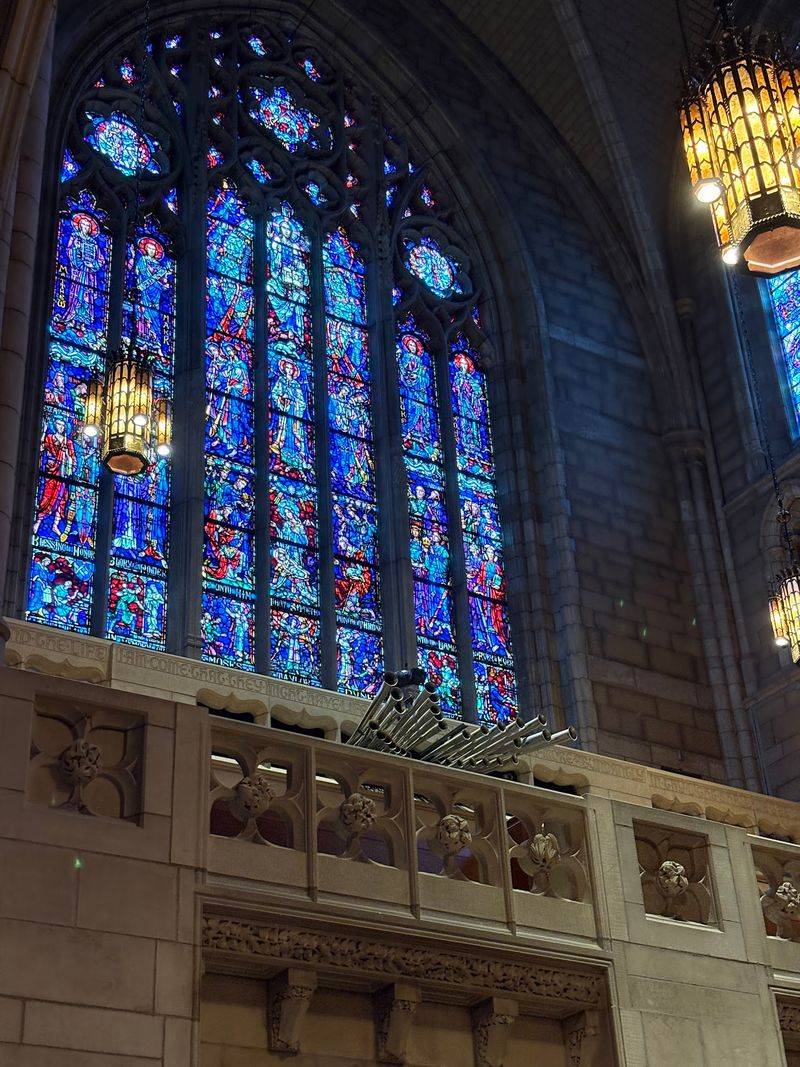
Bring binoculars. That sounds excessive until you spend five minutes trying to identify a tiny poet floating several stories above your head.
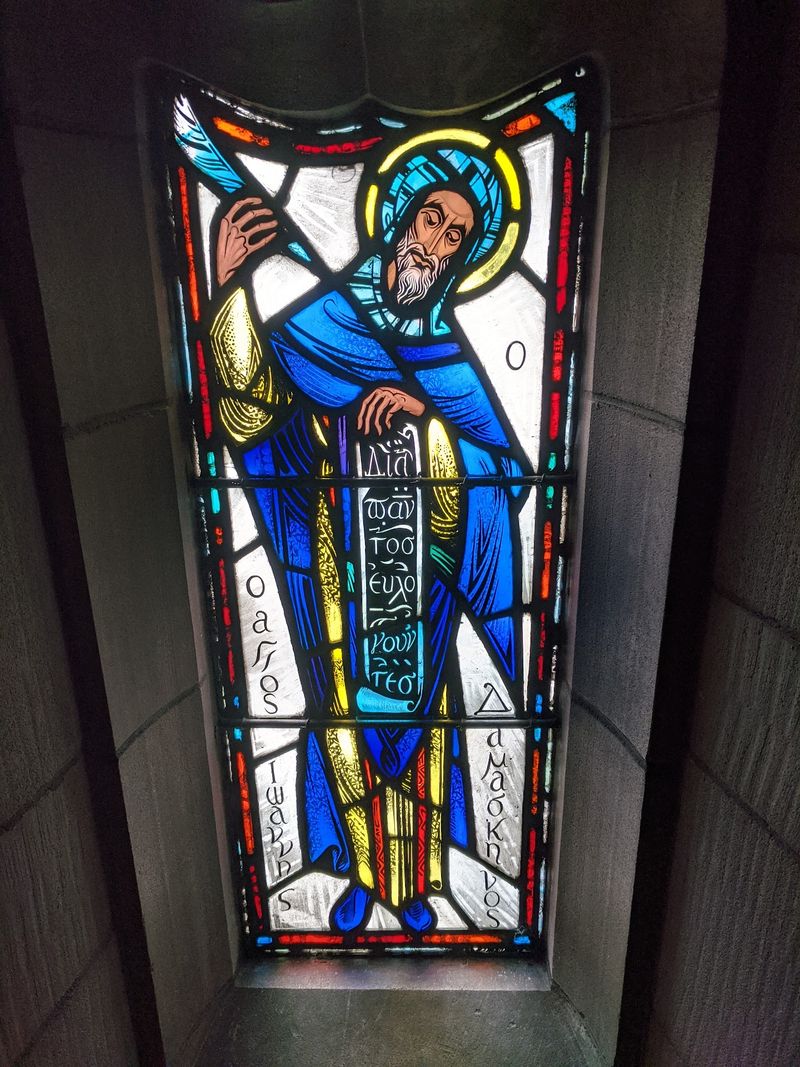
Even Princeton’s own chapel tour suggests binoculars because the stained glass is dense with people, symbols, stories, and details that can be difficult to appreciate from the floor. These are not exclusively biblical windows, either.
One of the pleasures of exploring the chapel is realizing how quickly its cast expands beyond saints and scripture. The Poetry Window includes writers such as Virgil, Dante, Chaucer, Shakespeare, John Donne, Milton, William Blake, T.S.
Eliot, and Emily Dickinson. The science imagery brings in names including Hippocrates, Aristotle, Euclid, Archimedes, Galileo, Pascal, Newton, William Harvey, Louis Pasteur, and Princeton physicist Joseph Henry.
James Madison appears in the Window of the Law, while his Princeton teacher John Witherspoon, a signer of the Declaration of Independence, appears in the Great South Window. Some of the chapel’s richest storytelling sits around the chancel.
Six bays of windows include imagery connected with two Psalms and four major works of Christian literature: Dante’s Divine Comedy, Thomas Malory’s Le Morte d’Arthur, John Milton’s Paradise Lost, and John Bunyan’s The Pilgrim’s Progress. That mix was deliberate.
The glass connects religious ideas with the subjects studied at a university, turning literature, law, science, history, and education into part of the visual program rather than treating them as separate worlds. It also gives visitors a built-in scavenger hunt.
You can spend ten minutes simply enjoying the colors, or much longer trying to spot famous faces and decode what each panel is doing. The windows received a huge conservation effort in 2000 and 2001 involving 27 stained-glass windows, the chapel’s first major stained-glass restoration since its construction.
Look closely enough and the glass stops being decoration. It becomes the chapel’s most complicated book.
What to Know Before Visiting Princeton University Chapel
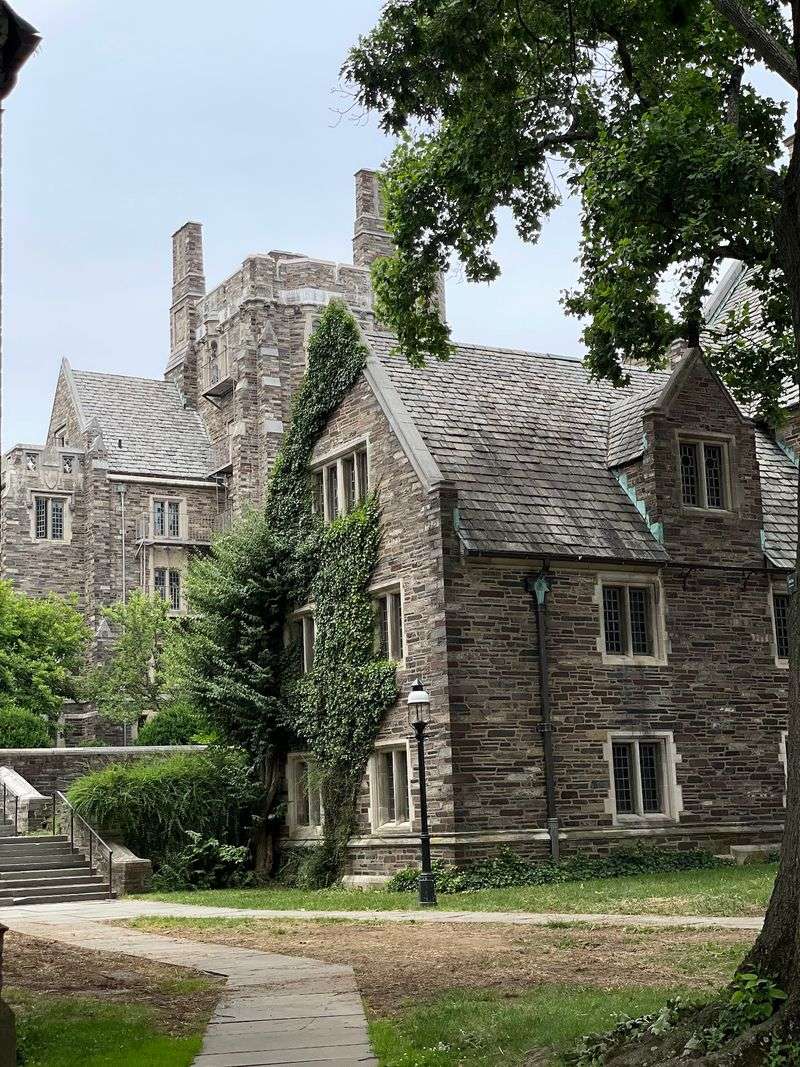
The easiest landmark to use is Firestone Library. Princeton University Chapel sits beside it near Washington Road, in the heart of campus and only a short walk from Nassau Street, which makes it simple to fold into a day spent around downtown Princeton.
There is no general admission fee to step inside during public hours, and people of all faiths are welcome to use the chapel for reflection and prayer. During the academic year, Princeton lists regular chapel hours as 7 a.m. to 11 p.m.; summer hours are typically 7 a.m. to 4 p.m.
The building also has a ramp, ADA doors, and a lift providing access to the restrooms. There is one important temporary wrinkle for anyone reading this in August 2026: the chapel is closed for maintenance from August 3 through August 29 and is scheduled to reopen for services and events on Sunday, August 30.
Because ceremonies, worship services, concerts, maintenance, and university events can affect access, checking the current schedule before making a special trip is sensible. Drivers should also know that parking immediately beside the chapel is not the normal weekday setup.
From 7 a.m. to 4 p.m. Monday through Friday, visitors are directed to Stadium Drive Garage and need to register for a daily visitor permit.
TigerTransit buses run from the garage toward stops on Washington Road, Nassau Street, and University Place. After 4 p.m. on weekdays and throughout the weekend, visitors can use numbered, non-restricted university lots, including Stadium Drive Garage, Theater Drive Garage, and Prospect Avenue Garage.
Once inside, resist the urge to make one quick lap and leave. Give your eyes time to adjust to the darker interior, look behind and above the pews, and scan the glass rather than treating it as colorful background.
Somewhere between the medieval arches, the Civil War-era oak, the French pulpit, and Emily Dickinson hiding overhead, the chapel begins to feel less like one grand monument and more like hundreds of small stories sharing the same roof.