An enormous bronze George Washington kneels beside Paramus Road, his cape gathered behind him and both hands resting on the hilt of a sword. He is not standing outside a museum, courthouse, or Revolutionary War battlefield.
He is guarding the entrance to a cemetery. Beyond him, George Washington Memorial Park unfolds across 98 acres of open lawns, mature trees, fountains, sculptures, and carefully arranged memorial spaces.
The property was created as a final resting place, but it was also designed to offer something meaningful to the people who return: beauty, stillness, and room to breathe. That approach makes this Bergen County landmark feel surprisingly different from a conventional cemetery.
Flush markers leave the landscape open, artwork appears around bends in the road, and water features soften the surrounding quiet. It remains an active place of burial and remembrance, of course, but it is also one of North Jersey’s most unexpected outdoor art environments.
A 98-acre Paramus cemetery designed to feel more like a sculpture garden
Drive through the gates at 234 Paramus Road and the first surprise is how much uninterrupted green space stretches ahead. George Washington Memorial Park covers 98 acres, yet it avoids the dense rows of upright headstones that define many older cemeteries.
Its grave markers must be made from bronze or pink granite and installed flush with the ground, a practical rule that also preserves broad views across the lawns. The result is closer to a landscaped park than a crowded field of monuments.
Curving roads pass Art Deco-inspired structures, formal planting beds, sculptures, fountains, mausoleums, and shaded corners where visitors can pause without feeling boxed in by stone. That openness gives the park’s larger works of art room to make an impression.
A statue can rise against a wall of trees rather than compete with hundreds of neighboring monuments, while a small decorative feature can become the focus of an entire lawn.
The grounds are also the final resting place of several notable figures, including singer Luther Vandross, New York Yankees trailblazer Elston Howard, rapper Big L, and members of the Isley family.
Still, the park does not feel like a celebrity-grave checklist. Its strongest impression comes from the overall composition: art, architecture, horticulture, and memorial space working together.
This remains a functioning cemetery rather than a public sculpture museum, so the atmosphere calls for the same respect visitors would bring to any burial ground. The park welcomes visitors every day of the year from 8 a.m. until dark, providing plenty of time to take in its design without turning the experience into a hurried stop.
The 1939 vision that turned memorial grounds into a sanctuary for the living too
When the association was founded in 1939, its organizers were embracing the memorial-park movement, which favored lawns, controlled landscaping, and low markers over the forest of elaborate headstones found in traditional Victorian cemeteries. The idea was not simply to provide burial plots.
It was to create an orderly, uplifting environment where grieving families could find calm rather than gloom. That philosophy still appears in the association’s description of the property as a place expressing gratitude for life and offering relief from the pressures of the outside world.
The park is operated as a mutual nonprofit, non-sectarian association under the oversight of New Jersey’s Cemetery Board, and its benefactors fund has helped purchase artwork and support continued beautification. Its history, however, also includes a chapter that should not be polished away.
The cemetery originally restricted burial privileges to white people through a discriminatory bylaw and deed covenant. A New Jersey court later ruled that restriction contrary to the state’s public policy, and the cemetery was integrated.
That uncomfortable history adds necessary context to a place that now describes itself as non-sectarian and dedicated to providing comfort to all relatives and visitors. The choice of George Washington as its namesake was closely tied to local geography as well.
Washington and Continental forces moved repeatedly through Bergen County during the Revolutionary War, and the association emphasizes the land’s connection to the country’s founding era. Over time, the initial memorial-park concept expanded through fountains, sculpture, architecture, and landscape design.
What began as a new kind of cemetery in 1939 gradually became something broader: a carefully maintained refuge intended not only for those buried there, but also for everyone carrying flowers, memories, questions, or simply the need for a few undisturbed minutes.
A monumental kneeling George Washington statue anchors the landscape
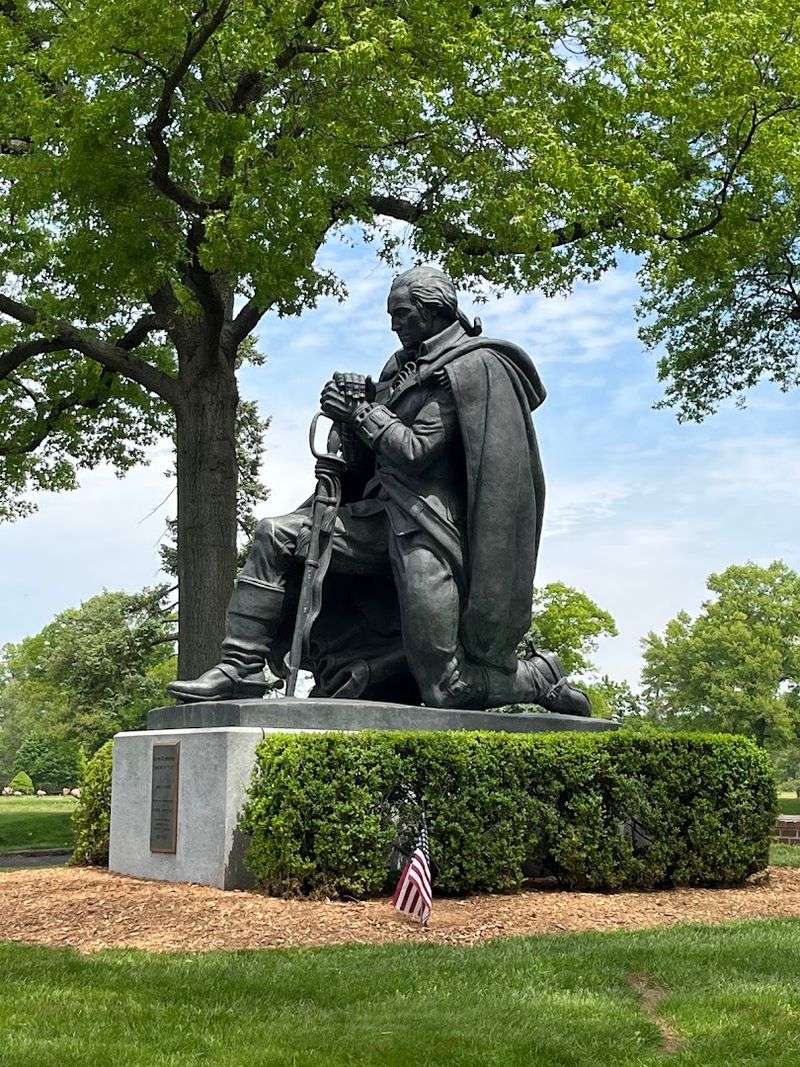
The park’s signature monument does not portray Washington charging into battle or posing triumphantly on horseback. Instead, he is down on one knee, head bowed, cape falling heavily from his shoulders.
His hands meet over the handle of a sword whose tip rests against the ground, turning the weapon into something closer to a temporary support than a symbol of conquest. The bronze figure stands roughly nine and a half feet tall on a three-foot granite base and weighs more than three tons.
Even at that scale, the pose feels restrained rather than boastful. That contrast is precisely what makes the sculpture so memorable.
Washington was usually represented in public art as a commanding general or dignified statesman, but here he appears caught in a private moment of uncertainty and reflection.
The composition draws on the enduring Valley Forge story that Washington withdrew into the woods to pray during the Continental Army’s brutal winter encampment.
The tale is associated with early biographer Mason Locke Weems and cannot be treated as a firmly documented eyewitness account, but it became a powerful piece of American visual mythology. At the cemetery, the image works especially well because it focuses on humility, burden, and contemplation instead of victory.
The statue sits near the entrance at Paramus and Century roads, making it difficult to miss and establishing the tone before the wider grounds come into view. A plaque identifies the piece as George Washington Kneeling in Prayer and notes that it commemorated the cemetery association’s 50th anniversary, spanning 1939 to 1989.
It functions as a landmark visible from the road, but up close the small details—the folds of the uniform, the bowed face, the tension in the hands—give the giant figure an unexpectedly human presence.
Donald DeLue created one of the park’s most unforgettable works of art
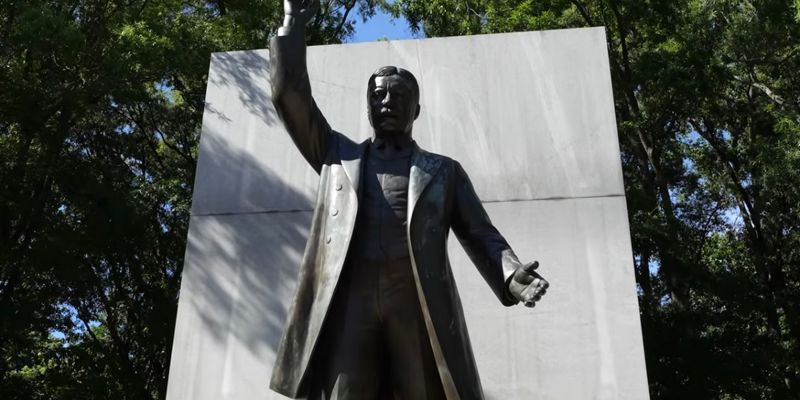
The name Donald DeLue carries serious weight in American monumental sculpture. Born in 1897, DeLue spent nearly half a century creating heroic public works, becoming one of the most prolific monumental sculptors of his generation.
His best-known pieces include Spirit of American Youth Rising from the Waves at the Normandy American Cemetery in France and Rocket Thrower, the soaring bronze figure created for the 1964 New York World’s Fair in Flushing Meadows. New Jersey was home, though.
DeLue lived and worked in the Leonardo section of Middletown, producing powerful, oversized human figures in a studio large enough to accommodate his ambitions.
His Washington design had appeared decades earlier at the Freedoms Foundation in Valley Forge, but the Paramus version became closely associated with the final period of his career.
DeLue died in 1988, shortly before the cemetery’s anniversary monument was installed, and sculptor Granville Carter helped bring the commission to completion.
The finished work bears all the trademarks that made DeLue’s sculpture instantly recognizable: exaggerated physical strength, dramatic fabric, a carefully controlled pose, and an emotional idea that can be understood from a distance.
Yet it also departs from the upward-thrusting energy of Rocket Thrower or the youthful defiance of his Normandy memorial. Washington’s strength is deliberately folded inward.
The general’s body is monumental, but his posture is vulnerable. That makes the sculpture unusually appropriate for a cemetery, where strength and grief often occupy the same space.
It is easy to admire the work simply as an impressive roadside monument, but knowing DeLue’s career turns it into something richer—a late work by a nationally important artist who spent much of his creative life right here in New Jersey.
A griffin sundial and historic memorial tower add unexpected artistic details
Not every artistic feature here announces itself with three tons of bronze. One of the park’s more peculiar treasures sits close to the ground: a metal griffin incorporated into a functioning sundial.
The winged creature appears seated within a crown, which rests above a cross on a circular marble base surrounded by slate paving. Its head supports the sundial’s marker, allowing a mythical beast to perform the very practical job of tracking the movement of the sun.
The artist is unknown, which somehow makes the object even more intriguing. It feels like the kind of strange little detail that rewards anyone willing to slow down and look beyond the largest monuments.
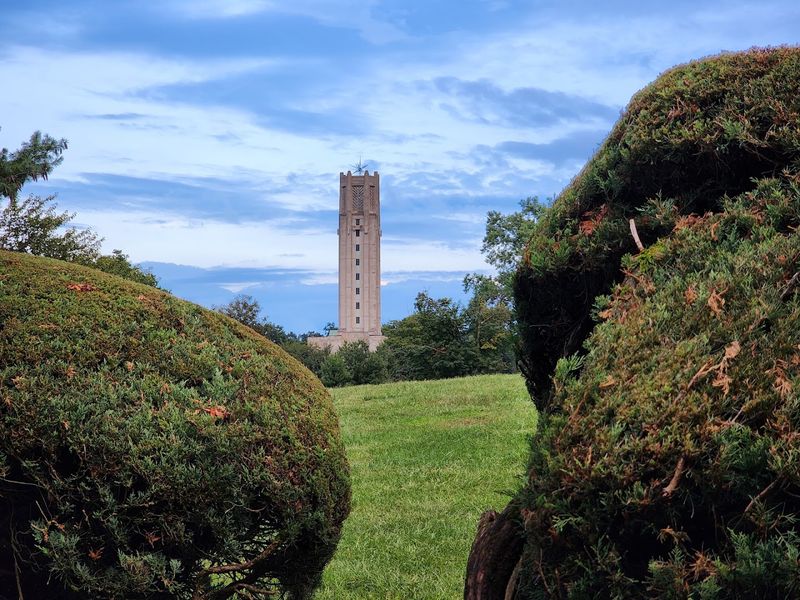
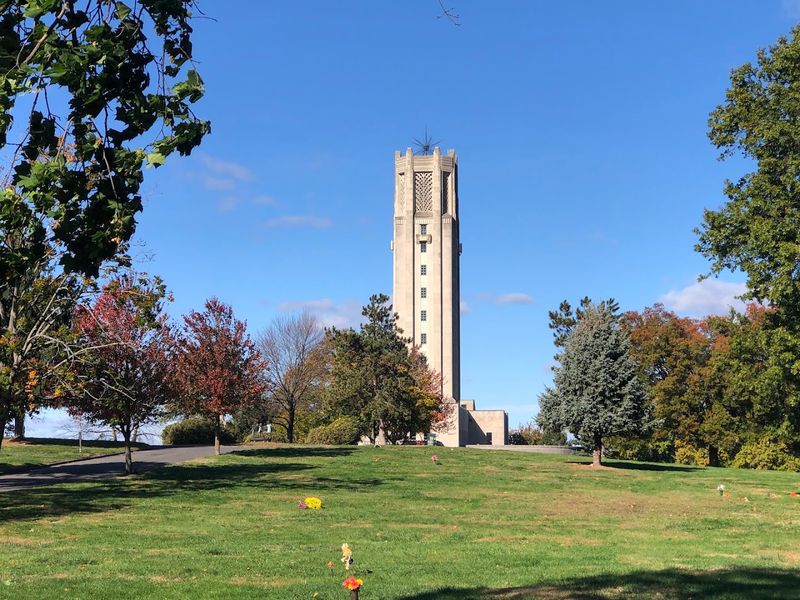
Elsewhere, the memorial tower gives the grounds a strong architectural focal point, rising above the lawns with the formality of a civic monument. Together with the park’s Art Deco entry structures and pavilions, it reinforces the sense that the landscape was composed rather than merely divided into burial sections.
Even the roads contribute to that effect. Instead of forming a rigid city grid, they curve around central features and create gradual reveals, so a structure or sculpture may appear through trees before the full lawn opens around it.
The park’s benefactors fund helps explain how this collection continued to grow. Donations have been used to acquire quality works of art and further beautify the grounds, allowing memorial design to become a shared project extending beyond individual graves.
Some pieces are solemn, some patriotic, and others—like that crowned griffin keeping time in the grass—are delightfully unexpected. The variety prevents the property from feeling like a single grand monument.
It is a collection of visual moments, some obvious from the car and others waiting quietly at walking pace.
Meadows, ponds, woodlands, and waterfalls create an oasis in busy North Jersey
Paramus is famous for highways, shopping centers, and traffic patterns that can make a three-mile errand feel like a small expedition. That surrounding bustle makes the landscape inside George Washington Memorial Park even more striking.
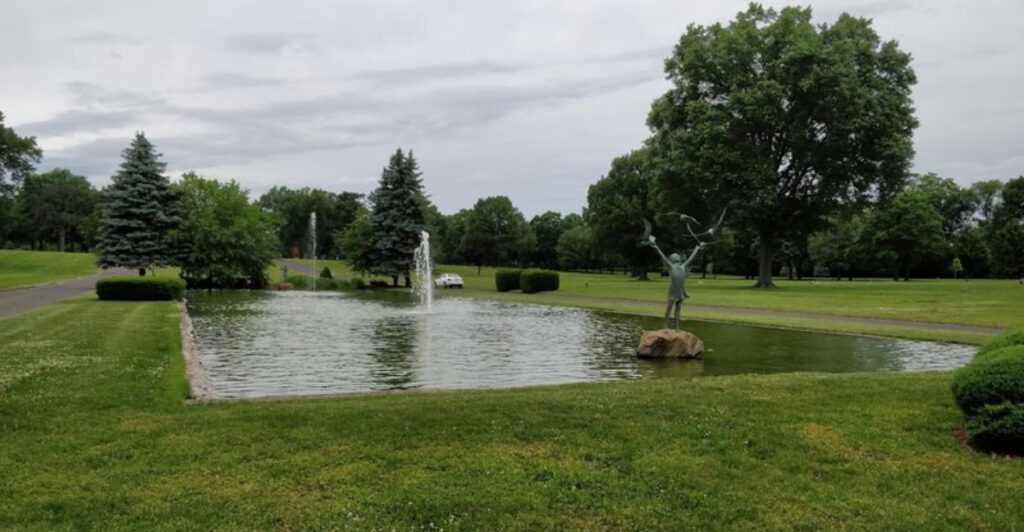
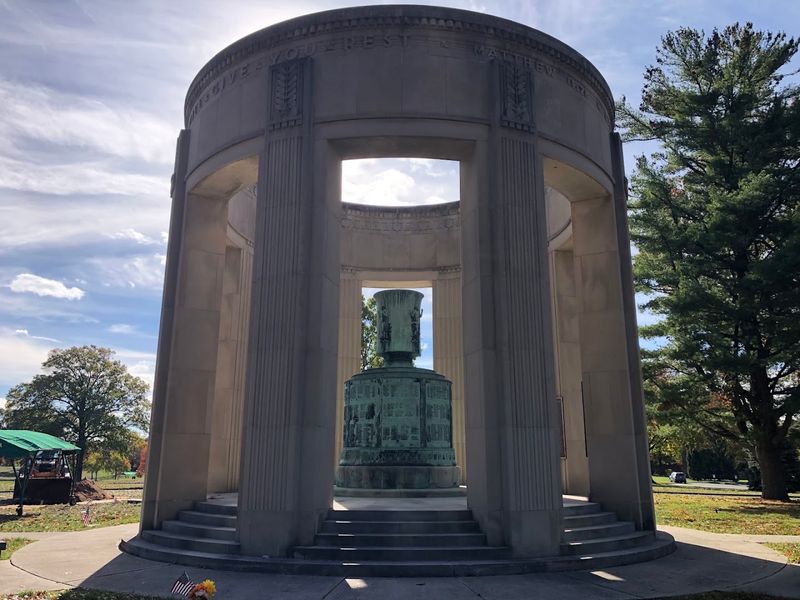
Past the entrance, the commercial noise gives way to rolling lawns, groups of mature trees, planted evergreens, ponds, fountains, and sections of woodland that create natural boundaries across the 98-acre property. Water plays a particularly important role.
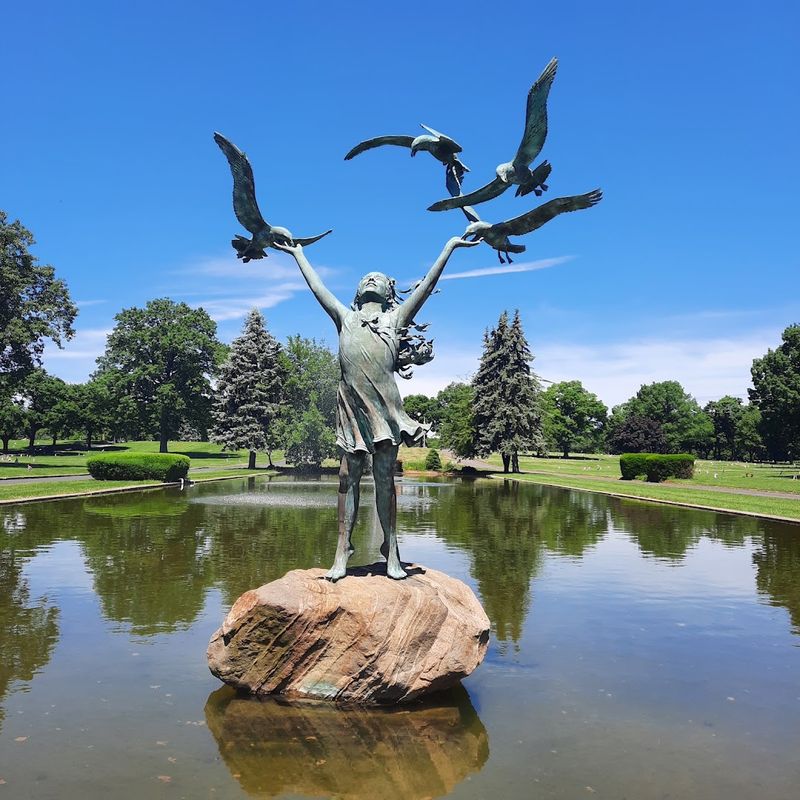
Jets rising from ponds add movement without breaking the calm, while smaller cascades and waterfall features provide a steady background sound that softens everything around them. Bronze figures appear beside the water, and reflections briefly double the sculptures, trees, and open sky.
The official cemetery map shows how the property is organized along long curving drives, with memorial sections arranged around central landscaped areas rather than packed into a tight rectangle. That spacious design changes with the seasons.
Spring brings flowering trees and brighter lawns; summer fills the canopy and shades the roads; autumn gives the grounds deep reds and golds; winter exposes the clean lines of the tower, pavilions, and sculpture. None of this erases the cemetery’s purpose.
Visitors are often there on difficult days, and the beauty is not meant to distract from loss. It gives that loss a gentler setting.
A bench near the water, a wide meadow without visual clutter, or the sound of a fountain can provide a little breathing room when conversation has run out. That may be the park’s most successful artistic decision of all: the landscape is not treated as empty space between memorials, but as part of the memorial itself.