Imagine climbing a staircase inside a six-story elephant, peering out through its eyes, and realizing the Atlantic Ocean is right outside. Somehow, that isn’t even the strangest architectural experience New Jersey has to offer.
Across the state, determined eccentrics, famous architects, artists, entrepreneurs, and dreamers have left behind structures that seem to ignore every rule about what a building is supposed to look like.
There is a castle dressed up like something from a candy-colored fairy tale, a home that resembles a landed spacecraft, and an enormous entertainment complex where you can ski indoors while summer temperatures bake the parking lot outside.
Some are beautifully preserved. Others are fragile survivors whose strange histories are half the fun. Together, they prove that New Jersey architecture gets wonderfully unpredictable once you leave the predictable landmarks behind.
These eight buildings deserve a closer look — even if your first reaction is simply, “Who thought of this?”
1. Lucy the Elephant – Margate City
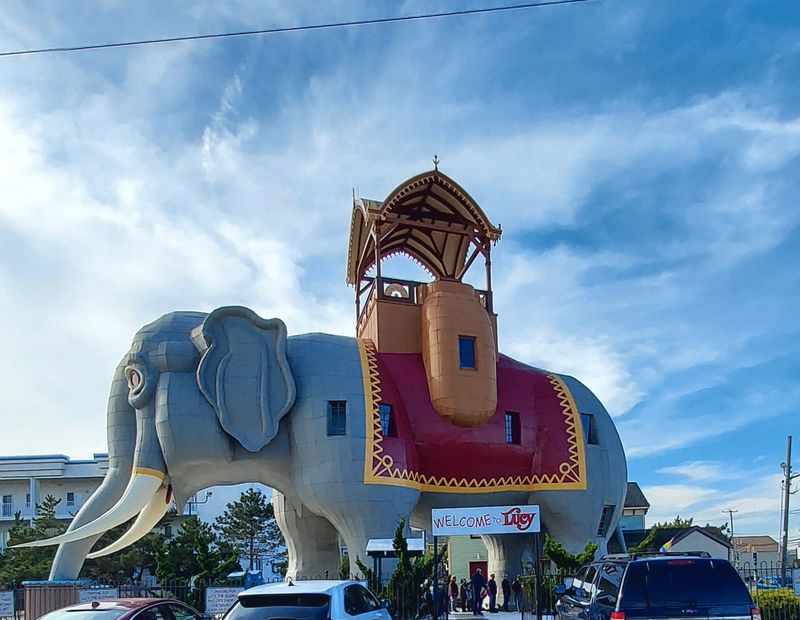
From the beach in Margate, you can spot a gray elephant towering above the surrounding houses — and no, it is not a statue in the usual sense. Built in 1881, Lucy is an actual building, complete with rooms, stairways, windows tucked into her body, and a small howdah perched on her back.
Developer James V. Lafferty created the enormous pachyderm as an attention-grabbing way to promote real estate in what was then known as South Atlantic City.
More than 140 years later, the marketing stunt has outlived almost everything that once surrounded it. The best way to appreciate Lucy is to go inside.
Guided tours take visitors through the elephant’s interior, where you can learn about her construction, look through her eye windows, and climb to the howdah for wide-open views across Margate and toward the Atlantic. It is equal parts historic landmark and wonderfully silly roadside attraction.
Visiting the grounds and gift shop is free, while interior tours require admission; tours are typically offered every 45 minutes during operating hours. Limited on-site parking is available, so summer weekends can require a little patience.
Plenty of Jersey Shore landmarks are recognizable, but few allow you to casually tell people you spent the afternoon standing inside an elephant.
2. Luna Parc – Sandyston
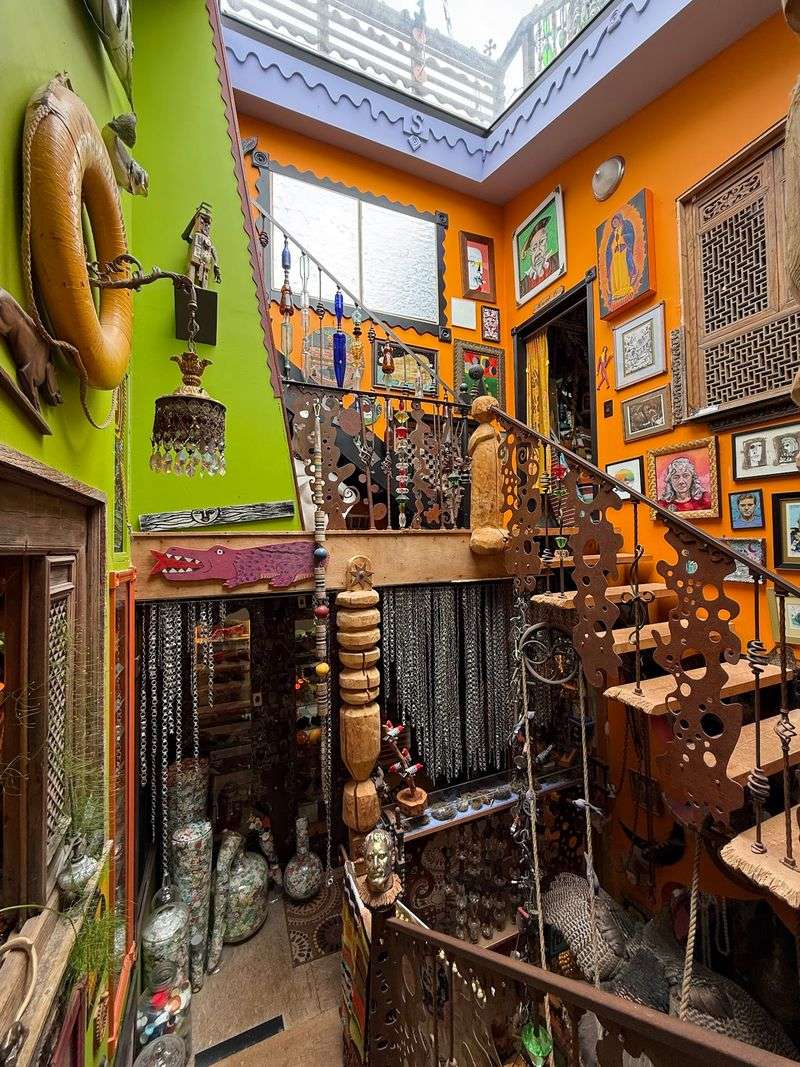
The first clue that Luna Parc is not a normal house is the mosaic work. Then you notice the sculptures.
Then the strange faces, brightly patterned surfaces, towers, ceramics, metalwork, painted details, and dozens of little artistic surprises competing for your attention.
Artist Ricky Boscarino has spent decades transforming his Sandyston home and studio into what feels like an ongoing experiment in how much imagination one property can physically hold.
Calling it eclectic barely gets the job done. Boscarino works across ceramics, jewelry, mosaics, painting, sculpture, and other forms, and the building itself has become one enormous piece of art rather than simply a place where art is displayed.
Look closely and tiny details become as memorable as the bigger architectural flourishes; this is the sort of place where rushing through would mean missing half the fun. Unlike a conventional museum, Luna Parc is also a private home and working studio, so showing up unannounced is not the move.
Public visiting days and tours are scheduled rather than offered on standard daily museum hours, with dates generally added throughout the warmer months and into autumn. Book ahead when an opening appears.
The controlled access actually suits the place: Luna Parc feels less like another attraction on an itinerary and more like you somehow received permission to wander through one artist’s extremely colorful imagination.
3. Palace of Depression – Vineland
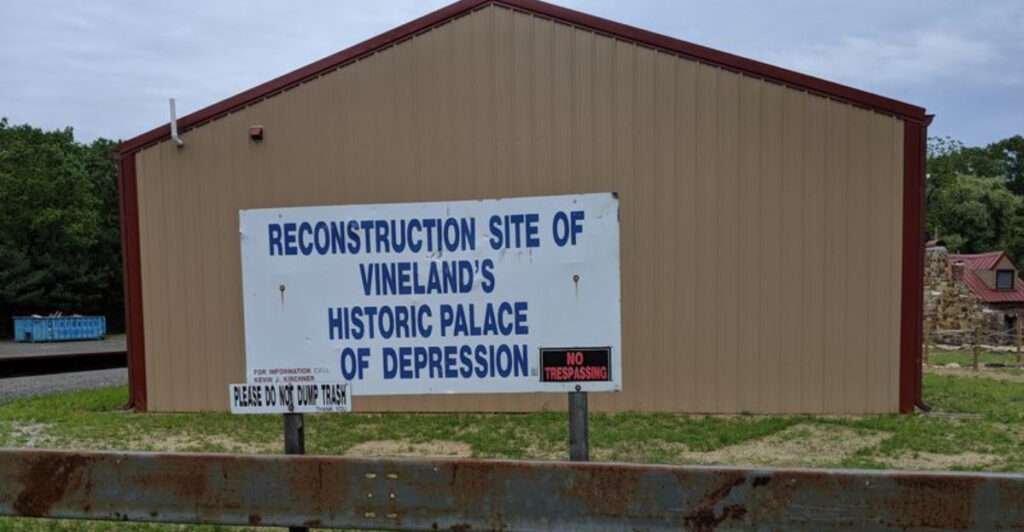
A house built from junk sounds like the beginning of a demolition story. In Vineland, it became a local legend instead.
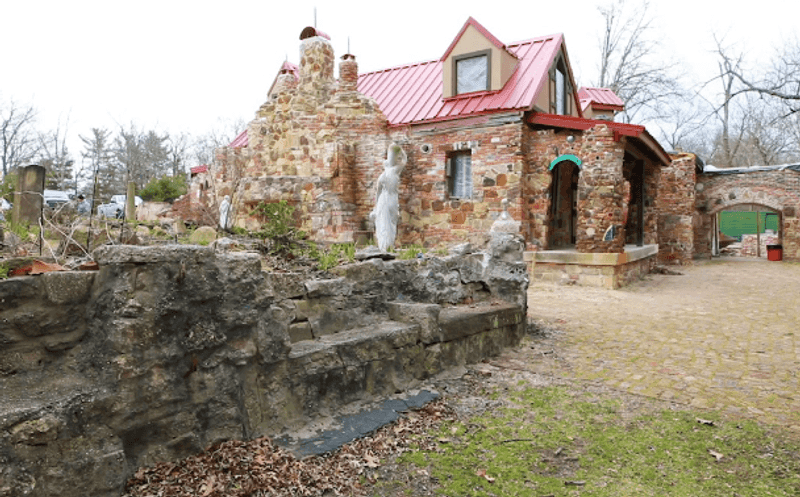
George Daynor constructed the original Palace of Depression during the 1930s using whatever materials he could get his hands on, including rocks, mud, auto parts, glass, and discarded objects. The resulting property looked somewhere between a homemade castle, a folk-art installation, and an architectural dare.
Daynor charged visitors a nickel to look around and proved surprisingly good at keeping people fascinated by both the building and the larger-than-life stories he told about himself. After years of vandalism and neglect, the original palace was largely destroyed and eventually cleared away in the late 1960s.
What visitors see today is a painstaking reconstruction created through years of volunteer work, with the surviving original ticket booth incorporated into the story. Bottles, hubcaps, stone, mosaics, shells, and other found materials once again give the building its gloriously improvised appearance.
There is even a basement space associated with Daynor’s wonderfully ridiculous claim that the New Jersey Devil lived there. This is not a polished attraction with predictable daily hours, so don’t build a trip around simply arriving at the gate.
Public access has historically depended on tours, special events, and restoration activity. Think of it as a living preservation project — one that remains nearly as eccentric as the man who dreamed it up.
4. Futuro House – Greenwich
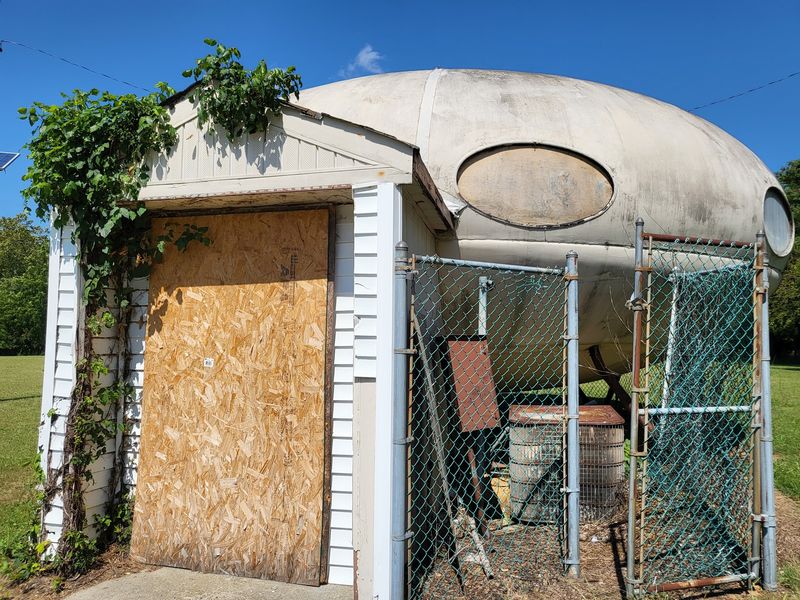
At first glance, the Futuro House looks as if somebody parked a flying saucer beside the Delaware Bay and forgot to come back for it. Finnish architect Matti Suuronen designed the Futuro in the late 1960s as a lightweight, prefabricated structure made from fiberglass-reinforced plastic.
Its elliptical shell, oval windows, and compact footprint made it look less like a ski chalet — its original intended purpose — and more like the vacation home of a very stylish alien. Fewer than 100 were produced, which makes the story of New Jersey’s examples especially fascinating.
The Futuro that spent years in Greenwich had already enjoyed an appropriately strange life before arriving there. It appeared at Morey’s Pier in Wildwood in the early 1970s as part of an amusement attraction and was later moved to a boatyard in Greenwich, where it became an unlikely roadside curiosity.
There is an important catch for anyone planning a visit today: the Greenwich Futuro was purchased and removed from the boatyard in late 2021 for restoration, so driving to its former Hancock Harbor Road location will not produce the UFO sighting you are hoping for.
New Jersey’s remaining publicly documented Futuro can instead be found at Mill Creek Park in Willingboro, where preservation work continues around another example of Suuronen’s Space Age design.
Greenwich still earns its spot on this list — just consider it a bizarre chapter of New Jersey architecture that has literally moved on.
5. Gingerbread Castle – Hamburg
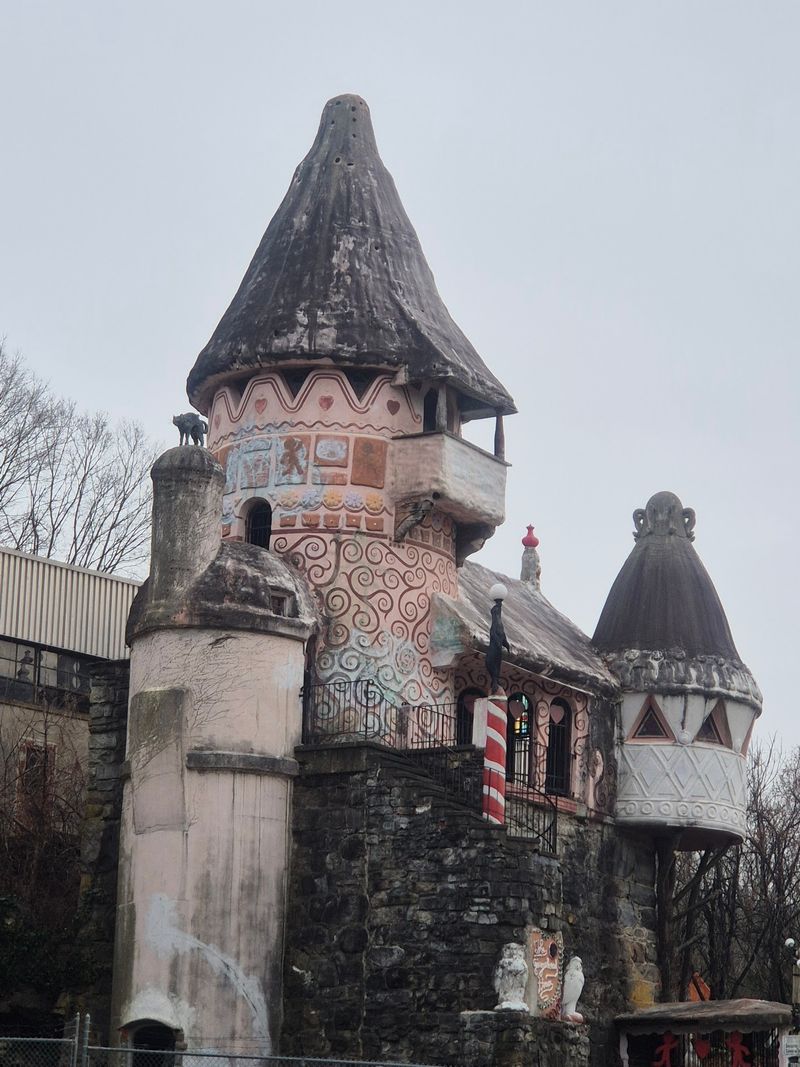
Imagine commissioning a building after seeing Hansel and Gretel and deciding that the sensible next step is to recreate the fairy tale in concrete. That is essentially how Hamburg ended up with the Gingerbread Castle.
Businessman F.H. Bennett, whose company operated the nearby Wheatsworth Mill, hired celebrated architect and theatrical designer Joseph Urban to create the fantasy attraction around the end of the 1920s.
Urban did not approach the assignment subtly. Towers, rounded forms, decorative trim, exaggerated textures, storybook figures, and details meant to resemble icing and candy turned the structure into something closer to a stage set than a conventional building.
For decades, families wandered through scenes inspired by children’s stories while a small train carried visitors around the grounds. The attraction initially closed in 1978, briefly returned years later, and eventually slipped into a long period of deterioration.
That weathered condition now makes the castle even stranger: the sugary fantasy aesthetic sits beside the hulking industrial buildings of the old mill complex, creating a contrast that looks almost unreal. Today, however, this is a historic curiosity rather than a functioning amusement park.
The property remains private and should not be entered without permission, and preservation concerns have followed both the castle and neighboring mill for years. If you pass through Hamburg, admire the architecture only from a legal public vantage point.
The witch’s house may look inviting, but trespassing definitely ruins the fairy tale.
6. Emlen Physick Estate – Cape May
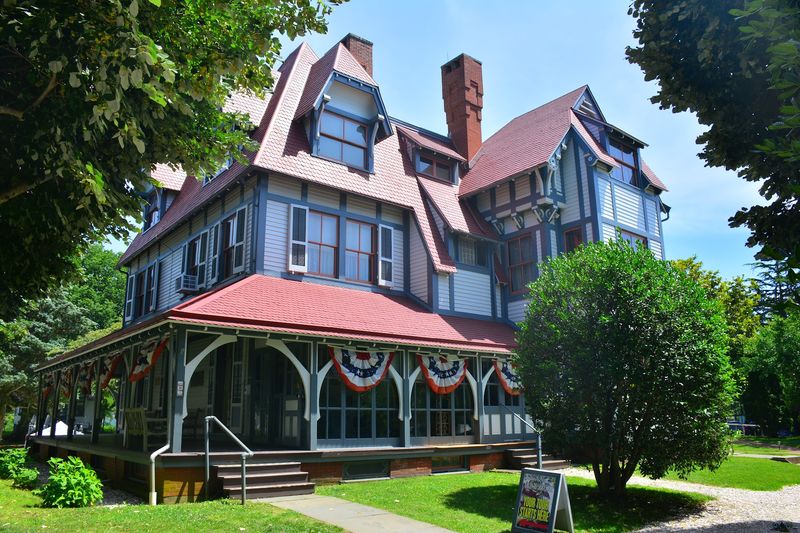
Cape May has no shortage of ornate Victorian houses, which makes it impressive that one mansion can still manage to look noticeably stranger than its neighbors.
The Emlen Physick Estate dates to 1879 and was designed by architect Frank Furness, whose bold Victorian work rarely bothered with delicacy when a dramatic roofline, oversized chimney, unconventional window, or heavy architectural flourish would do instead.
The 18-room house is an outstanding example of Stick Style architecture, and its sharp angles and muscular details give it a personality quite different from the pastel, gingerbread-trimmed homes many visitors associate with Cape May.
The exterior is worth circling slowly before heading inside, but the guided house tour is where the place becomes more than a photo stop.
Furnished rooms and changing interpretive themes explore the Physick family’s daily life, household routines, possessions, and the larger Victorian world around them. The 2026 tour program connects the family era to the enormous influence of Philadelphia’s 1876 Centennial Exposition.
Standard estate tours run roughly 45 minutes, and tickets currently cost $20 for adults and $15 for children ages 3 to 12. Free on-site parking removes one headache that anyone who has tried parking near central Cape May will appreciate.
The first floor is accessible, and tour schedules vary by date, so checking times before heading over is smart.
7. Asbury Park Convention Hall – Asbury Park
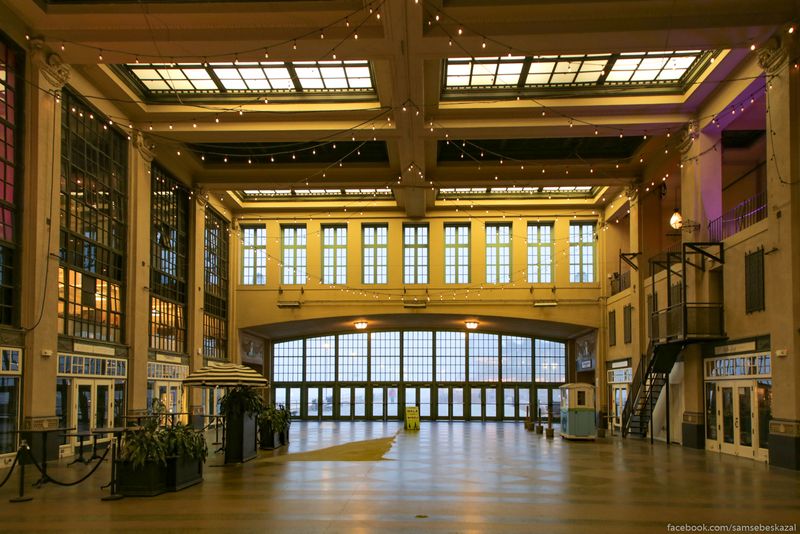
Walk the Asbury Park boardwalk toward Convention Hall and the building seems to keep going until the land runs out — because, in a sense, it does. Part of the enormous entertainment complex actually extends over the beach, giving the structure a scale and location that feel almost absurd when seen from the sand.
Designed by Warren and Wetmore, the architectural firm best known for New York’s Grand Central Terminal, the complex combines Convention Hall, the Paramount Theatre, and the Grand Arcade linking them together.
Its mix of grand arches, brickwork, decorative details, and oceanfront bulk looks nothing like the lightweight seaside architecture you might expect along a boardwalk.
Inside, the Grand Arcade doubles as a passageway and gathering space, while Convention Hall itself has room for crowds of up to roughly 3,600. Music history adds another layer to the building’s oversized personality.
Bruce Springsteen is closely associated with Asbury Park, naturally, but the hall has also hosted performers including Frank Sinatra, the Rolling Stones, and Elton John. Rather than treating this as a building you simply photograph and leave, check the event calendar before your trip.
A concert, market, festival, or other event gives you an excuse to spend time inside the complex and appreciate just how strange it is to attend something in a monumental hall sitting practically on top of the Atlantic Ocean.
8. American Dream – East Rutherford
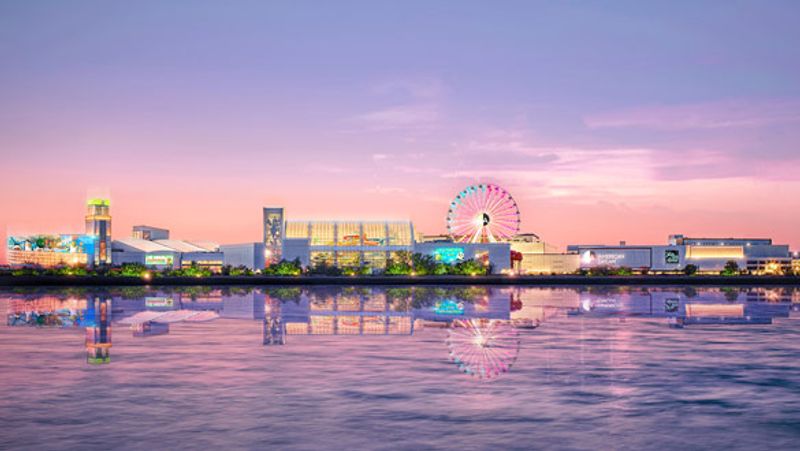
There are malls, and then there is the place where you can buy a pair of shoes, ride a roller coaster, splash through an indoor water park, and ski down real snow without ever leaving the same East Rutherford complex. American Dream’s weirdness is not about decorative gargoyles or eccentric historic architecture.
It is about scale. The enormous building beside the Meadowlands packs an almost comically ambitious collection of experiences under one roof, making the exterior’s sheer mass feel appropriate once you understand what is hiding inside.
Nickelodeon Universe provides the roller coasters and theme-park rides. DreamWorks Water Park delivers waterslides, pools, and tropical temperatures.
Then BIG SNOW flips the script with an indoor ski slope kept cold enough for skiing and snowboarding year-round. Beyond those headliners are shops, restaurants, an ice rink, miniature golf, aquarium attractions, and enough other distractions to turn a quick stop into an accidental full day.
Trying to tackle everything at once is the easiest way to make the place exhausting, so choose one major ticketed attraction as the centerpiece and treat anything else as a bonus. Check individual attraction hours rather than relying on the shopping center’s general schedule, since operating times differ.
American Dream may lack the handmade eccentricity of Luna Parc or the historic charm of Lucy, but building an indoor mountain, water park, and amusement park in the New Jersey Meadowlands certainly qualifies as its own wonderfully excessive kind of strange.