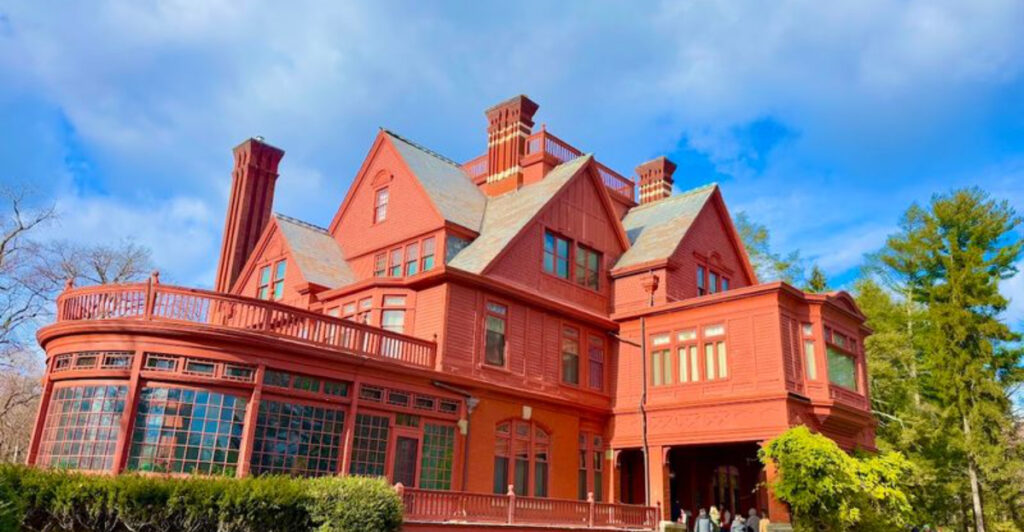
A Tiffany clock still keeps watch over rooms lined with Persian rugs, hand-stenciled walls, and furniture chosen before Thomas Edison ever crossed the threshold. At Glenmont in West Orange, history has not been polished into something generic.
The 29-room mansion remains crowded with the objects, colors, and wonderfully elaborate details that defined an affluent Victorian home. Edison bought the estate for his new wife, Mina, in 1886, then spent more than four decades living here while his nearby laboratories changed modern life.
The house saw children grow up, prominent guests arrive for dinner, servants manage a demanding household, and one famously tireless inventor return after another long night of work.
Because the Edison family altered relatively little, Glenmont feels less like a reconstruction than a home whose residents have briefly stepped outside.
Hidden within gated Llewellyn Park, it offers one of New Jersey’s most complete and unexpectedly personal glimpses into the late 1800s.
Glenmont Rises Above the Trees in Historic Llewellyn Park
Reaching the estate involves passing through one of the most historically significant residential communities in the country. Llewellyn Park was established in the 1850s and is widely recognized as America’s first planned residential community.
Instead of the straight street grid familiar across North Jersey, its designers favored curving roads, wooded slopes, and homes positioned to take advantage of the landscape. Native trees were deliberately preserved while exotic specimens and rustic architectural touches helped create the feeling of an enormous private park.
More than a century and a half later, that original idea remains easy to see. Glenmont sits near the top of the community on approximately 13.5 acres, surrounded by lawns and mature trees that partially conceal the mansion until visitors draw close.
Architect Henry Hudson Holly designed the home for businessman Henry C. Pedder, who purchased the property in 1879 and poured money into creating an exceptionally grand residence.
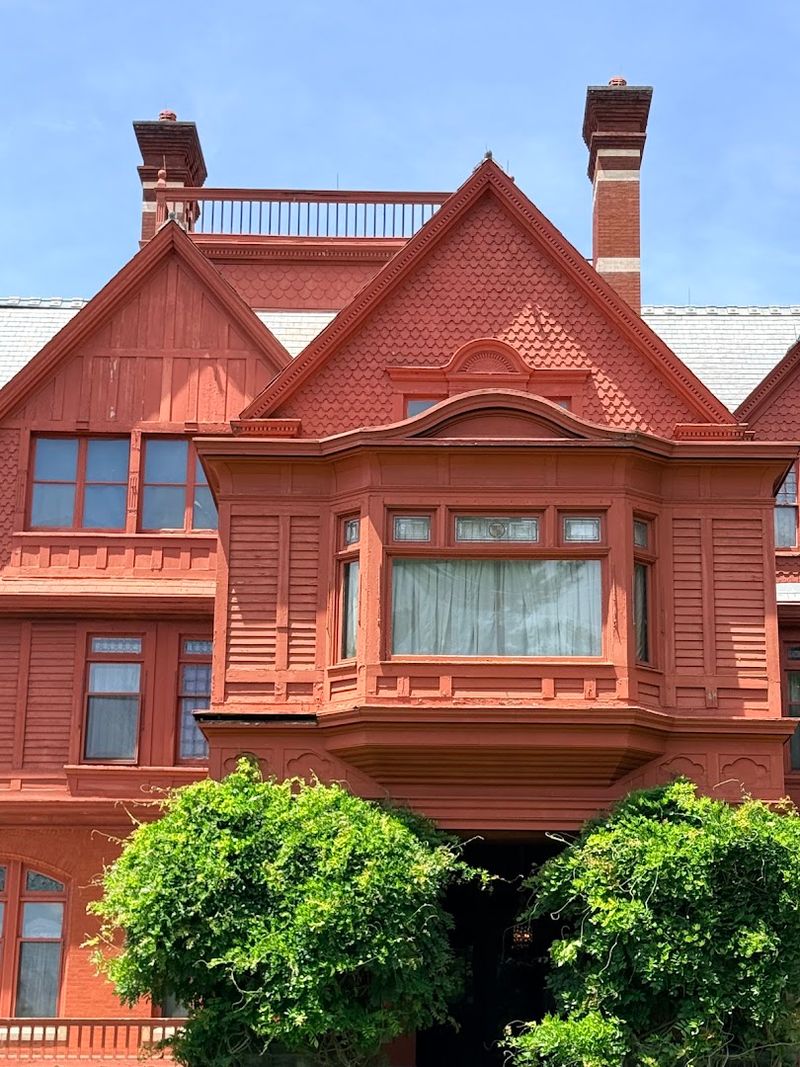
Completed around 1880, the red-brick mansion is an exuberant example of Queen Anne architecture, complete with steeply pitched roofs, projecting bays, tall chimneys, balconies, and covered porches. There is no single tidy facade meant to be admired from one spot.
Every side seems to reveal another roofline, window arrangement, or decorative flourish. Landscape designer Nathan Franklin Barrett began laying out the grounds in the early 1880s, arranging maples, beeches, oaks, evergreens, and specimen trees to frame attractive views while screening working areas.
Glenmont was not merely a showplace, after all. It operated as a busy country estate with a barn, greenhouse, gardener’s cottage, garage, and other outbuildings.
Some of Edison’s later poured-concrete structures, including the automobile garage and potting shed, survive alongside the older buildings. The combination makes the property feel like a self-contained Victorian world tucked above the traffic and tightly packed neighborhoods of modern Essex County.
Thomas Edison Bought the Mansion as a Wedding Gift for Mina
The purchase came with romantic timing and a distinctly Edison-sized price tag. Thomas Edison acquired Glenmont in 1886 for $125,000 and presented it as a wedding gift to Mina Miller, his second wife.
Even more remarkably, the mansion came fully furnished, allowing the newlyweds to move into a home already filled with costly furniture, carpets, art, and decorative objects. Edison and Mina married on February 24, 1886, then settled at Glenmont after honeymooning in Florida.
She was 20 years old, while he was 39 and already one of the best-known inventors in America. Family lore holds that Edison taught Mina Morse code so the couple could communicate secretly while others were present.
According to his version of the story, he even proposed in Morse code and received her coded acceptance. Life inside the mansion was less storybook-simple.
Mina became stepmother to Edison’s three children from his marriage to Mary Stilwell Edison, and she and Thomas later had three children of their own, Madeleine, Charles, and Theodore. Edison’s work habits also meant frequent late nights at the laboratory complex down the hill.
While he directed teams of experimenters nicknamed “muckers,” Mina ran Glenmont. She hired and supervised maids, a cook, a nanny, and gardening employees, referring to herself with impressive practicality as the “home executive.”
In 1891, ownership of the estate was transferred to her, helping shield the family home from potential business debts.
Mina also became deeply involved in civic, religious, conservation, and gardening organizations, including the National Audubon Society and the Daughters of the American Revolution. Edison lived at Glenmont for more than half his life and died in 1931.
Mina remained connected to the estate until her death in 1947. Their story gives the mansion an intimacy that Edison’s industrial laboratories cannot.
The inventions made him famous, but Glenmont shows who kept the household running while that history was being made.
Twenty-Nine Rooms Reveal the Height of Victorian Luxury
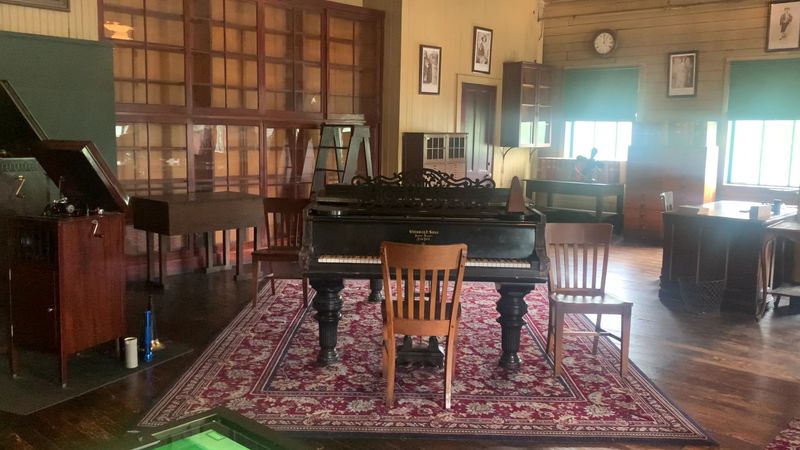
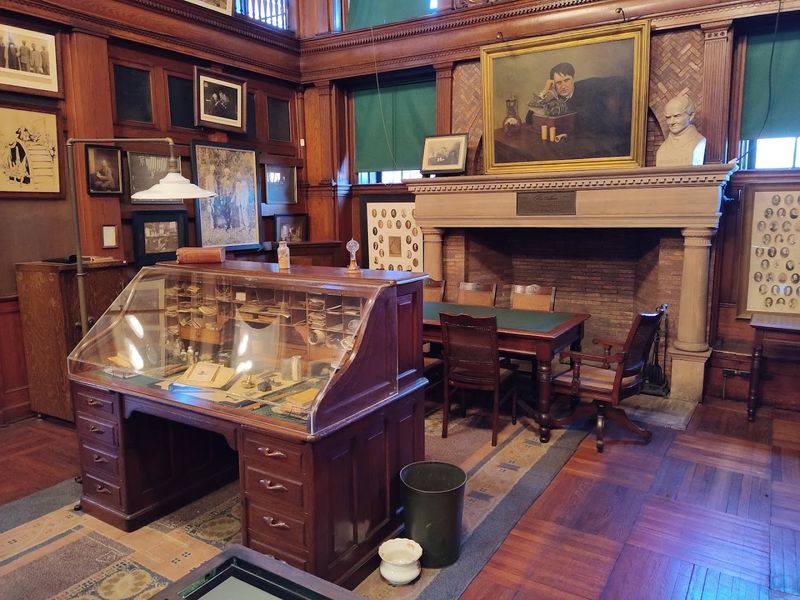
Victorian restraint did exist, presumably, but nobody mentioned it to the people who designed Glenmont. The mansion’s 29 rooms embrace layered patterns, dark woods, ornate fireplaces, decorative ceilings, and richly colored textiles with complete confidence.
Henry Hudson Holly, often associated with the development of the American Queen Anne style, designed a house that rewards close attention. Rather than arranging everything around one monumental central space, he created a sequence of rooms with distinct purposes and personalities.
Public areas welcomed family friends, business associates, and notable guests, while private rooms accommodated the Edisons, their children, and the domestic staff needed to operate an estate of this scale.
The house includes formal entertaining spaces, family rooms, bedrooms, service areas, and a first-floor library that is among its most memorable interiors.
Its walls carry flat, stylized floral stenciling, while tall cabinets hold rows of leather-bound books. The room’s elaborate ceiling and carefully coordinated decoration demonstrate how seriously affluent Victorians treated interior design.
Glenmont also reflects the Eastlake and Aesthetic Movement styles, both of which favored skilled craftsmanship and artful decoration over plain, mass-produced surfaces. Modern Gothic furniture, patterned rugs, carved wood, and carefully selected objects turn each room into a complete composition.
Yet the house never feels like a palace detached from everyday routines. The butler’s pantry, household china, linen collection, family toiletries, and service spaces reveal the practical machinery behind the grandeur.
Someone had to polish the silver, maintain the fires, prepare formal meals, care for the children, and keep all 29 rooms in order. Edison also brought his own era-defining technology into domestic life.
Electric lighting and examples of his inventions appear naturally within the home rather than sitting apart as museum props. That contrast is part of Glenmont’s charm.
One moment belongs to carved Victorian furniture and formal entertaining; the next hints at the electrical future being developed a short distance down the hill.
Original Furnishings Make the House Feel Frozen in Time
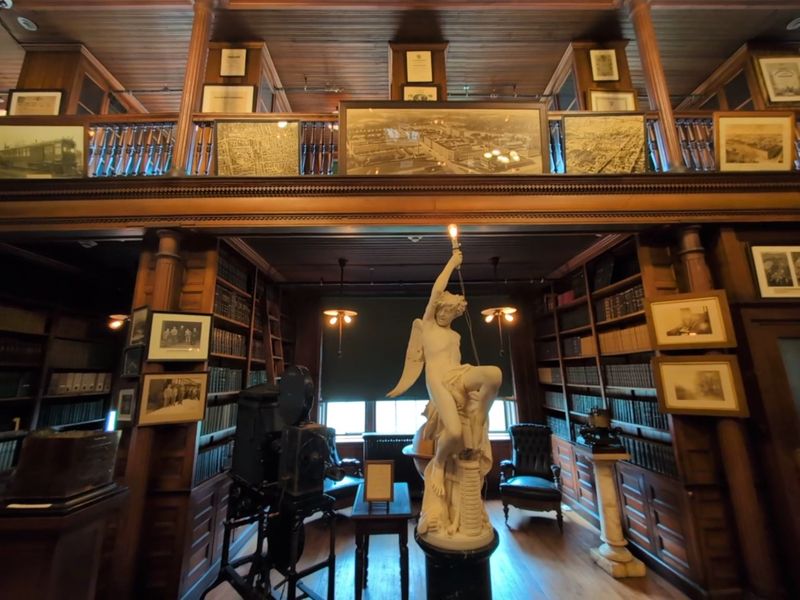
Many historic homes contain period-appropriate pieces collected long after their original residents disappeared. Glenmont offers something much rarer.
Much of what visitors see was chosen for the mansion when it was first decorated or belonged directly to the Edison family. Henry Pedder hired the prestigious New York decorating firm Pottier & Stymus to furnish the house in lavish Victorian fashion.
The company had supplied interiors for wealthy clients and major public buildings, but a catastrophic warehouse fire in 1888 destroyed most of its business records and stock. That loss makes Glenmont’s surviving interiors especially valuable.
Its coordinated furniture suites and decorative schemes preserve physical evidence of the firm’s work on a scale that is difficult to find elsewhere. When Thomas and Mina Edison purchased the fully furnished estate, they apparently recognized that they had inherited something exceptional.
Rather than stripping the rooms and imposing every passing fashion, the family made relatively modest decorative changes during decades of residence. The result is not a loose interpretation of an 1880s mansion.
It is an unusually intact home in which furniture, wall treatments, artwork, carpets, books, clocks, and household goods still relate to one another as their designers intended. That authenticity changes the experience of walking through the rooms.
A chair is not simply an antique placed in an empty corner; it belongs to a suite selected for that interior. China remains in the butler’s pantry instead of appearing in a detached display case.
Personal photographs and mementos sit within the larger decorative scheme, gradually shifting the house from architectural showpiece to family home. The preservation also owes much to what happened after Mina’s death.
The property ultimately became part of the national park system, and there was no long succession of private owners eager to gut the interior, paint over the stenciling, or replace carved woodwork with whatever happened to be fashionable. Glenmont therefore carries its age honestly.
It is ornate, deeply personal, slightly overwhelming, and far more interesting than a spotless modern imitation of Victorian style could ever be.
Forty Thousand Historic Objects Fill the Remarkable Collection
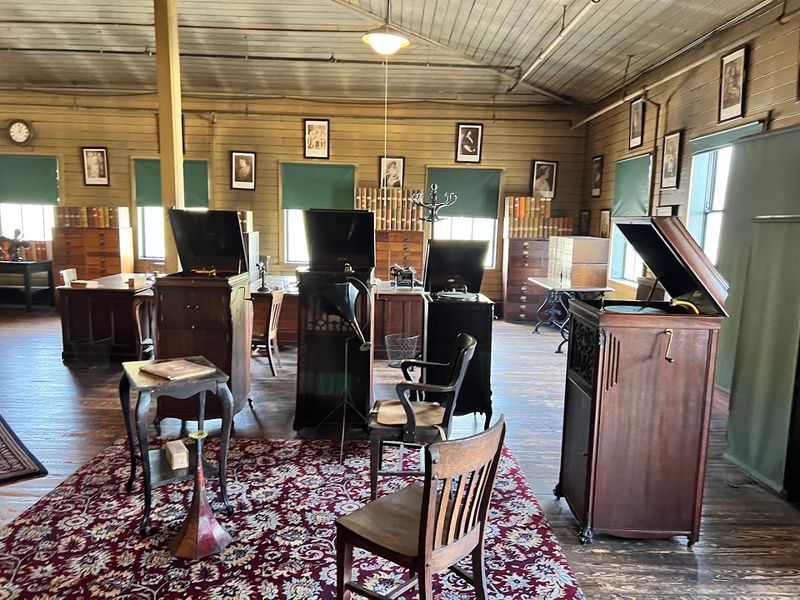
A household receipt may not compete visually with French porcelain or a Hudson River School painting, but at Glenmont, the ordinary objects often tell the sharpest stories. The estate’s collection contains approximately 40,000 items, ranging from major decorative arts to the small necessities of family life.
Tiffany & Co. clocks, Persian rugs, sculpture, fine paintings, and ornate furniture establish the Edisons’ wealth and social position. Then the collection shifts scale.
There are linens, toiletries, dishes, books, photographs, awards, family keepsakes, and records of everyday purchases. Together, they explain not only how the rooms looked but how the household functioned.
Receipts and vouchers reveal what the family bought and how much they spent, while china stored in the historic butler’s pantry helps reconstruct the rhythms of meals and entertaining. Personal possessions also pull Thomas Edison away from the familiar image of a solemn inventor posed beside a light bulb.
At Glenmont, he appears as a husband, father, host, reader, and sometimes-absent head of a complicated home. Mina emerges just as clearly through family materials and objects connected with gardening, household management, and her many public interests.
Edison inventions are represented as well, showing how technologies developed at the laboratory entered the family’s daily surroundings. The Glenmont holdings form only one portion of the enormous collection preserved at Thomas Edison National Historical Park.
Across the estate and laboratory complex, the park holds hundreds of thousands of historic artifacts and roughly five million documents, making it one of the largest museum collections in the National Park Service.
Still, Glenmont’s 40,000 objects have a special immediacy because so many remain connected to the rooms where they were used.
The grandest pieces supply the initial wow factor, but smaller details tend to linger in the mind: books arranged in tall cases, dishes waiting in the pantry, family photographs, and a household bill that survived long enough to become historical evidence.
Victorian grandeur may dominate the first impression, but ordinary life gives the mansion its depth.
Guided Tours Offer a Rare Look Inside the Edison Family Home
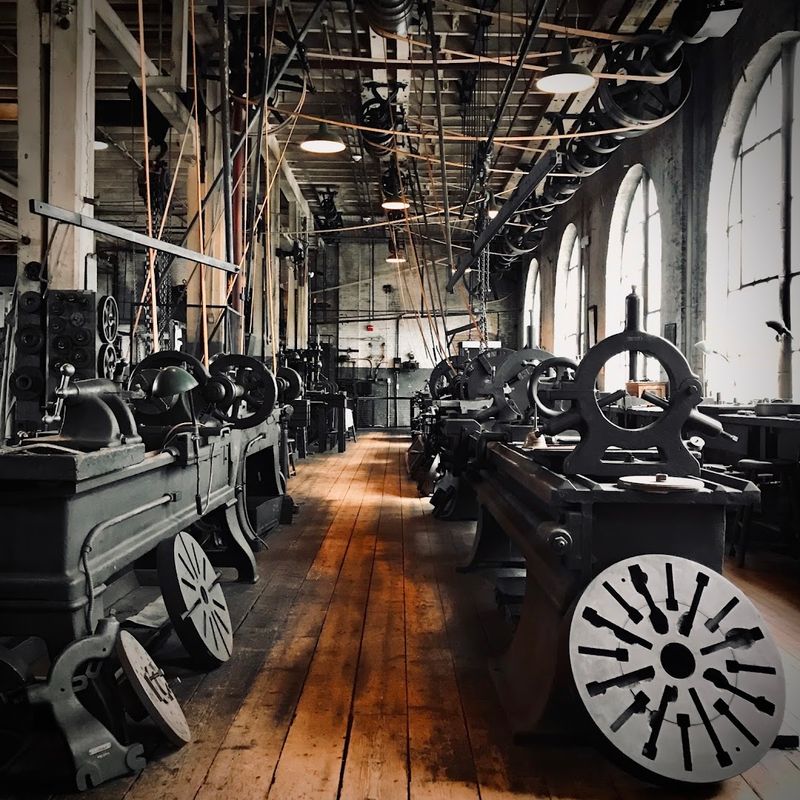
Getting through Glenmont’s front door requires a little more planning than pulling into a museum parking lot. The mansion stands inside gated Llewellyn Park, which remains a private residential community, so visitors must begin at the Thomas Edison National Historical Park laboratory complex at 211 Main Street in West Orange.
There, they pay the park entrance fee or present an accepted pass and obtain the separate grounds pass required at the Llewellyn Park gate. A mansion tour ticket is also necessary.
Advance reservations are handled online, and limited same-day tickets may sometimes be available at the laboratory visitor center on a first-come, first-served basis. Current seasonal schedules should be checked before making the trip because tour dates and capacity depend on staffing.
The 2026 mansion season began May 1, with tickets released in batches as dates become available. Guided interior tours last about 30 minutes and cover the first and second floors.
Photography and video are not permitted inside, an old-fashioned restriction that actually suits a place where phones would otherwise rise in front of every fireplace and carved cabinet. The route includes several flights of stairs and extended standing, with no elevator, so the interior tour is not fully accessible.
A video tour is available at the laboratory visitor center for those unable to manage the stairs. Visitors can also explore the estate grounds, where an audio tour provides context for the landscape and surviving outbuildings.
The greenhouse, barn, gardener’s cottage, poured-concrete garage, and carefully arranged trees show that Glenmont was far more than a large house on a lawn. Behind the mansion are the graves of Thomas and Mina Edison, marked within the property they shared for decades.
Ending there brings the story to a quiet close. The laboratories preserve the public Edison whose inventions traveled around the world; Glenmont preserves the private life that unfolded when he came home.