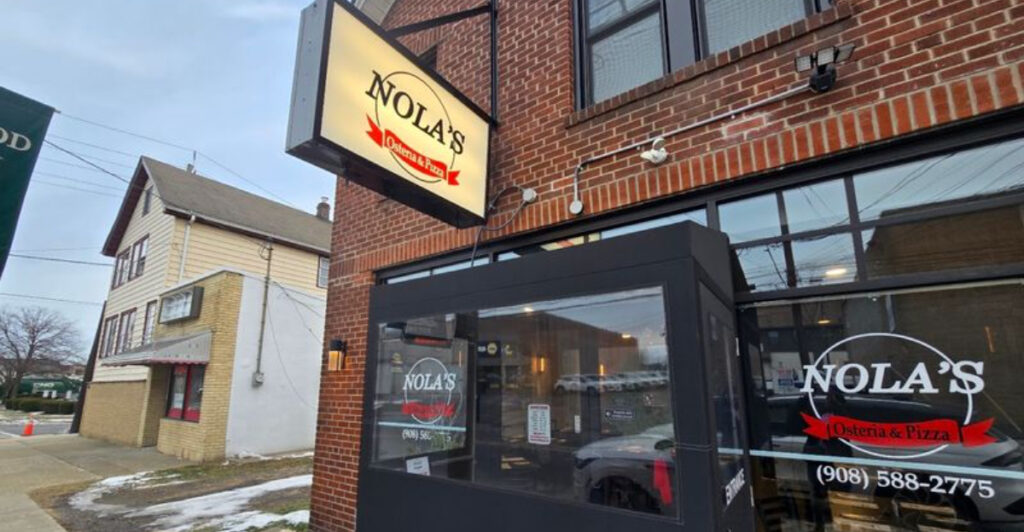
The first clue that Nola’s Osteria and Pizza is not running an ordinary neighborhood pizza operation appears before you even order. There are no loose slices waiting under warming lights, reservations are strongly recommended, and the kitchen politely reminds customers that every pie and dish is prepared to order.
Then a thin pan pizza reaches the table with a deeply browned bottom, crisp edges, and enough bubbling mozzarella to make everyone temporarily forget the conversation.
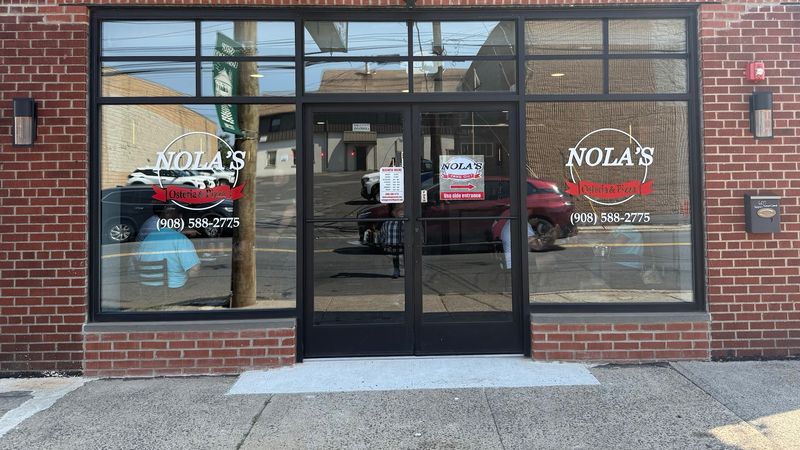
This is Nola’s, an Italian restaurant tucked into a modest storefront at 607 South Avenue in Garwood, a small Union County borough that rarely gets mentioned alongside New Jersey’s famous pizza destinations.
That has not stopped serious pizza fans from finding it. They come for square pies with caramelized corners, unconventional topping combinations, and a signature creation called the Warrior.
Many leave talking just as enthusiastically about the meatballs, spicy rigatoni, and homemade mozzarella sticks. Nola’s may look like a local secret, but the secret is getting harder to keep.
Nola’s Osteria and Pizza brings serious pizza talent to an unassuming Garwood storefront
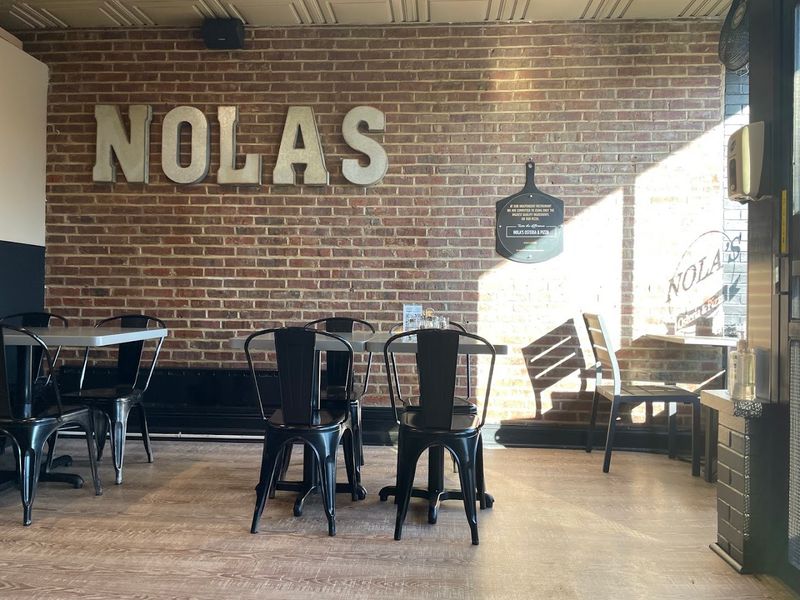
Marc Spagnola had already spent decades in the Italian restaurant business before opening Nola’s. He previously owned the original La Cucina Ristorante and Seafood Grill on Essex Street in Millburn and says he brought roughly 30 years of experience into his Garwood restaurant.
That background helps explain why Nola’s feels less like a standard takeout pizzeria and more like a full Italian kitchen that happens to be unusually obsessed with crust. The current location at 607 South Avenue does not announce itself with a giant dining room or a theatrical open kitchen.
It sits along a busy local corridor in a borough squeezed between Westfield and Cranford, where commuters and residents could easily pass without realizing what is being made inside. The menu reveals the restaurant’s ambition much faster.
A basic 12-inch cheese pie starts at $12, but nearby are square pies, super-thin pan pizzas, Trenton-style creations, white pies, hot-honey combinations, and specialty pizzas available only through the restaurant’s back door. Nola’s does not sell individual slices, which changes the rhythm of the experience.
You are choosing an entire pie, and that makes the decision feel pleasantly serious. The kitchen also prepares its food to order, so this is not the place to rush in expecting a slice and soda in four minutes.
That patience is part of the arrangement. What comes out of the oven has been built for the table in front of it, not reheated for whoever happens to walk through the door next.
Even the restaurant’s full name matters. “Osteria and Pizza” signals that Spagnola is not separating the pies from the rest of his Italian cooking. The same tomato sauces, cheeses, long hot peppers, meatballs, and fresh herbs move across appetizers, pasta dishes, sandwiches, entrées, and pizzas.
It is a neighborhood restaurant with the menu of someone who clearly had too many good ideas to stop at pepperoni.
Hearth-baked crusts and crispy pan pies set this neighborhood spot apart
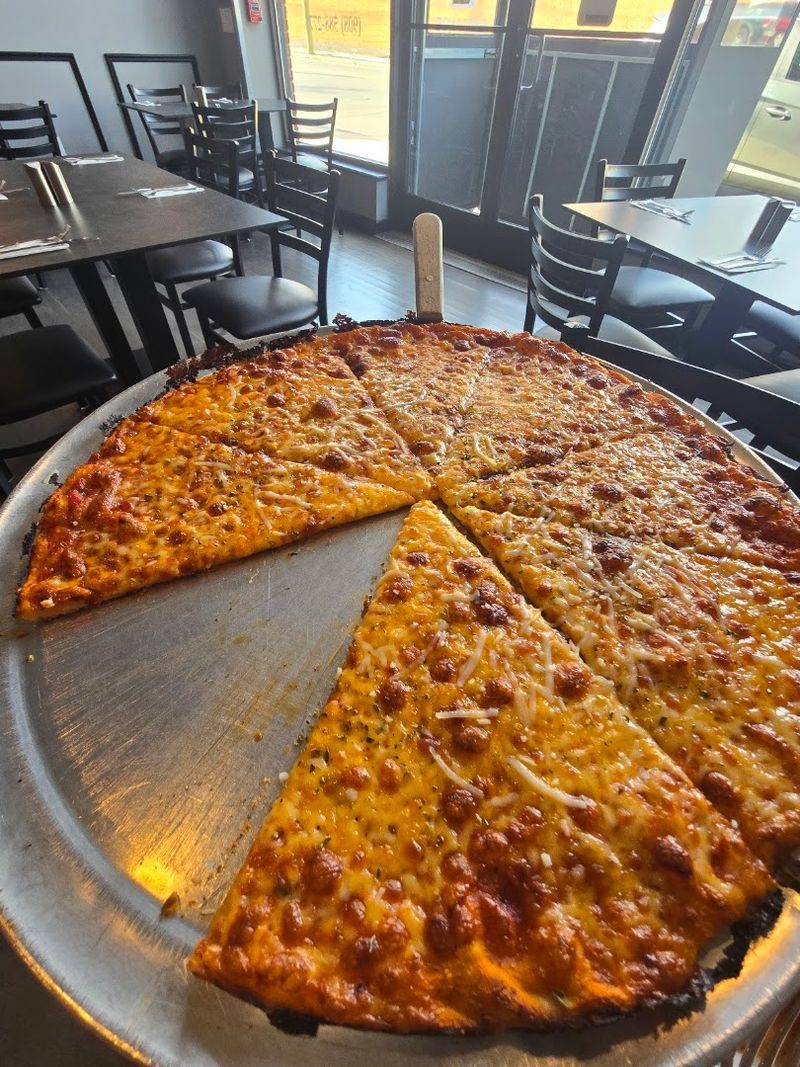
Pick up one of the thin pan slices and the structure becomes obvious immediately. The base is firm enough to hold its toppings without folding into a cheese-covered surrender, while the underside carries the deep golden color that comes from letting the dough stay in the heat long enough to develop real crunch.
Nola’s standard pizzas are baked on the hearth of a gas-fueled deck oven, while many of its most distinctive pies are cooked thin and well-done in pans. The two approaches produce different personalities.
Hearth-baked rounds offer the familiar crisp-chewy balance New Jersey pizza eaters know well, but the pan pies lean harder into texture, especially around the edges where cheese, sauce, and heat meet. The menu gives customers several ways to explore that style without burying the crust.
A 16-inch Cheese Pan Pie costs $18 and keeps things straightforward with homemade pizza sauce, a mozzarella blend, and Pecorino Romano. The Super Thin Cheese Pan Pie is also $18, but the crust is so delicate that the kitchen limits additional toppings to pepperoni, red onion, or crumbled sausage.
That restriction is not fussy behavior for its own sake. Pile too much onto a crust that thin and its entire appeal disappears beneath the weight.
Other pies use the pan as a foundation for bolder combinations. The Diavolo Square Pan Pie brings spicy tomato sauce, soppressata, Italian sausage, sautéed onions, basil, and hot honey onto a crust specifically cooked crisp and well-done.
The Grandpa Pan Pie layers mozzarella and sausage beneath sauce, shaved Pecorino Romano, and Italian long hots. Even a mustard-and-sausage pan pie appears on the menu, with spicy brown mustard, mozzarella, sausage, tomato sauce, and Romano.
That range would mean little if the crust turned soft halfway through dinner. Instead, the pan technique gives those toppings something sturdy to land on.
At Nola’s, crispness is not an accidental bonus around the rim. It is the organizing principle of the pie.
The Warrior has become the signature pizza regulars insist you try
Some restaurant signatures are the result of a marketing campaign. The Warrior feels more like a pie that customers collectively promoted until newcomers understood the assignment.
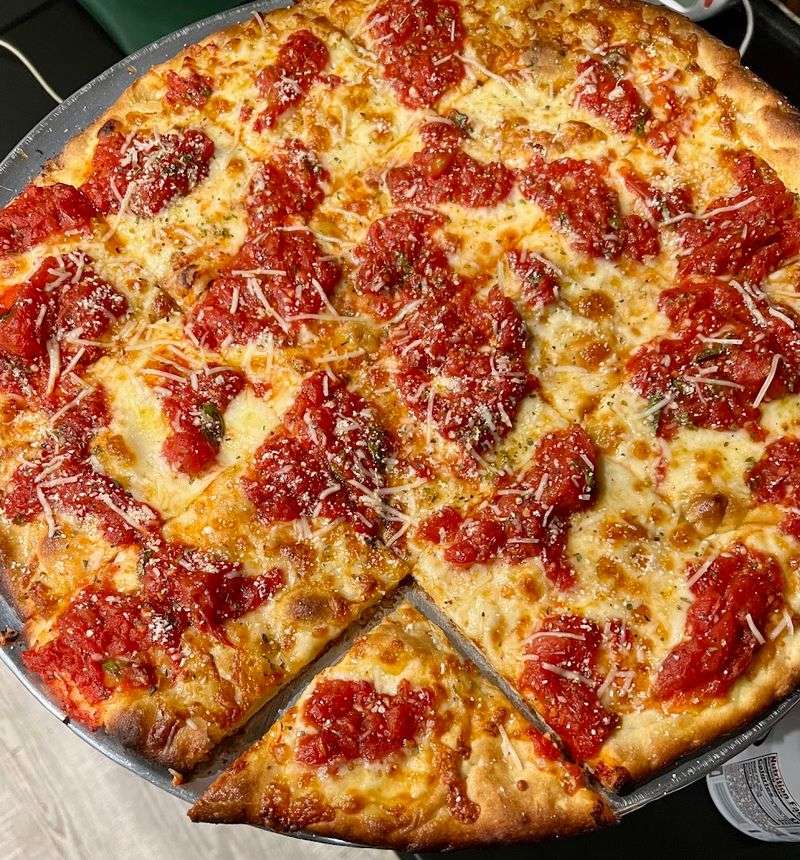
It is a 16-inch thin-crust pan pizza built with a light mozzarella blend, fresh mozzarella, slightly spicy plum tomato sauce, oregano, Pecorino Romano, and extra-virgin olive oil. At $21, it is not the most elaborate or expensive option on the menu.
There are no towering chicken cutlets, fistfuls of pepperoni, or dramatic ribbons of hot honey. The draw comes from how those familiar ingredients behave on a crust cooked firmly enough to keep every bite crisp.
The cheese is applied with restraint rather than piled on like insulation. Fresh mozzarella contributes soft, creamy pockets, while the lower-moisture blend provides the even melt and browned spots pizza lovers expect.
The plum tomato sauce brings a touch of heat without turning the pie into a spice challenge, and Romano sharpens the finish. Oregano and olive oil do the final bit of work, giving the surface the aroma of an old-school tomato pie even though the cheese arrangement is more generous.
What makes the Warrior especially useful for a first visit is that it functions as a test of Nola’s basic strengths. There is nowhere for weak dough or flat sauce to hide.
Remove the novelty toppings, and the kitchen has to hold your attention with tomatoes, cheese, seasoning, and heat. Recent diners have continued singling out the Warrior by name, including customers willing to make drives of 30 minutes or more for another one.
It is tempting to order the most crowded pizza on a menu this creative, but the Warrior makes the stronger introduction. The pie says plenty without shouting, and its carefully browned pan crust tends to make the loudest impression anyway.
Nonna squares and inventive specialty pies keep the menu exciting
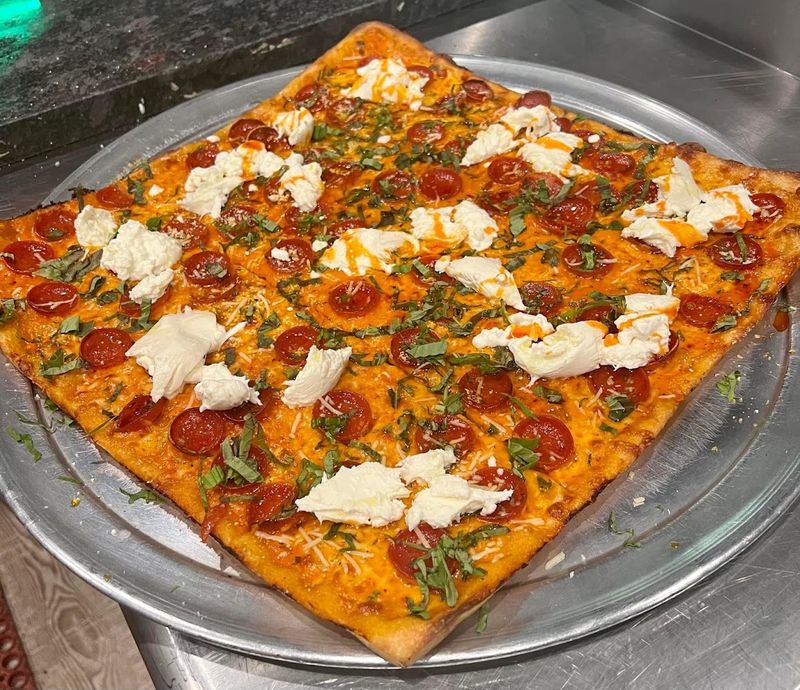
Square-pie loyalists face an immediate problem at Nola’s because the kitchen gives them several convincing answers. The $22 Nonna’s Square Pie stays relatively traditional, combining slightly spicy plum tomato sauce, fresh mozzarella, a house mozzarella blend, and fresh basil on a thin pan-cooked grandma crust.
Its sibling, the $23 Drunkin Nonna, swaps the plum tomato sauce for vodka sauce, creating a richer and creamier version without abandoning those crisp square edges. Both pies understand one of the great pleasures of grandma-style pizza: every slice is good, but the corner pieces inspire negotiations.
From there, the menu becomes increasingly playful. The Pizzaiolo Speciale Square costs $32 and layers fresh mozzarella, tomato sauce, pepperoni cups, burrata, basil, and olive oil across a thin pan base.
Justin’s Special goes further with vodka sauce, pepperoni cups, burrata, hot honey, Pecorino Romano, and a $35 price tag. The Jersey Joints Pan Pie takes a sharper North Jersey route, using hot cherry peppers, onions, mozzarella, tomato sauce, and Romano for $21.
Diners who prefer something creamy can choose the Spags Pan Pie, where vodka sauce, two styles of mozzarella, ricotta, and crispy chicken cutlet meet on a thin crust. Even the salad course can become pizza through the Insalata Pie, topped with romaine, roasted peppers, grape tomatoes, balsamic vinaigrette, and slivers of Romano.
The names give the menu a personal, slightly chaotic charm, as though each successful kitchen experiment eventually earned its own place on the family roster. Yet these combinations rarely feel random.
Rich toppings are balanced with hot peppers, bitter greens, spicy tomato sauce, balsamic dressing, or sharp cheese. The crust remains thin beneath almost all of them, preventing a heavily topped pie from turning into bread casserole.
That balance between recognizable Italian-American flavors and mildly mischievous invention is why returning customers can order something different each time without wandering away from what Nola’s does best.
Homemade meatballs, pasta and appetizers prove there is much more than pizza
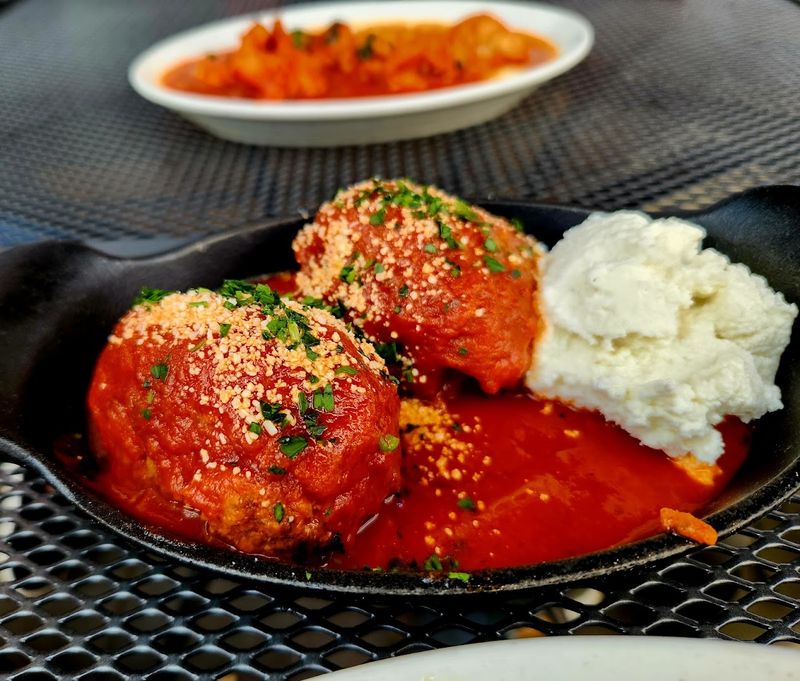
The most dangerous sentence at Nola’s may be, “Let’s get one appetizer for the table.” One quickly becomes homemade mozzarella sticks, meatballs, rice balls, and a plate of long hot peppers with potatoes before anyone has settled on a pizza.
The $15 homemade mozzarella sticks are made with fresh Grande mozzarella, coated in panko, dipped in egg batter, and lightly fried.
They arrive four to an order, thicker and more substantial than the frozen sticks found on countless pizzeria menus. Two homemade meatballs cost $16 and come with tomato-basil sauce and ricotta, while the $15 risotto rice balls are made with Pecorino Romano, mascarpone, and fresh mozzarella.
For another dollar, the kitchen serves them in vodka sauce. There are simpler starters too, including garlic knots, parmesan-and-olive-oil potato chips, fried calamari, and pasta fagioli made with ditalini, cannellini beans, white wine, garlic, tomato sauce, Romano, and olive oil.
The special version adds crumbled Italian sausage and hot cherry peppers. Those dishes establish the restaurant’s old-school side before the pasta menu starts bending the rules.
Nola’s Spicy Rigatoni Vodka, priced at $20, mixes short rigatoni with homemade vodka sauce, spicy infused vodka, sautéed hot seeds, and slivers of Pecorino Romano. Rigatoni Bolognese brings meat sauce, minced carrots and celery, and a dollop of ricotta, while penne alla vodka includes peas and prosciutto.
Entrées such as chicken Francese, chicken Parmesan, drunken chicken Parmesan, and jumbo shrimp scampi make it entirely possible for one person at the table to skip pizza without looking like they made a terrible mistake. Dessert keeps the homemade theme going.
Cannoli cream is piped into warm zeppole bombs, and a Nutella-filled version is available for anyone who believes fried dough should end with a little more drama. Pizza may start the conversation here, but it rarely gets the last word.
A welcoming atmosphere and loyal following have turned Nola’s into a destination
Garwood covers less than a square mile, yet Nola’s now pulls customers from well beyond the borough’s borders. Recent diners describe making repeat trips from Staten Island and continuing to return even after their drive stretched to roughly an hour.
Others mention working through the pizza selection one weekend at a time, ordering a different pie on each visit. That is what a cult following looks like before it becomes a crowd scene: regulars who know specific menu names, debate favorite crusts, and willingly plan dinner around the kitchen’s pace.
Nola’s operates on a schedule that reinforces its dinner-destination personality. It is closed Monday, opens from 3 p.m. to 8 p.m. Tuesday, 3 p.m. to 9 p.m. Wednesday, noon to 9 p.m. Thursday and Friday, 3 p.m. to 9 p.m. Saturday, and 2 p.m. to 8 p.m.
Sunday. Reservations are strongly recommended, especially for anyone hoping to dine in rather than carry a stack of boxes home.
The restaurant also applies a 3 percent supplemental fee to card purchases, with a corresponding 3 percent cash discount noted on the menu. None of those practical details fit the usual grab-and-go slice-shop model, and that is exactly the point.
Nola’s asks customers to slow down, choose a whole pie, and let the kitchen cook it properly. The room is casual enough for a midweek family dinner, but the food generates the kind of concentration usually reserved for restaurants with white tablecloths and much smaller portions.
Behind that energy is an owner who can move between the dining room, the pizza oven, and a conversation with regulars without making the hospitality feel rehearsed. Nola’s has not become a Garwood favorite because it tries to behave like New Jersey’s next famous pizzeria.
It has done so by behaving like a deeply personal neighborhood restaurant, then making pizza good enough that the neighborhood keeps getting larger.