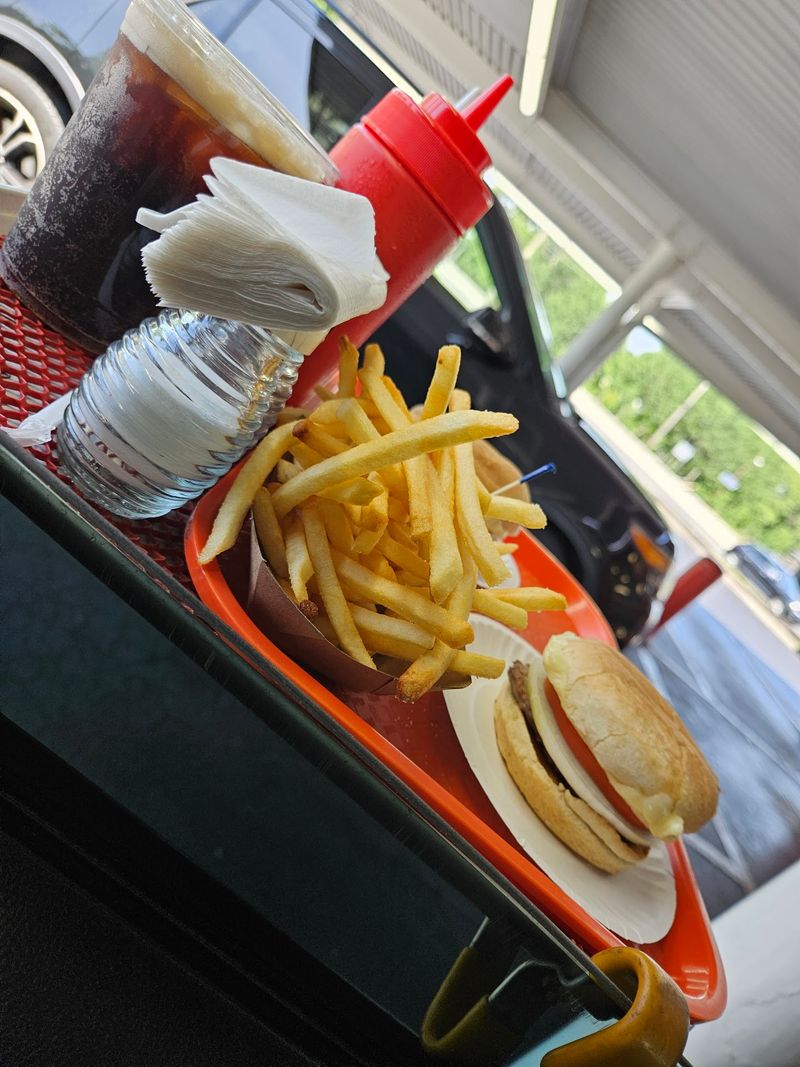
A server steps up to your rolled-down window, takes your order, and returns carrying a metal tray that hooks onto the side of your car. A frosty mug of root beer lands beside a cheeseburger and a pile of hot fries, turning the front seat into the best table in the parking lot.
This is still an ordinary meal at Weber’s Drive-In in Pennsauken, where decades of fast-food innovation have failed to improve upon the simple pleasure of dinner delivered by a carhop.
The low-slung orange building, covered parking spaces, and unmistakable roadside sign preserve a style of dining that has nearly vanished elsewhere.
Yet Weber’s never feels like a retro attraction assembled for photographs. It remains a working neighborhood restaurant where families stop for pork roll sandwiches, regulars know the menu by heart, and newcomers discover that eating in a parked car can be oddly delightful.
Nothing here needs updating because the original idea still works.
Weber’s Drive-In Has Kept Pennsauken Cruising Back Since the 1950s
Weber’s opened its Pennsauken location in 1954, when drive-in restaurants were booming and a meal served through the car window felt thoroughly modern. Route 38 carried a steady stream of motorists past the stand, and its bold sign was designed to catch their attention before they sailed by.
More than seven decades later, traffic still moves through this busy corner of Camden County, but Weber’s now stands out for a different reason. Most of the roadside businesses built during that period have disappeared, changed names, or been replaced by national chains.
Weber’s has held onto the same basic identity. The restaurant traces its roots to the Weber’s root beer brand, which began in Tulsa, Oklahoma, before expanding through independently operated drive-ins.
Several Weber’s stands once served South Jersey, including locations in Brooklawn and Stratford. Each developed its own following, but the Pennsauken restaurant became particularly recognizable for its low orange building, covered carhop area, and attention-grabbing sign.
It is now one of only a small number of genuine drive-ins remaining in New Jersey. That history matters, but it is not treated like a museum exhibit.
There are no admission tickets, velvet ropes, or plaques asking visitors to admire an obsolete way of eating. Customers simply pull into one of the numbered spaces and order lunch or dinner much as people did in the Eisenhower era.
The restaurant sits at 6019 Lexington Avenue, only a short drive from the Ben Franklin Bridge and central Philadelphia. Its surroundings have grown busier and less glamorous over time, which somehow makes the survival of Weber’s even more appealing.
The drive-in has not been preserved behind glass. It has remained useful, affordable, and woven into everyday Pennsauken life.
Old-Fashioned Carhop Service Turns Your Vehicle Into the Dining Room
Pull beneath the canopy, choose a numbered space, and switch on your headlights when you are ready to order. That small ritual activates the full Weber’s experience.
A carhop walks over to the vehicle, takes the order through the open window, and returns with food balanced on a tray designed to attach to the door. There is no garbled conversation through an intercom and no frantic shuffle toward a pickup window.
You stay parked while dinner comes to you. The system feels charming now, but it was originally built around convenience.
Drive-ins flourished during the rise of American car culture because motorists could eat without finding a conventional parking spot, dressing up, or leaving their vehicles. Weber’s still demonstrates why the format became popular in the first place.
Parents do not have to herd children through a dining room, travelers can take a comfortable break, and anyone with a dog along for the ride can keep the whole group together. Eating from a window-mounted tray requires a little coordination, especially when fries and drinks are involved, but that is part of the fun.
The steering wheel becomes an improvised table, cupholders earn their keep, and passing a milkshake across the front seat feels like a team exercise. Visitors who would rather get out can order near the stand and eat beneath the covered area, but remaining in the car delivers the full throwback effect.
Service tends to move quickly because the menu is straightforward and much of the operation has been refined over decades. The carhops know how to navigate the rows, secure trays, and keep orders organized without making the process feel rushed.
What could easily come across as a staged novelty instead feels completely natural. At Weber’s, the car is not merely where you wait for the food.
It is the booth, the dining room, and the best seat in the house.
Homemade Root Beer Remains the Star of the Show
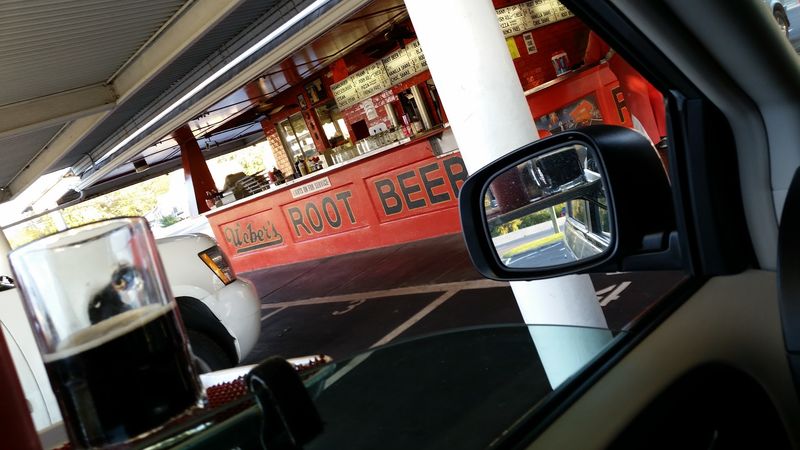
Before burgers became endlessly customizable and milkshakes arrived crowned with entire slices of cake, a cold mug of root beer was enough to define a roadside restaurant. It still defines Weber’s.
The drink has been central to the brand from the beginning, and the Pennsauken stand has long prepared its root beer on-site rather than treating it as another fountain selection. Served cold with a foamy head, it carries the sweet, creamy flavor that regulars expect from an old-fashioned draft.
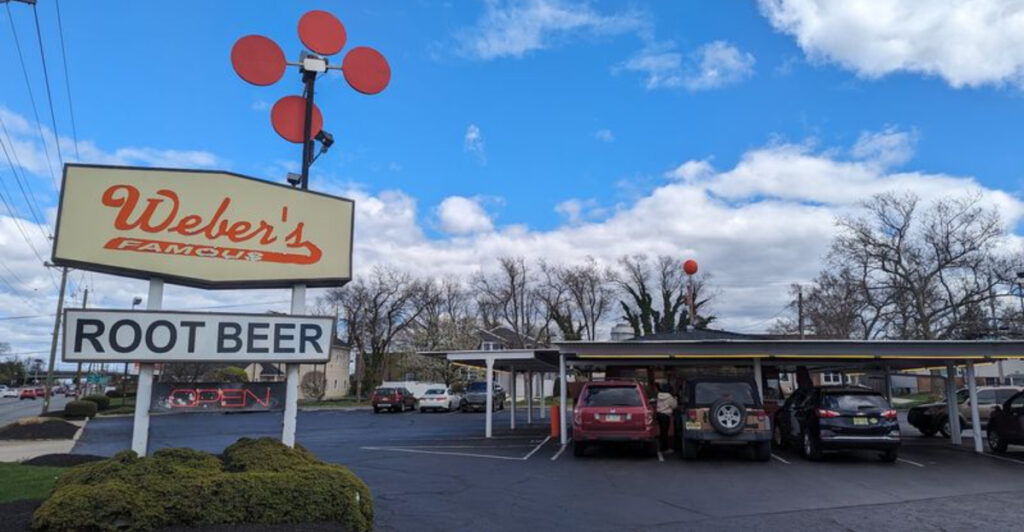
The large “ROOT BEER” lettering on the sign makes the restaurant’s priorities clear well before anyone sees the menu. A plain mug is the traditional starting point, especially alongside a salty hot dog or cheeseburger.
Order a Black Cow, however, and vanilla ice cream turns that root beer into dessert. The scoop begins to soften as soon as it hits the drink, producing a foamy cap that threatens to climb over the edge before settling into a rich mixture of soda and melted ice cream.
It is wonderfully impractical inside a car and completely appropriate for the setting. Milkshakes provide serious competition, with chocolate, vanilla, and black-and-white combinations among the familiar favorites.
They arrive thick, cold, and substantial enough to count as the final course. Root beer still wins on personality.
It connects the menu, the building, and the history in a way that no generic soft drink could. Customers once stopped at root beer stands specifically for a frosty mug, much as modern diners might seek out a specialty coffee shop or craft brewery.
Weber’s preserves that focus without turning it into a lecture about nostalgia. The drink simply shows up at the car window, cold and frothy, ready to wash down a basket of fries.
One sip explains why it earned top billing on the sign.
Burgers, Hot Dogs, and Pork Roll Keep the Menu Comfortingly Classic
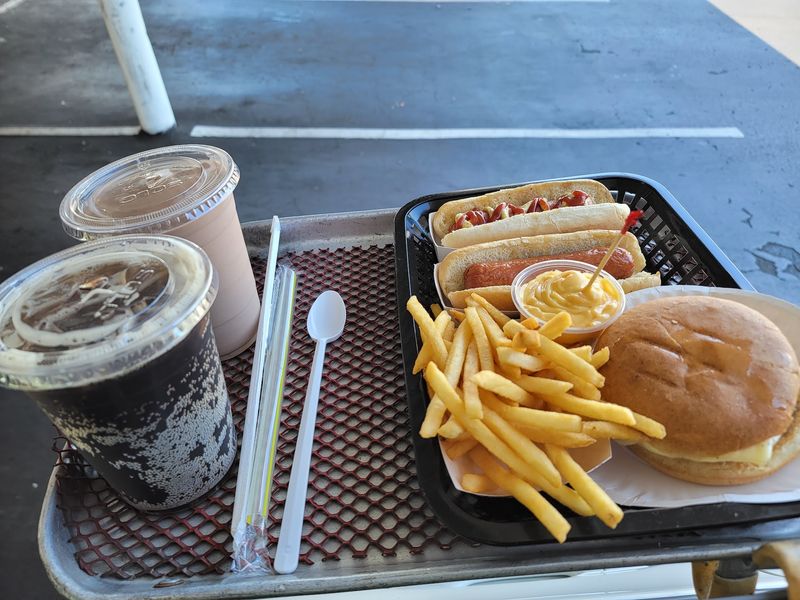
South Jersey reveals itself quickly on the Weber’s menu. Alongside drive-in standards such as hamburgers, cheeseburgers, hot dogs, steak sandwiches, and grilled cheese sits pork roll, the unmistakable local addition.
Served hot on a soft roll and often paired with cheese, it brings a salty, griddled bite that belongs at a New Jersey roadside stand. There is no debate over what to call it here and no attempt to reinvent it with fashionable toppings.
It is pork roll, cooked properly and handed through the car window. The hot dogs are another dependable choice, particularly with mustard, onions, or sauerkraut.
A toasted or warmed bun, a snappy frank, and a straightforward topping combination deliver exactly what a drive-in hot dog should. Burgers follow the same uncomplicated formula.
A cheeseburger can be dressed with lettuce, tomato, onion, ketchup, or the usual condiments, but it never becomes so tall that eating it behind the steering wheel requires structural planning.
Cheesesteaks and pizza steaks give the menu another regional accent, while chicken tenders, grilled chicken, tuna sandwiches, veggie burgers, and grilled cheese cover groups whose members cannot agree on one craving.
Fries are practically mandatory. The thin, hot, crisp style works with everything, from a frank to a shake, and cheese fries provide the messier option for diners willing to risk a little cheddar on the upholstery.
Sweet potato fries offer a slightly sweeter alternative without wandering beyond the familiar drive-in playbook. Much of the food is cooked to order rather than left waiting beneath heat lamps, an important detail for a menu built on simplicity.
With nowhere for a stale bun or lukewarm fry to hide, temperature and timing matter. Weber’s succeeds by keeping the choices recognizable and concentrating on the basics.
The menu does not demand a five-minute explanation. Read the board, pick what sounds good, and leave room for a float.
The Spinning Roadside Sign Sets the Retro Mood Before You Park
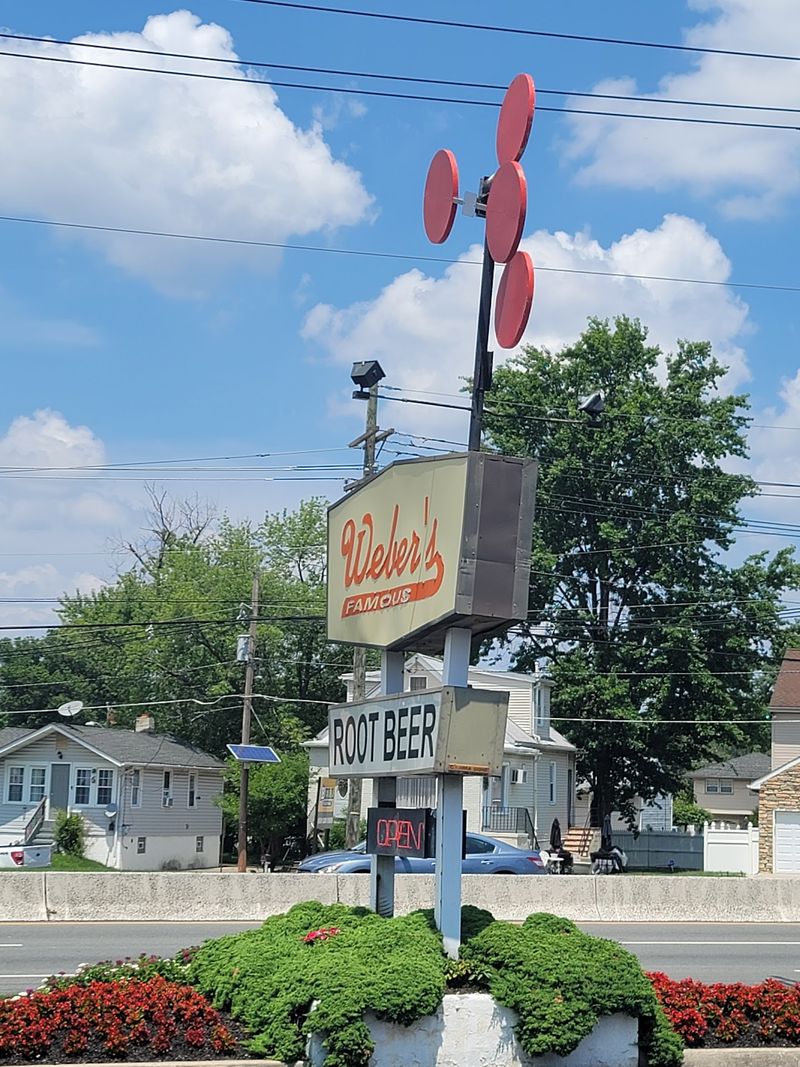
Long before the carhop reaches the window, Weber’s announces itself with one of South Jersey’s great pieces of roadside theater. The tall sign rises above the low restaurant with bold lettering, bright colors, and circular “lollipop” elements that were designed to spin and catch the eyes of passing drivers.
In an era of restrained corporate logos and identical illuminated boxes, it looks almost rebellious. The sign does not whisper that a restaurant happens to be nearby.
It practically waves motorists into the parking lot. Midcentury roadside signs had to perform a difficult job.
Drivers approaching at speed needed to recognize a business, understand what it sold, and decide whether to turn within seconds. Weber’s sign handles all three tasks.
The name sits prominently at the top, while the oversized root beer lettering communicates the specialty in terms no one could miss. Its motion and height once competed with dozens of similarly exuberant roadside businesses.
Today, with many of those landmarks gone, the sign has become a vivid survivor of the period that produced it. Beneath it, the building completes the picture.
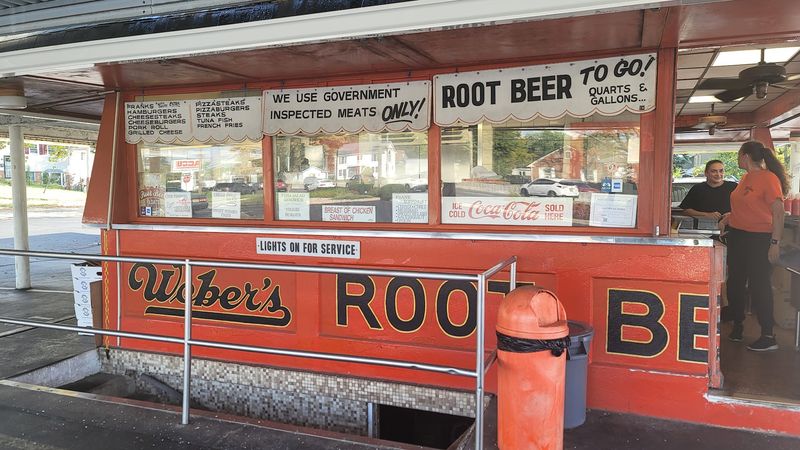
Warm orange-red surfaces, a service counter, wide pavement, and the protective canopy all follow the practical logic of a classic drive-in. None of it was created as a decorative backdrop.
The canopy shelters customers and servers from sun and light rain, the parking spaces organize carhop service, and the compact kitchen keeps orders moving. That functionality gives Weber’s its authenticity.
Even the painted instruction to turn on the lights for service belongs to an operating system rather than a collection of vintage props. Arriving near dusk brings the details together particularly well.
The sign becomes brighter against the evening sky, headlights blink on beneath the canopy, and trays begin appearing at open windows. The scene looks cinematic, but it is simply another dinner shift in Pennsauken.
Generations of South Jersey Families Keep the Drive-In Tradition Alive
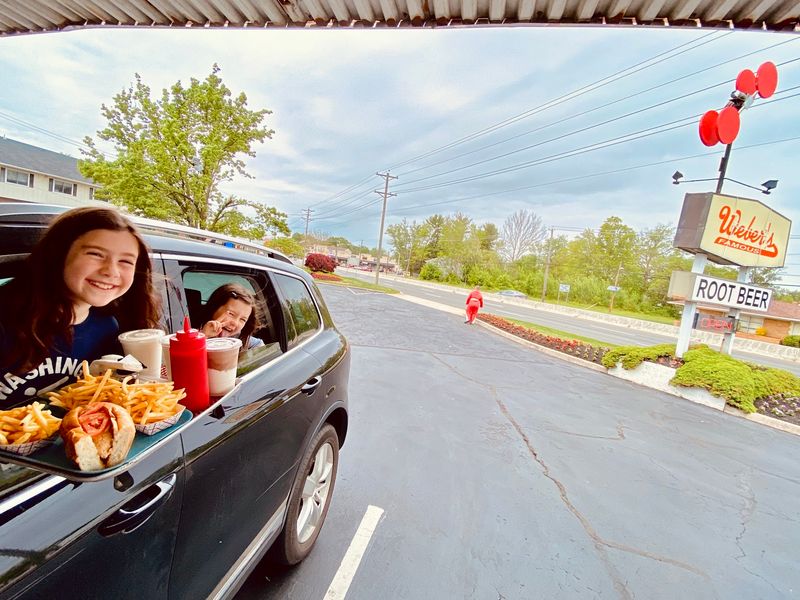
For some customers, Weber’s is a new discovery. For others, it is where their parents took them for root beer when they were children, and where they now bring children or grandchildren of their own.
That repetition has kept the restaurant alive far longer than novelty alone could manage. A vintage sign may inspire a photograph, but it takes reliable food, friendly service, and community loyalty to fill numbered parking spaces year after year.
The mix of customers tells the story. On a warm afternoon, a work truck might sit beside a family SUV, while a classic car shares the canopy with a compact sedan.
Children encounter carhop service for the first time only a few spaces away from regulars who know exactly when to turn on their lights and what they want before a server arrives. Couples stop for floats, solo diners eat lunch behind the wheel, and families divide burgers and fries across the front and back seats.
Because Weber’s is close to Philadelphia and easy to reach from surrounding Camden County communities, it attracts visitors without losing its neighborhood character. The restaurant has also remained approachable.
This is not a polished recreation charging a premium for “midcentury-inspired” food. It is a casual roadside stop where a pork roll sandwich, fries, and root beer still make sense as an ordinary meal.
That distinction is important. Places endure when people can keep using them, not merely admiring them.
Drive-ins once represented speed and modern convenience, then gradually became symbols of a disappearing America. At Weber’s, both ideas remain true.
The service is efficient, the food is familiar, and the experience carries decades of memories without feeling burdened by them. Every tray attached to a car window adds another small chapter to a South Jersey tradition that has never needed to pretend it belongs to the past.