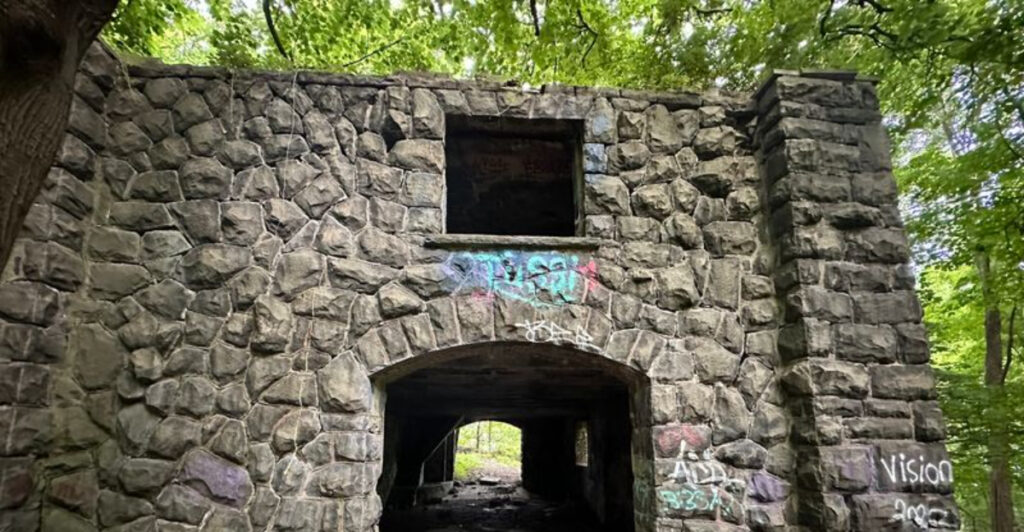
A two-story stone shell rises from the woods in Alpine, its empty windows framing trees instead of chandeliers and its stairways ending beneath open sky. This is Cliff Dale, the stubborn remains of a 15-room mansion built high above the Hudson River in 1911.
More than a century later, the estate still knows how to make an entrance. There is no visitor center announcing it, no paved walkway leading to the door, and no polished restoration smoothing away the mystery.
Hikers reach it by following the aqua blazes of the Long Path through Palisades Interstate Park. What waits ahead looks less like a Bergen County summer home and more like a castle abandoned halfway through a ghost story.
Stone columns, terraced grounds, and the outline of a former pond hint at how elaborate the property once was. The best part is that this strange piece of Millionaire’s Row history sits only about half a mile from Alpine Lookout.
The Long Path Leads Straight to Cliff Dale’s Hidden Ruins
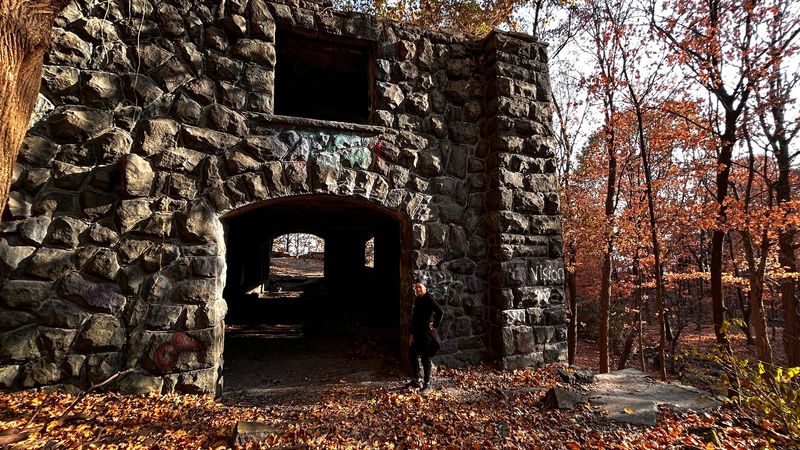
At first, the walk looks like a pleasant stretch of woodland with little indication that one of the Palisades’ grandest former estates is waiting among the trees. The Long Path slips north from Alpine Lookout, marked by aqua-colored blazes that stand out clearly against the bark.
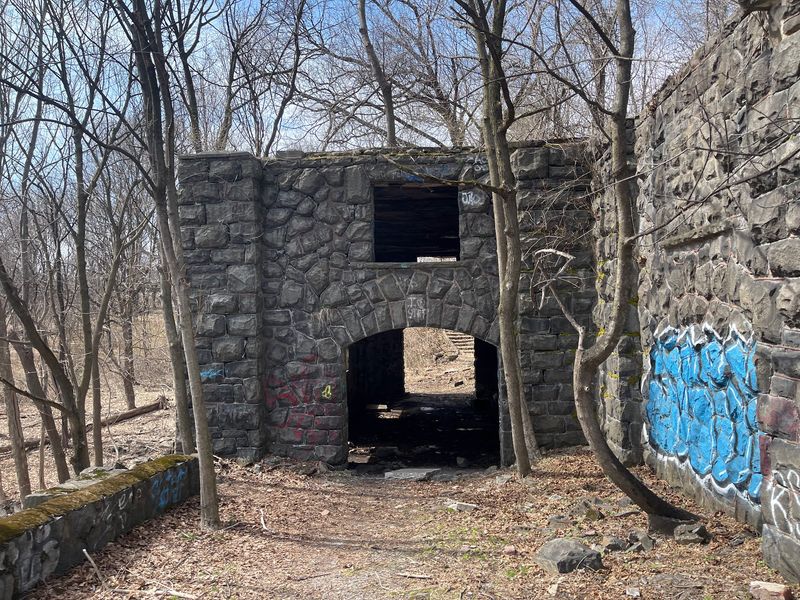
Follow those markers for roughly half a mile and ordinary forest scenery gradually gives way to something much stranger. Gray walls appear between the trunks, followed by tall openings, scattered columns, and the unmistakable remains of a building far too substantial to have been an old trail shelter.
Cliff Dale sits directly beside the route, yet the surrounding vegetation keeps it concealed until hikers are close. That delayed reveal is part of what makes the place so memorable.
In summer, leaves and vines soften the stone and can hide large sections from view. Late fall and winter expose more of the structure, allowing its two-story scale to emerge through bare branches.
The foundation is not the only trace of the estate. Careful observers can spot stonework from the old terraced gardens and a depression that once held a landscaped pond.
Trees now grow in and around areas that were designed for formal entertaining, creating a slightly surreal mix of deliberate architecture and unchecked forest. The Long Path itself continues far beyond the ruins, but Cliff Dale makes a satisfying destination for hikers interested in a shorter outing.
There is no need to tackle a major elevation change or commit an entire day to reach it. Within minutes of leaving the overlook, the trail delivers a close encounter with a mansion that has spent decades slowly disappearing into the Palisades.
George A. Zabriskie Built the 15-Room Estate in 1911
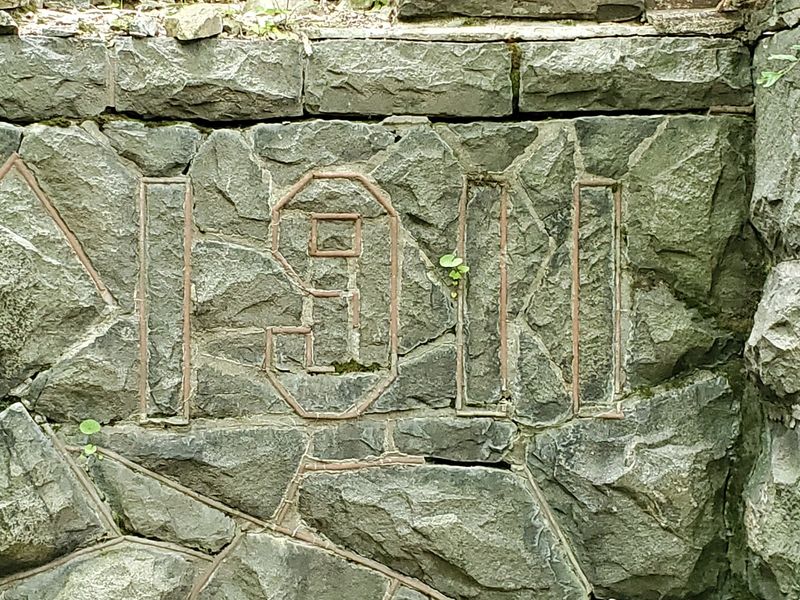
The large numerals set into the surviving masonry remove any doubt about the mansion’s age. They read 1911, the year George Albert Zabriskie completed his cliff-top summer residence on a 25-acre property in Alpine.
Zabriskie was the New York representative for Pillsbury Flour Mills, and his success in the flour business gave him the resources to build something considerably grander than a rustic weekend cabin.
His manor contained 15 rooms and incorporated native stone, a choice that helped the lower structure blend into the hillside and, eventually, made it remarkably difficult to erase.
Zabriskie called the estate Cliff Dale, sometimes writing the name as Cliffdale. He inherited that poetic name from an earlier estate owner, William C.
Baker, whose property had occupied the site beginning in the 1870s. Baker was an inventor with an unusual specialty.
He developed methods for hatching eggs with artificial heat, and his operation reportedly handled around 200,000 chickens per year. By Zabriskie’s time, poultry experimentation had given way to a mansion, gatehouse, cottages, greenhouses, a barn, gardens, and a man-made pond.
The home was only one part of an estate designed to take advantage of a position roughly 500 feet above the Hudson River. Zabriskie’s interests stretched well beyond flour and real estate.
During World War I, he worked in federal food administration under Herbert Hoover, helping oversee flour and sugar. He later became president of the New-York Historical Society and fought to protect historic landmarks.
He also wrote about subjects ranging from polar exploration to old Christmas traditions and cocktail making. That eclectic personality makes Cliff Dale feel especially fitting.
Even in ruins, it is difficult to mistake for anyone else’s ordinary country house.
Cliff Dale Once Stood Along the Palisades’ Millionaire’s Row
Imagine looking north from the George Washington Bridge during the early 20th century and seeing mansion after mansion crowning the New Jersey cliffs. Wealthy New Yorkers prized this side of the Hudson for the same reasons people still stop at Palisades overlooks today.
The elevation delivered enormous river views, while Manhattan remained close enough to reach without treating the journey like an expedition. The collection of estates became known as Millionaire’s Row, and Cliff Dale was one of its largest residences.
From its perch in Alpine, the mansion overlooked the Hudson toward Yonkers. Its grounds were arranged to make the most of that dramatic setting.
Terraced gardens stepped along the cliff edge east of the house, while a pond occupied a natural hollow to the south. Other working buildings stood closer to the road and across what is now U.S. Route 9W. Alpine Public School occupies part of that former estate land today.
Little of Millionaire’s Row remains recognizable as a neighborhood of country estates. Most of the houses were removed after the properties entered public ownership, allowing forest to reclaim the skyline.
Cliff Dale is the striking exception. Its surviving stone base offers enough architectural detail to convey the scale that property records and old photographs describe.
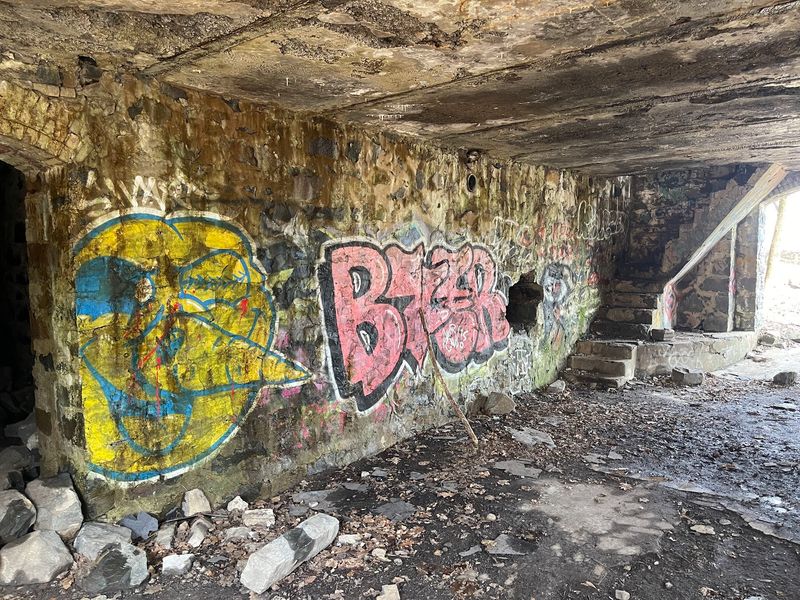
Openings that once led between finished rooms now face bare ground. Sections of flooring and masonry survive without the polished interiors they supported.
The estate’s abandoned appearance can make it seem isolated from the surrounding world, but it once belonged to a distinctly fashionable corridor. This was premium real estate occupied by industrialists, executives, and prominent families who wanted a private retreat above the river.
Standing inside the remaining walls, it takes only a little imagination to replace the trees with gardens and picture guests arriving at one of the grandest addresses on the Palisades.
Rockefeller Bought the Property to Protect the Palisades Skyline
By 1930, this stretch of the Hudson was facing a new kind of pressure. Construction of the George Washington Bridge was nearing completion, and its 1931 opening promised to make the New Jersey side of the river far more accessible.
Easier access also meant greater potential for development along cliffs that preservationists had already spent years protecting from quarrying and other industrial damage. John D.
Rockefeller Jr. responded on an enormous scale. Working quietly through real estate agents, he acquired Cliff Dale and numerous neighboring properties along the Palisades.
The goal was not to move into Zabriskie’s mansion or transform it into another private retreat. Rockefeller wanted to prevent dense development from reshaping the natural skyline above the Hudson.
In 1933, he donated the collected properties to the Palisades Interstate Park Commission. The gift came with a request that the cliff-top scenery be returned to a more natural appearance.
That condition sealed the fate of several mansions, including Cliff Dale. It also helped preserve the landscape that hikers experience today.
The forest surrounding the Long Path is not simply land that developers happened to overlook. It survives in part because Rockefeller spent millions assembling a continuous belt of property and placing it under public protection.
There is an odd twist to the story. Saving the Palisades scenery required removing many of the buildings that had defined its Millionaire’s Row era.
Cliff Dale therefore became both a casualty of the preservation project and one of its most intriguing historical remnants. Its owners lost their commanding architectural presence on the skyline, but the land beneath those homes escaped subdivision and commercial construction.
The short woodland approach to the ruins exists because that larger conservation effort succeeded. What feels like untouched forest is actually a landscape shaped by wealth, development pressure, demolition, and one of the region’s most consequential land donations.
A WPA Demolition Left the Massive Stone Foundation Standing
Demolition crews arrived in 1939 with a clear assignment, but Cliff Dale refused to vanish neatly. Workers operating through the Works Progress Administration removed the upper floors as part of the effort to clear former mansions from the Palisades skyline.
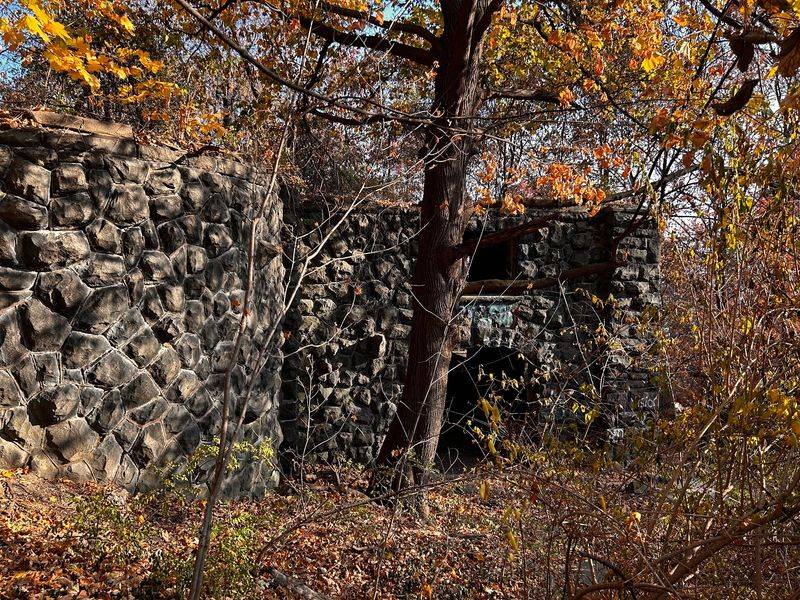
The house had been built into a hillside, however, and its thick native-stone base presented a much harder problem. The southern portion rose two stories, while other sections functioned as heavy retaining walls and basement spaces.
Crews toppled sections of the upper structure into the foundation and left a sizable portion in place. What was supposed to be a demolition became an accidental act of preservation.
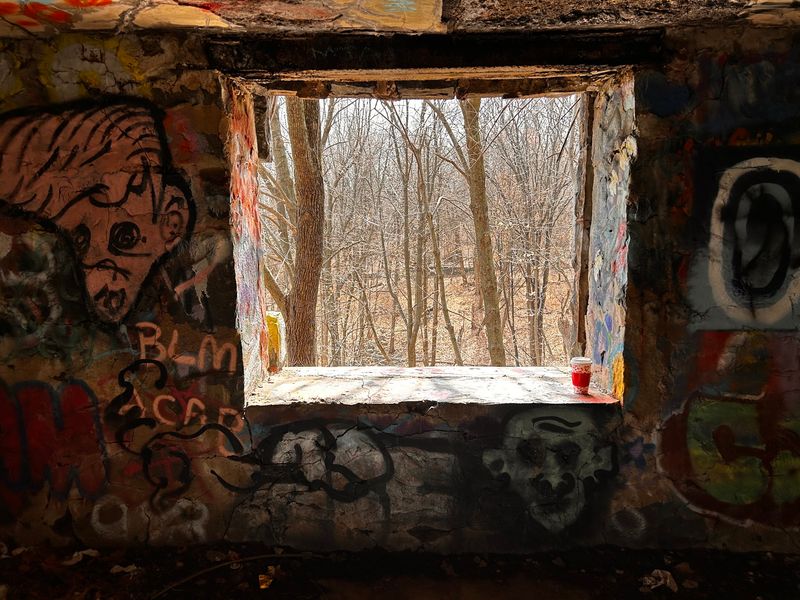
The remaining shell is substantial enough to make the lost mansion feel tangible. Tall walls define former rooms, stone stairs climb toward levels that no longer exist, and window openings frame woodland views that were once enjoyed through glass.
On the western side, the date 1911 appears in large numerals formed from stone and mortar. Elsewhere, columns sit among the trees, red tile survives in spots, and vegetation fills areas that once belonged entirely to the house.
The place earns its ghostly reputation through architecture rather than supernatural claims. It is the abruptness of the destruction that feels eerie.
This does not resemble a carefully stabilized museum ruin with plaques identifying every room. It looks interrupted, as though the building lost its upper half and the forest simply moved in.
That rough condition is also a reason to explore cautiously. Old masonry can shift, loose rocks hide beneath leaves, and a staircase that looks solid may end beside a drop.
Climbing walls or treating the structure like an obstacle course is neither necessary nor wise. The most compelling details are visible from the ground, where the scale of the surviving foundation reveals why the WPA found Cliff Dale so difficult to finish off.
The Short Hike From Alpine Lookout Rewards Careful Explorers
A full visit can fit comfortably into a morning because the ruins sit about half a mile north of Alpine Lookout. Park in the designated area at the overlook, locate the aqua-blazed Long Path, and follow it north through the woods.
The direct out-and-back walk is roughly a mile, although time spent examining the estate grounds can easily make the outing last longer than the mileage suggests. This is a short hike, not a paved historical attraction.
Roots, rocks, wet leaves, and uneven ground make sturdy shoes a better choice than casual sneakers with smooth soles. Portions of the route travel close to the top of the Palisades, so staying on marked paths and keeping back from cliff edges matters.
Around the mansion, old depressions and loose masonry can be hard to see beneath vegetation. Daylight is essential for reading the terrain safely, and public areas of Palisades Interstate Park are currently open from 6 a.m. to 9 p.m. daily.
Conditions and closures can change, making posted notices at the park the final word. Seasonal timing changes the experience noticeably.
Summer brings deep green foliage and shade, but it also conceals parts of the foundation. Late autumn and winter open the views, exposing stone walls through the trees and making the former pond and terraced landscape easier to identify.
Early morning tends to provide a quieter walk, especially on fair-weather weekends when overlooks and trailheads can fill quickly.
The return trip follows the same aqua blazes back to Alpine Lookout, leaving the stone shell behind the way hikers first found it—half hidden, slightly unsettling, and still standing more than eight decades after workers tried to make it disappear.