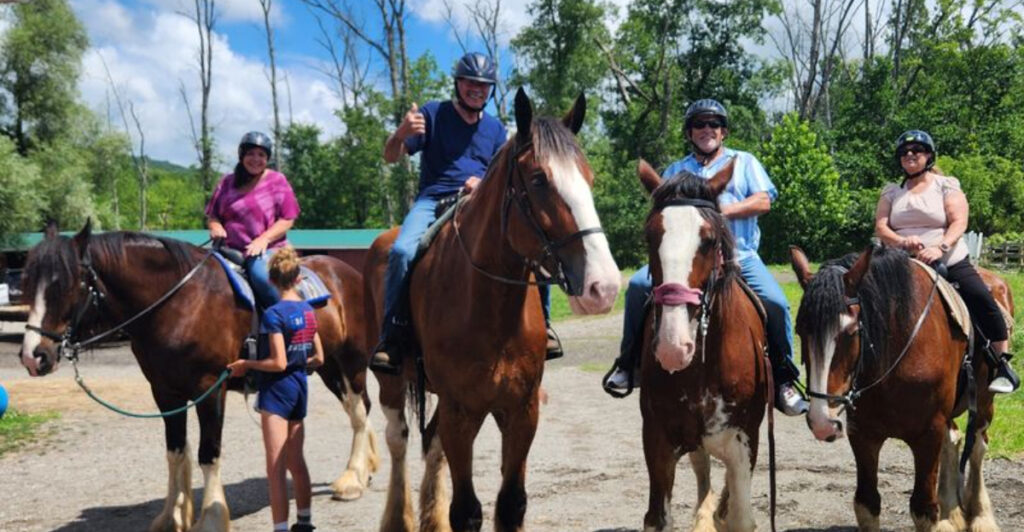
From the ground, a Clydesdale already looks enormous. From the saddle, the barn roof suddenly seems much closer, the fence posts look strangely small, and an ordinary trail ride begins to feel like a minor expedition.
That wonderfully oversized experience is waiting at Willow Grove Farm in Long Valley, where visitors can ride the same powerful breed most people know from parade teams and television commercials.
Clydesdales commonly stand between 17 and 18 hands high, placing a rider roughly six feet above the ground before counting the horse’s neck and head.
Despite that imposing build, the breed is celebrated for its calm disposition and steady movement. Willow Grove turns those qualities into an approachable one-hour riding experience through the Morris County countryside.
The farm is home to more than 30 Clydesdales and offers wagon rides, lessons, tours, and special events, but climbing into a saddle on one of these massive horses remains the headline attraction.
Willow Grove Farm Makes Clydesdale Riding Possible in Long Valley
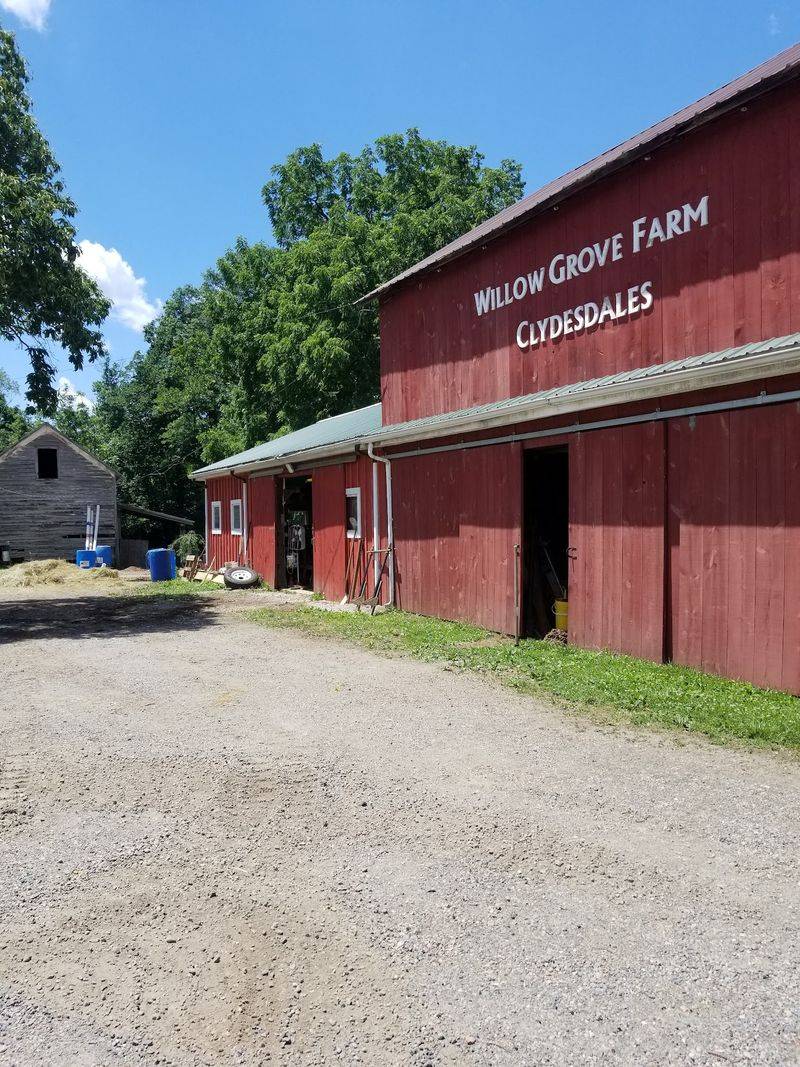
The first surprise is that this unusual riding experience is tucked along West Mill Road in Long Valley rather than somewhere in Kentucky or the wide-open West.
Willow Grove Farm sits in the Middle Valley section of Washington Township, a rural corner of Morris County shaped by rolling fields, old farm roads, and the South Branch of the Raritan River.
It feels comfortably removed from North Jersey’s busier stretches without requiring a flight, a dude-ranch vacation, or ownership of riding boots polished to a mirror shine. The farm is operated by Heidi Schubert Ort and Win Lake, who together bring more than 50 years of experience with horses across multiple breeds and riding disciplines.
Their specialty here is the Clydesdale, a Scottish draft breed developed for demanding agricultural and hauling work. Most people encounter these horses pulling polished wagons in parades, where their matching white markings, broad hooves, and silky leg feathering are impossible to miss.
Willow Grove does something far less common by training them for recreational riding and allowing members of the public to experience the breed from the saddle. That distinction matters because many horse farms use smaller breeds for guided rides, while Clydesdales are more frequently seen in harness.
At Willow Grove, their size is not merely something to photograph from behind a fence. Riders get to feel the long, measured stride and look across the property from a height that makes an ordinary horse seem almost compact.
The farm’s address is 458 West Mill Road, placing it close to Long Valley’s village center while preserving the open agricultural character that makes the ride feel properly removed from everyday errands and traffic.
More Than Thirty Gentle Giants Call This Historic Farm Home
Long before towering horses filled its paddocks, the property was a working dairy farm. More than 60 years ago, Henry J. Schubert purchased the 120-acre spread on a sweeping bend of the South Branch of the Raritan River.
Its purpose changed with the decades, shifting from dairy production to a produce operation before becoming the home of Orion Clydesdales.
Today, it is recognized as one of the East Coast’s larger Clydesdale breeding and training facilities. That history gives the place a depth that a newly constructed riding center cannot manufacture.
The acreage was already shaped by agricultural work, and its barns, fields, river frontage, and country lanes provide a natural setting for a breed once relied upon to plow land and move heavy loads.
More than 30 Clydesdales now live at Willow Grove, so visitors are not arriving to meet one novelty horse brought out for scheduled appearances.
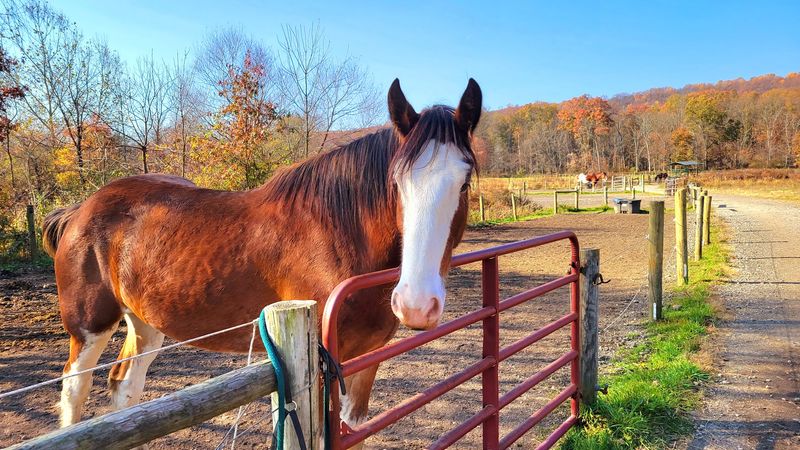
The herd is the heart of the operation. Depending on which animals are in the barns or paddocks, guests may see bays and browns with the breed’s familiar white blazes and stockings, along with the occasional darker coat.
Up close, the details are as striking as the size. Their lower legs carry long, silky hair known as feathering, their hooves look almost comically broad beside a human boot, and their muscular shoulders hint at the pulling power behind those elegant parade hitches.
Clydesdales generally stand between 17 and 18 hands, with some geldings and stallions growing even taller. One hand equals four inches, measured at the withers, so an 18-hand horse reaches six feet at the shoulder.
The farm’s large herd also allows staff to choose horses with different temperaments and experience levels rather than expecting one animal to suit every visitor.
One-Hour Trail Rides Put Visitors High Above the New Jersey Countryside
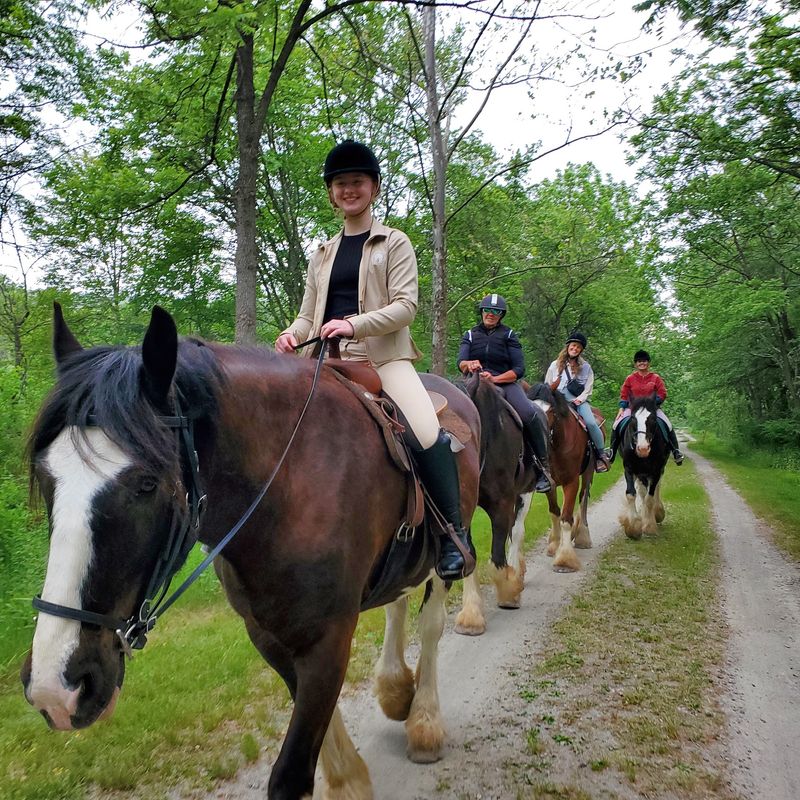
The moment of truth comes when a rider settles into the saddle and realizes just how far away the ground has become. Clydesdales carry their height through their shoulders, backs, and long legs, producing a viewpoint that feels noticeably different from riding a typical trail horse.
Fence rails fall below eye level, nearby riders seem farther apart, and the landscape opens up over hedgerows that might otherwise block the view. Once the initial “this horse is enormous” reaction passes, the ride takes on an easy rhythm.
Willow Grove’s guided riding experiences last one hour and currently cost $100 per person. They can be scheduled Tuesday through Sunday, with the farm closed for rides on Mondays.
The route uses the Columbia Trail, a converted rail corridor that passes through Long Valley and follows sections of the South Branch of the Raritan River. The broader trail stretches 16.5 miles through western Morris County and into Hunterdon County, crossing wooded areas, fields, farms, small bridges, and quiet country roads.
Riders experience only a portion during the hour-long outing, but the setting delivers plenty of classic Long Valley scenery without turning the trip into an all-day endurance test.
The former railroad grade also helps keep much of the trail relatively level, an advantage for newcomers who would rather concentrate on the horse beneath them than negotiate steep climbs.
A Clydesdale’s stride is long and deliberate, creating a gentle rocking motion as the group moves along.
There is still enough height and horsepower to make the experience feel adventurous, but the pace leaves room to notice the trees, river corridor, and working farmland instead of staring nervously between the horse’s ears for 60 straight minutes.
Calm Clydesdales Make the Experience Surprisingly Friendly for Beginners
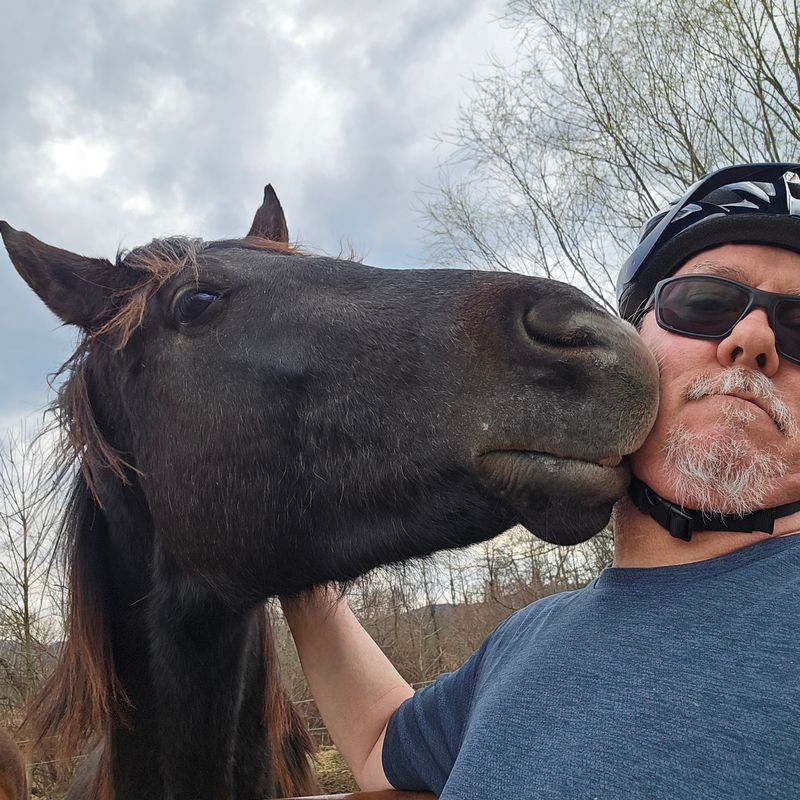
Size is the first thing nervous riders notice, yet temperament is the reason many of them can relax. Clydesdales were bred to perform demanding work alongside people, and a useful draft horse needed more than strength.
It had to be responsive, predictable, and level-headed while pulling equipment, navigating farms, and working around other animals. Willow Grove leans into those qualities by pairing visitors with horses suited to their comfort and experience.
The farm describes its riding program as appropriate for a broad range of ability levels, from people who feel uneasy merely standing beside a horse to experienced riders interested in trying a very different mount. Beginners should not mistake calm for automatic, of course.
A Clydesdale remains a powerful animal, and riders still need to listen closely to the guide, hold the reins correctly, and follow instructions about mounting, spacing, and stopping. What changes is the emotional temperature of the experience.
A steady horse that is accustomed to the trail gives a first-timer time to find a comfortable seat instead of reacting to every sound or movement. The broad back can feel especially secure once the rider is settled, while the measured walk makes it easier to adjust to the motion.
Staff members consider each participant’s experience before the ride and can discuss practical restrictions involving age, weight, and group size. Those limits are not presented as one universal number on the farm’s current booking information, so guests need to ask directly rather than making assumptions.
That conversation also helps the farm select an appropriate horse and prepare any younger or apprehensive riders. The height may produce butterflies at the mounting block, but once the group is moving, the Clydesdale’s composure becomes the feature riders remember most.
Wagon Rides and Riding Lessons Offer More Ways to Meet the Horses
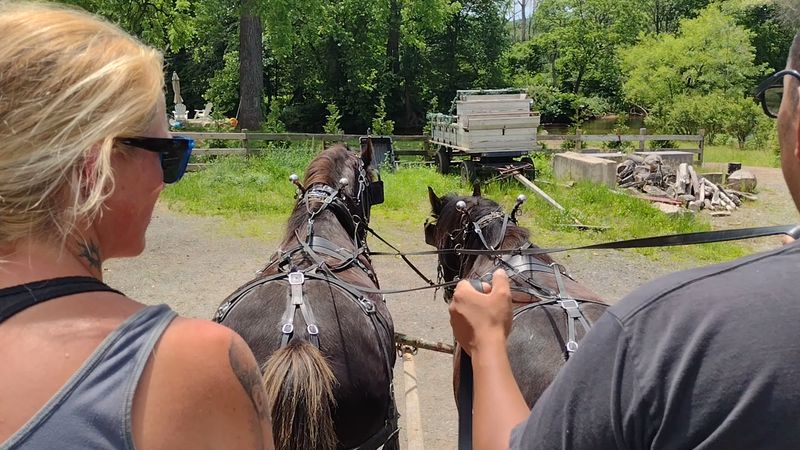
Not everyone sees a six-foot shoulder and immediately thinks, “Hand me a helmet.” Willow Grove has several alternatives for visitors who would rather experience Clydesdale power with both feet planted a little closer to the earth.
Horse-drawn wagon rides place a matched team in front, allowing guests to watch the horses work together while enjoying the surrounding countryside from a bench seat.
These outings can be arranged on or off the property and may include a barn tour, time to meet other horses, and use of the farm’s picnic area. Larger wagons accommodate groups, while a smaller carriage offers a quieter option for couples or special occasions.
Wagon pricing depends on the arrangement and must be confirmed directly with the farm. Visitors who want more participation can book individual riding lessons rather than heading immediately onto the trail.
Current rates are $50 for a 30-minute riding lesson and $70 for 45 minutes. Instruction is adapted to the student’s ability, whether the goal is learning basic control for the first time or improving an existing riding skill.
Willow Grove also teaches driving, the equestrian term for handling a horse pulling a cart or wagon. A one-hour lesson with a single horse in a cart is listed at $140, while a team-driving lesson in a wagon costs $200 per hour.
Barn experiences add another layer for families and youth groups by introducing the daily work behind the impressive photographs. Participants may learn about grooming, feeding, and caring for a breed whose size makes every routine task—from cleaning a hoof to fitting a harness—a larger operation.
Together, these programs show that Clydesdales are not simply decorative celebrities. They are versatile working horses capable of carrying riders, pulling vehicles, and patiently teaching newcomers how equestrian life operates.
Reservations Are Required Before Visitors Can Saddle Up
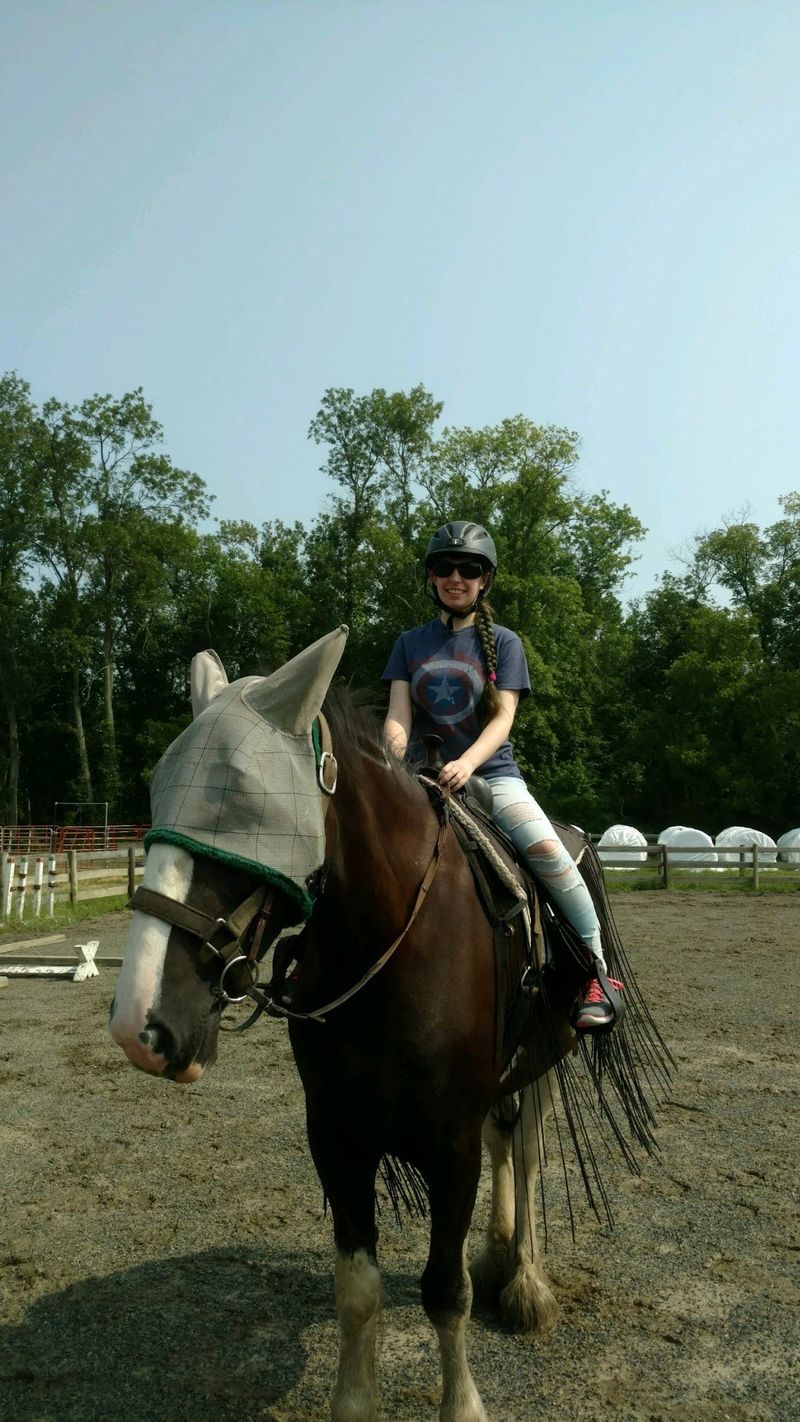
This is not the kind of farm where visitors can arrive unannounced, point to the tallest horse in the paddock, and head down the trail. Reservations are required for all rides, and the farm currently handles booking by phone or email while its online reservation system is being updated.
The practical reason is easy to understand. Staff members need time to confirm availability, organize a guide, prepare tack, and match each rider with a suitable horse.
Guests should be ready to provide the number of people in the group, riding experience, and information about younger participants. The farm also asks visitors to contact staff about age, weight, and group-size restrictions before confirming the outing.
Trail experiences cost $100 per rider for one hour and are scheduled Tuesday through Sunday; Mondays are closed. Riding and driving lessons require separate scheduling, while wagon rides are priced according to the group and type of vehicle.
The farm is located at 458 West Mill Road in Long Valley, and the published booking number is 973-615-6745. Riders must also complete a general release waiver, so arriving early enough to handle paperwork and instructions is wiser than pulling into the driveway at the exact appointment time.
Closed-toe shoes and practical clothing make considerably more sense than sandals or anything that cannot survive a little barn dust. Because pricing, operating times, and rider restrictions can change, confirming every detail during the reservation conversation avoids surprises.
The planning may be more involved than buying admission to a standard attraction, but this is not a standard attraction. At Willow Grove, the experience is built around an individual animal, a carefully chosen rider, and an hour spent viewing Long Valley from the back of a horse unlike almost any other.